Betting Guide
English Greyhound Derby Betting Guide 2026: Odds, Tips and Strategy
Complete guide to odds, form analysis, strategy and history of the UK's biggest greyhound race.
 Available in US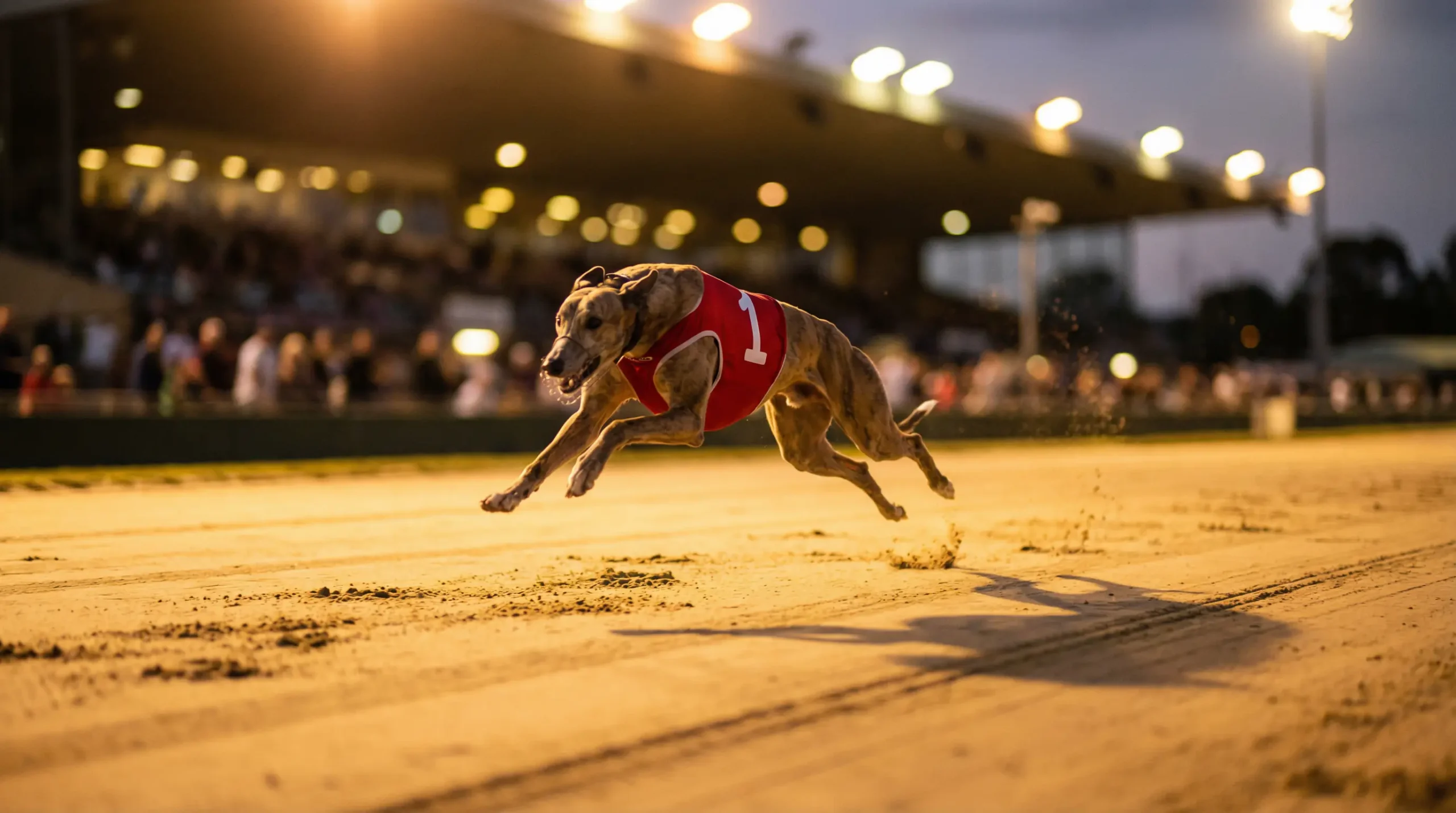
Contents
English Greyhound Derby Betting Guide 2026: Odds, Tips and Strategy
The Race That Sets the Standard for British Greyhound Betting
No other greyhound race in Britain generates the same volume of ante-post activity as the English Greyhound Derby. The race has been running since 1927, when Entry Badge crossed the line first at White City Stadium in front of a crowd that had barely grasped the sport existed. Nearly a century later, the Derby remains the centrepiece of the British greyhound calendar, a six-round knockout that stretches across five weeks and produces more betting market movement than any comparable event in the sport.
The 2026 Star Sports and Orchestrate English Greyhound Derby returns to Towcester Racecourse, with first-round heats commencing on 30 April and the final scheduled for Saturday 6 June. This year's winner's purse stands at £125,000 — a reduction from the £175,000 that Patrick Janssens' Droopys Plunge collected in 2025, reflecting the change in promotional structure following Towcester's ownership transition. The total prize fund remains one of the richest in British greyhound racing, and the competition will again attract entries from both sides of the Irish Sea.
What separates the Derby from every other greyhound race is not just the money or the history. It is the format. Around 192 dogs enter. Six survive to the final. Between those two numbers lies a knockout structure that eliminates contenders in heats, reshuffles trap draws at every stage, and creates a betting landscape that shifts dramatically from round to round. If you are used to single-race betting, the Derby demands a different discipline entirely.
This is not the Irish Greyhound Derby at Shelbourne Park, though many of the same dogs and trainers cross the water to compete in both. It is not a one-off sprint with six unknowns. The English Derby is a campaign, and understanding how it works, how the odds behave, and how to read form across multiple rounds is the foundation of any serious betting approach. Everything in this guide is built on that premise.
English Greyhound Derby 2026 at a Glance
- Distance: 500 metres flat
- Venue: Towcester Racecourse, Northamptonshire
- Surface: Sand
- Winner's prize: £125,000
- Entries: Approximately 192
- Rounds: 6 (first round heats, second round, third round, quarter-finals, semi-finals, final)
- Dates: 30 April to 6 June 2026
- Sponsor: Star Sports and Orchestrate
How the English Greyhound Derby Works
One hundred and ninety-two entries, six rounds, one final — and every stage changes the market. The Derby's knockout format is the single biggest reason its betting dynamics differ from any other greyhound race. A standard open race is a six-dog sprint with a fixed field and a single set of odds. The Derby is a five-week elimination tournament, and the information generated by each round transforms the market in ways that no amount of pre-competition trial form can replicate.
The competition begins with first-round heats, typically split across three nights of racing. Dogs are drawn into heats of six, with the top finishers (usually the first two, sometimes three depending on heat structure and entry numbers) progressing to the next stage. From there, the field is whittled through a second round, third round, quarter-finals, and semi-finals before six dogs reach the final. The entire process runs from late April through the first week of June.
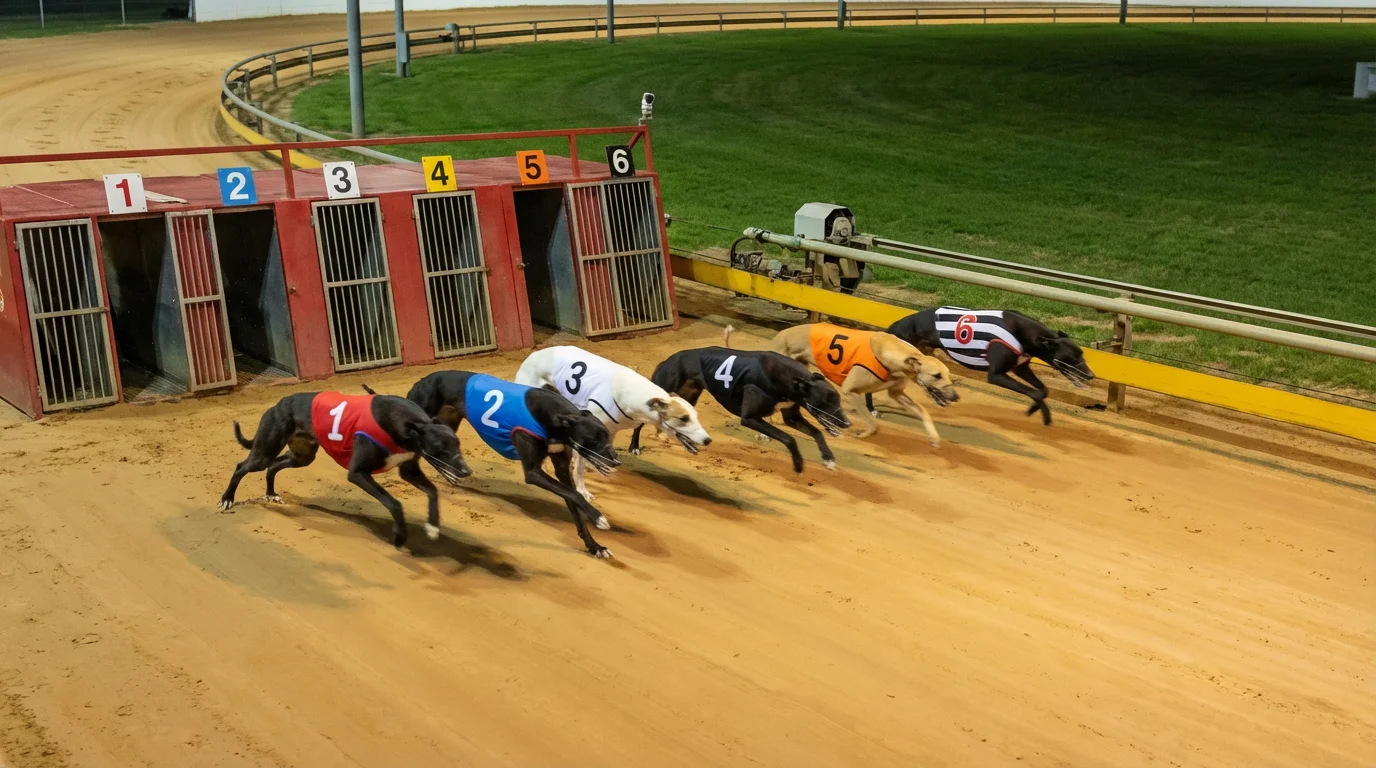
At every stage, the trap draw is reconducted. This is critical for bettors. A dog that won comfortably from trap one in round one might find itself drawn in trap six for the quarter-finals, facing a completely different tactical scenario. The GBGB's seeding system assigns dogs as railers, middle-seeders, or wide runners based on their natural running style, but within those categories, the draw itself is random. Understanding how trap redraws alter a dog's prospects is one of the core skills of Derby betting.
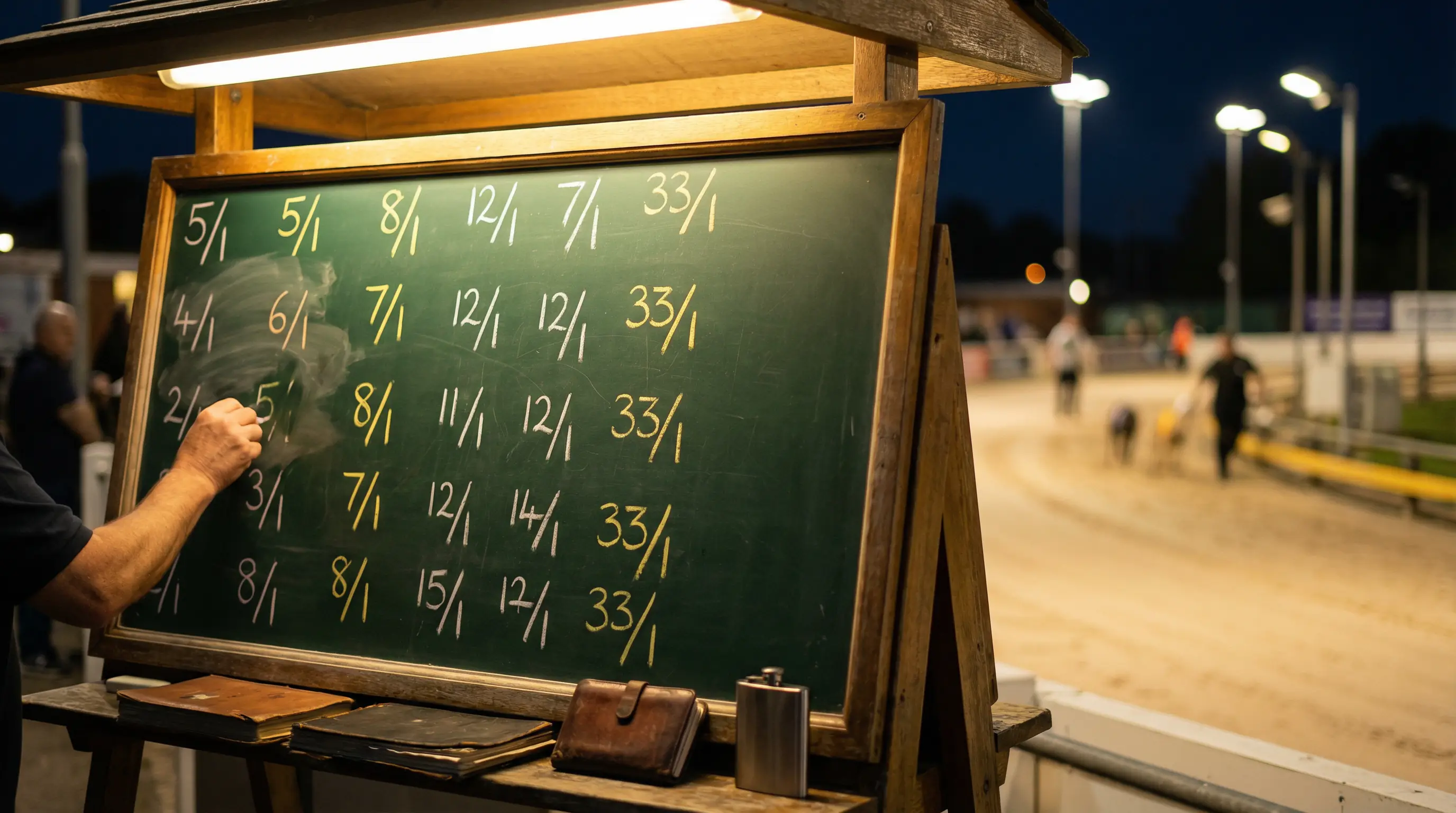
Ante-post — a bet placed before the day of the race, often weeks or months in advance. In the Derby context, ante-post markets open well before the first heat and carry the risk that your selection may be eliminated or withdrawn before the final. Stakes are typically lost if the dog does not run in the final, unless "non-runner, money back" terms apply.
The knockout format creates something rare in greyhound racing: a sustained information cycle. Each round reveals new data — how a dog handles Towcester's sand surface, how it responds to being crowded at the first bend, whether its early pace holds up over 500 metres under pressure. Smart bettors treat the early rounds as research, the middle rounds as positioning, and the final as execution. That discipline is what separates a Derby campaign from a punt.
First Round Heats and Early Elimination
The first round typically consists of around 32 heats spread across three days of racing. Six dogs run in each heat, with the first two finishers (and occasionally a fastest third) advancing. For bettors, the opening heats are an information goldmine. Many entrants will be running at Towcester for the first time, and the gap between impressive trial form elsewhere and actual performance on this track can be substantial. Dogs from smaller circuits often struggle with the wide bends and the sand surface, while experienced Towcester performers tend to hold an early-round edge.
The elimination rate is savage. Half the field or more can disappear in a single night. Ante-post prices shift violently after round one — a fancied dog that runs a sluggish 29.40 will drift from 16/1 to 50/1 overnight, while a lightly regarded qualifier posting 28.60 from an awkward draw will suddenly appear on shortlists. The first round is where the casual market gets its first correction, and where attentive bettors can find the earliest value.
Quarter-Finals Through to the Final
By the time the quarter-finals arrive, the field has been cut to around 24 dogs. The quality jump is immediate. Every heat now contains proven performers who have survived at least three rounds, and the margin for error shrinks. Trap draws at the quarter-final stage carry more weight because the dogs left in the competition are good enough to exploit a favourable draw and punish a poor one.
The semi-finals reduce the field to 12, split into two heats of six. The first two from each semi, plus the two fastest thirds, make the final — though the exact qualifying criteria can vary. This is the stage where ante-post bets are either confirmed or destroyed. A dog that has looked imperious through four rounds can hit trouble at the first bend in a semi-final and be eliminated in 30 seconds. It is also where hedging decisions become urgent, because the final trap draw — the last piece of information before the showpiece — is still unknown.
The six-dog final is a single race over 500 metres. There are no second chances, no repechages, no consolation. The trap draw for the final is conducted at a separate event, traditionally at a Derby lunch, and it can reshape the market entirely. In 2025, Droopys Plunge drew trap one for the final — a position that allowed him to hug the inside rail and produce the finishing kick that caught Bockos Diamond and De Lahdedah on the run-in. Had he drawn trap five, the story might have been very different.
Greyhound Derby Odds: How the Market Moves
Ante-post prices for the Derby open months before the first trap clicks — and that early window is where value lives. The Derby's ante-post market is unlike anything else in British greyhound racing. With nearly 200 entries and six weeks of racing ahead, bookmakers are forced to price up a field so large that initial odds of 100/1 or longer are routine for all but the most obvious contenders. This creates a pricing landscape where early movers can secure value that will never appear again once the competition is underway.
Prices are shaped by a handful of factors at each stage: pre-competition trial form at Towcester, kennel reputation, Irish vs English form lines, and the volume of market money. Before round one, the market is driven largely by reputation and trial times. After round one, it shifts to actual race performance. By the quarter-finals, the market begins to resemble something closer to a standard six-dog race, with the remaining contenders priced in single figures and the ante-post layers narrowing sharply.
Historical examples illustrate the scale of price movement. In 2025, Droopys Plunge was available at over 20/1 in early ante-post markets before tightening to 10/1 by the final. De Lahdedah, the defending champion, had drifted to 33/1 ante-post despite having won the race the previous year. Meanwhile, Bockos Diamond, the Irish Derby winner, was as short as 4/1 before the competition began and went off at a similar price in the final — only to be beaten. The lesson is consistent: early prices are set on expectation, and the Derby's knockout format is exceptionally good at dismantling expectations.
For serious bettors, the ante-post phase is not about picking the winner. It is about identifying dogs whose price does not reflect their realistic chance of making the final, and backing them before the market corrects. If you get that assessment right, the returns can be significant even if your selection finishes second or third in the final, provided you have taken each-way terms or hedged along the way.
Worked Example: Ante-Post Value and Price Movement
You back Dog A at 33/1 ante-post with a £10 win stake. Total outlay: £10.
Dog A wins its first three rounds convincingly. The price shortens to 6/1 by the semi-final stage.
At this point, your £10 bet has an implied value of approximately £55 (calculated as: if you could cash out at the current price, your position is worth roughly the stake multiplied by the ratio of original to current odds, minus the market's margin).
You now have three options: let the bet ride to the final, lay Dog A on a betting exchange to lock in a guaranteed profit regardless of the final result, or place additional bets on other finalists to spread your exposure.
If Dog A wins the final at 6/1, your original bet returns £340 (£330 profit + £10 stake). If you had hedged by laying at 6/1 on an exchange before the final, you could have guaranteed a profit of around £40-50 regardless of the outcome, depending on the lay stake used.
Ante-Post vs Final-Night Pricing
The distinction between ante-post and final-night odds is not just a matter of timing — it is a fundamentally different market. Ante-post prices carry non-runner risk: if your dog is eliminated before the final, or is withdrawn through injury, your stake is lost unless the bookmaker explicitly offers "non-runner, money back" terms, which is rare for greyhound ante-post markets. This risk is baked into the price, which is why ante-post odds are significantly more generous than final-night starting prices.
Final-night pricing, by contrast, reflects a complete information set. The field is known, the trap draw is settled, and late market money from informed connections can move prices quickly in the final hour. In 2024, De Lahdedah went off at 5/1 for the final despite having been one of the most consistent dogs in the competition — his trap four draw was considered advantageous, and the price shortened accordingly. In the same final, King Memphis, the pre-competition favourite, drifted significantly after a poor trap draw compounded a below-par semi-final.
Rule 4 deductions apply when a dog is withdrawn after final declarations but before the race, reducing the payout on winning bets to account for the removed runner. In a six-dog final, a single withdrawal triggers a meaningful deduction. Bettors who have taken an early price should be aware that their return may be reduced if the field changes on the night — though this scenario is uncommon in the Derby final itself, it occurs more regularly in earlier rounds.
Key Betting Markets for the Greyhound Derby
The Derby final has six runners, which narrows your options and concentrates your edge. Unlike horse racing, where fields of 20 or more can dilute the market, a six-dog race offers a manageable number of permutations across every bet type. This is where understanding the available markets — and knowing which one suits each stage of the competition — becomes a genuine advantage.
The outright win bet is the simplest: pick the dog that crosses the line first. In a six-runner field, the theoretical probability of any dog winning (assuming equal ability) is 16.7%. In practice, the favourite in the Derby final has a poor record — since 2010, the SP favourite has won only a handful of finals, and seven of the last thirteen winners have been priced at 5/1 or bigger. That historical pattern should inform how you approach the win market. Backing multiple selections at longer prices, rather than loading up on a short-priced favourite, has been a more profitable long-term approach.
Each-way betting is particularly well suited to six-dog races because most bookmakers pay out on the first two places at one-third the odds. In a six-runner field, the place element covers a third of the runners, which offers better proportional value than each-way terms in larger horse racing fields. If you identify a dog at 8/1 that you believe has a strong chance of finishing in the first two, the each-way bet provides a cushion that the straight win bet does not.
Forecast bets require you to predict the first and second finisher in the correct order. In a six-dog field, there are 30 possible forecast combinations — far fewer than in an eight-runner horse race. A straight forecast pays substantially more than a win bet, and if you have strong views on which two dogs will dominate, this market rewards that conviction. The reverse forecast covers both possible finishing orders of your two selections, doubling your stake but reducing the precision required. Tricast bets extend the concept to the first three finishers and can produce enormous returns in a competitive final where the market is split.
For those with exchange accounts, the Derby final also offers back and lay opportunities. You can back a dog to win at a bookmaker and lay it on an exchange to trade your position, or use the exchange market to hedge ante-post bets taken earlier in the competition. Exchange liquidity on the Derby final is typically the highest of any greyhound race in the UK, making it one of the few greyhound events where exchange trading is genuinely practical.
Outright Win
Dog A — 8/1
Stake: £10
Returns if wins: £90 (£80 profit + £10 stake)
Each Way (1/3 odds, places 1-2)
Dog A — 8/1 E/W
Stake: £10 (£5 win, £5 place)
Returns if wins: £45 (win part) + £18.33 (place part at 8/3) = £63.33
Returns if second: £18.33 (place part only, £13.33 profit + £5 stake)
Reading Greyhound Form for the Derby
Form in the Derby isn't about one fast time — it's about what a dog does under sustained pressure across six rounds. Reading greyhound form is a skill that transfers imperfectly from everyday graded racing to open-race competition, and the Derby amplifies every gap in understanding. A dog that has been winning comfortably in A1 graded company at its home track may struggle against open-class competition at Towcester, where the pace is faster, the bends are wider, and the opposition is significantly sharper.
The race card is your primary tool. Each entry carries a form line — a sequence of finishing positions from recent races, read from left to right in chronological order. A form line of 1-1-2-1 tells you the dog has been consistently competitive. But form figures alone are misleading without context. A "1" at a small track in a weak graded race is not the same as a "1" in an open race at Towcester. This is where calculated times come in: adjusted race times that account for track, distance, and going conditions, giving you a standardised measure to compare dogs from different circuits.
For Derby-level analysis, three elements matter more than raw finishing positions: early pace (how quickly a dog reaches the first bend), sectional splits (the time taken for specific portions of the race), and finishing effort (how much the dog has left over the final 100 metres). A dog with a fast first-bend sectional but a slow finishing split may lead for 400 metres and then be caught. A dog with a moderate early pace but a strong closing sectional may be ideally suited to a final where the front-runners tire from five weeks of hard racing.
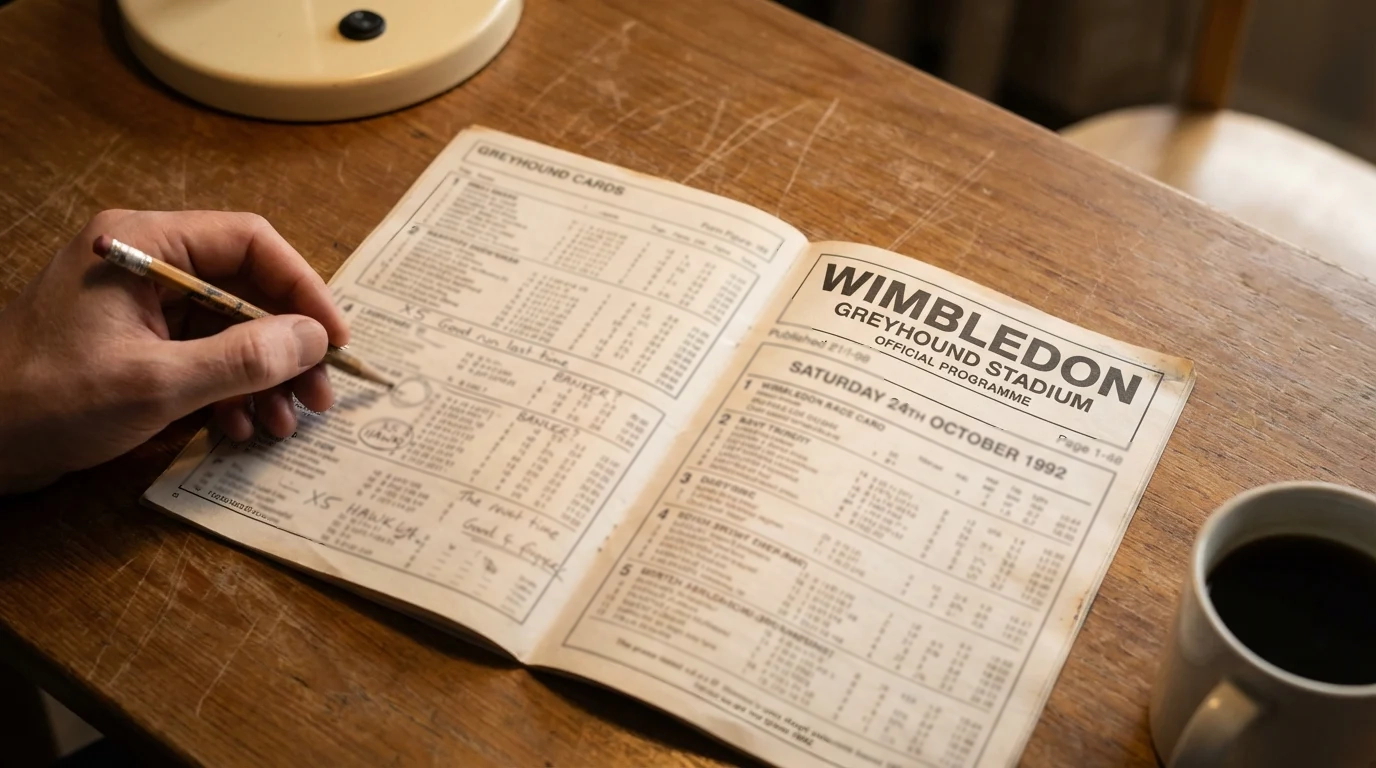
Early Pace
Measured by first-bend sectional time. Indicates how quickly a dog breaks from the trap and reaches racing position. Fast early pace secures track position but may not be sustainable over 500 metres.
Sectional Split
The difference between the first-half and second-half times. A dog that runs even splits — or negative splits, finishing faster than it started — is demonstrating genuine stamina, not just speed.
Finishing Kick
The closing sectional over the final straight. In a Derby final, where five weeks of racing take a physical toll, the dog with the strongest finishing kick often prevails. Droopys Plunge's 2025 victory was built on exactly this quality.
Grade context is equally important. The GBGB grading system runs from A1 (top grade at individual tracks) through to open race class, which has no upper limit on quality. A dog competing in A2 graded races at a provincial track is operating several levels below the open-class competition that dominates the Derby. When assessing form, look for dogs that have raced — and performed — in open races, Category One events, or other classic competitions. A string of A1 wins at a small circuit is encouraging but not diagnostic.
Sectional Times and What They Reveal
Sectional timing is the single most underused analytical tool in greyhound betting, and it is indispensable at Derby level. The first-bend sectional — typically measured to the first timing point around 100-120 metres into the race — tells you how a dog breaks and whether it is likely to secure an early racing position. At Towcester, a first-bend sectional under 4.10 seconds in a 500-metre race is genuinely quick. Droopys Plunge posted a 4.03 sectional in the 2025 final, which was the fastest of the six finalists and a key reason he was able to establish position on the rail before the pace heated up.
The second sectional — covering the middle portion of the race through the back straight and second bend — separates the front-runners from the sustainers. Dogs that post fast opening sectionals but slow through the middle are early-pace specialists who may lack the stamina for a 500-metre final after five weeks of racing. The closing sectional reveals who has something left. In knockout competitions, finishing speed is frequently the deciding factor because even the best dogs accumulate fatigue across rounds.
Running Style and Towcester Suitability
Towcester's sweeping bends are wider than those at most British greyhound tracks. This design was intended to reduce crowding and interference at the turns, and it largely succeeds — but it also creates a specific set of advantages and disadvantages based on running style. Wide runners — dogs that naturally race on the outside of the pack — get more room to operate at Towcester than at tighter circuits like Romford or Hove. However, running wide through two long bends adds ground, and the data shows that wide runners at Towcester still win less frequently than inside trackers over 500 metres.
The outside Swaffham hare, which runs on the outside rail rather than the inside, is another factor. It can pull dogs towards the outside, creating congestion for wide runners while leaving the inside lane cleaner for railers. Dogs that hug the rails and have the pace to hold position through the first two bends tend to perform well here. In the last three Derby finals at Towcester, the winner has come from traps one to four in every case. That is not coincidence — it reflects how the track geometry and hare position interact with running style.
Trap Draw at Towcester: What the Numbers Say
Towcester's sweeping bends were designed to neutralise trap bias — but the numbers tell a more nuanced story. Across 500-metre open races at Towcester in 2025, the winning percentages by trap tell a clear story about where the advantage lies. Traps one through three each produced win rates above 20%, while traps four, five, and six lagged behind, with trap four at around 14% and trap five at a similar level. Trap six, despite its perceived advantage for wide runners on a wide track, managed only around 17% — barely above the statistical expectation of 16.7% per trap if all positions were truly equal.
The pattern is instructive. Towcester's wide bends do reduce the extreme inside bias seen at tighter circuits, but they do not eliminate positional advantage. The inside traps benefit from a shorter run to the first bend, and the outside hare — which pulls the field towards the outside of the track — tends to create more space on the rail for dogs breaking from the lower traps. Over the Derby's history at Towcester, trap four has produced three of the seven winners (Astute Missile in 2017 was a notable exception at 28/1, while Romeo Magico and De Lahdedah both won from four), but traps one through three collectively account for the majority of placed finishers.
For bettors, the practical application is straightforward: do not dismiss a dog because of a wide draw, but do adjust your assessment of its chances downward by a few percentage points. A dog that you rate as a 6/1 chance from trap two might be more like 8/1 from trap five, and if the market has not adjusted accordingly, that gap is where value can sit — either by backing the inside-drawn rival or by opposing the wide-drawn dog in forecast and tricast markets.
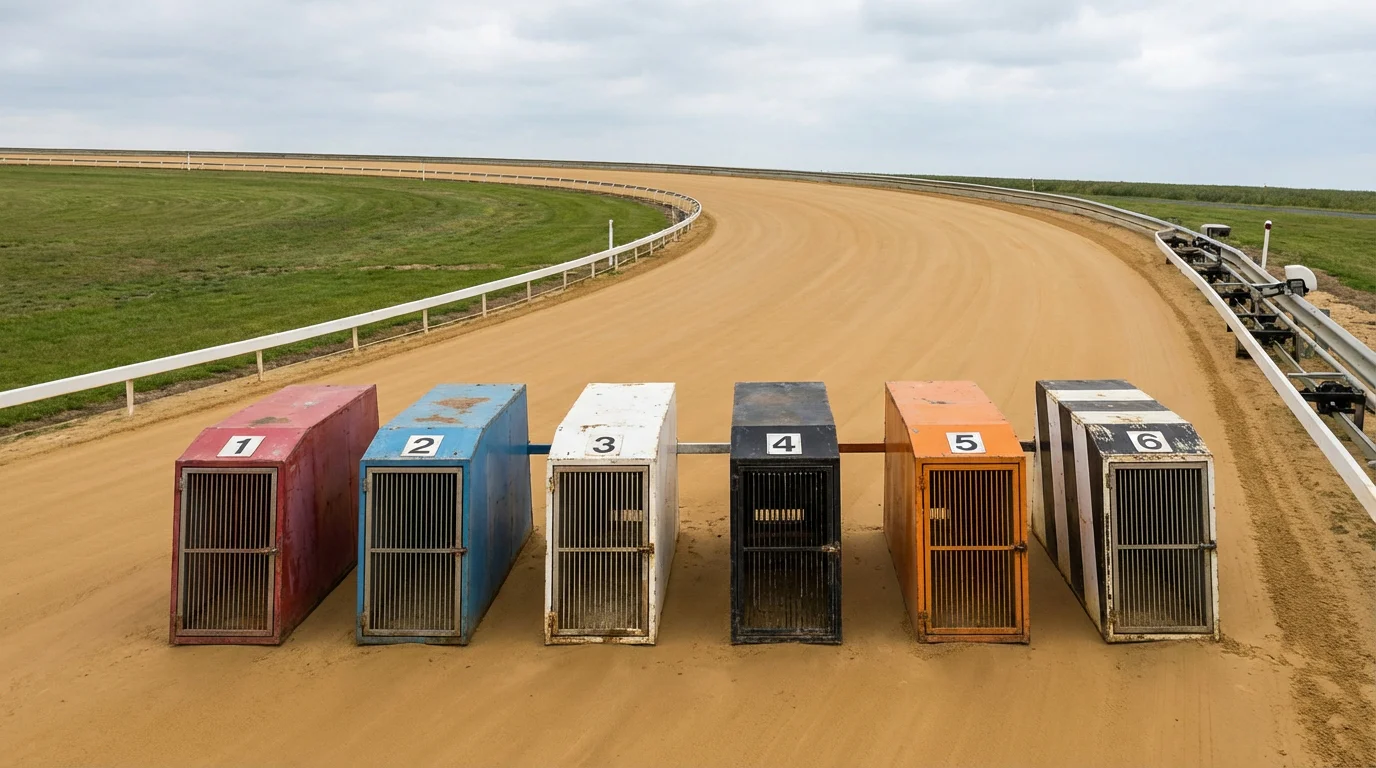
Trap 1 has produced more Derby finalists at Towcester than any other box — but fewer winners than Trap 4. In 2025, it was Droopys Plunge from the red jacket who broke that pattern, using the inside rail to devastating effect in the final straight.
One additional wrinkle: the trap draw is reconducted at every stage of the Derby. A dog that thrives from trap one in the first round may draw trap six in the quarter-finals. This randomisation is deliberate — it tests versatility — but it also means that form from earlier rounds must be read with the draw in mind. A sluggish quarter-final performance from a wide trap does not necessarily mean a dog has peaked. It may simply mean the draw caught it out, and a kinder draw in the semi-finals could produce a very different result.
Original tool · English Greyhound Derby
The First Bend
The rail is shorter but crowded. The outside is longer but clear. Every trap draw sets a different exchange rate between the two — so this model prices the traffic, not just the dogs, and then runs the same six through all 720 draws they could have had.
Six dogs, one final
Give each runner its seeding — how it wants to run — its first-bend sectional, and its calculated time over 500m. Under 4.10 to the bend is genuinely quick at Towcester; 28.60 is a very fast calculated time, 29.40 is slow.
Where the paths cross
Each dog leaves its box and settles on a line somewhere between the one it wants and the one its draw allows. Where two of those lines cross, somebody gives way — and it costs most when both arrive at the crossing point together. The bar at the end of each path is that dog’s share of the trouble.
Clean run against this draw
The first price is the race each dog would get with nobody in the way. The second is the race this particular draw actually gives it. The difference is stated in lengths, at Towcester’s working rate of one length to 0.08sec.
| Trap | Runner | Clean run | This draw | Traffic cost | Share of trouble |
|---|
Every draw this final could have had
The Derby redraws the traps at every stage, so these six could have come out of the hat in 720 different arrangements. All of them are worked out below — not sampled, not simulated. This is the whole space.
What the box is worth — in this field
Average win chance of whichever dog is standing in each box, across all 720 draws. The dark markers are the published Towcester figures for 500m opens. Those are an average taken over hundreds of different fields, which is exactly why yours will not sit on top of them.
What the draw is worth — to each dog
Each bar runs from a dog’s worst possible draw to its best. The red notch is where the draw on the card has actually put it.
What is inside the model
The line it gets
A dog does not simply run its seeding. The line it settles on is 72% the line it wants and 28% the box it came out of, so a railer drawn in six ends up racing wider than it would like and a wide runner drawn in one ends up tighter. Ground is charged at 0.026sec per lane, which makes the box itself worth about 0.036sec — near enough half a length — before anything else happens.
Crowding
Every pair of dogs interferes in proportion to how close their lines are, on a bell curve one lane wide, and in proportion to how close their sectionals are, on a bell curve 0.075sec wide. The inner dog of the pair carries 72% of it: it is the one with a rail to be squeezed against. This is why the fast ground is also the dirty ground.
Crossings
Two dogs cross when the order of their boxes is the reverse of the order of their lines. Severity rises with how deep the crossing is and collapses as the sectionals separate. The dog arriving second carries most of the cost — which is the whole reason a railer drawn wide can still work, provided it is quick enough to cross in front of the trouble rather than through it.
From trouble to price
Trouble converts to time at 0.075sec per unit, the fastest breaker is credited 0.03sec of clear air, and effective times become win chances on a 0.15sec scale. Prices shown are fair prices with no bookmaker margin in them, so they will always look bigger than the board.
A model is an argument, not a forecast. The sectionals and calculated times are yours, the parameters above are ours, and greyhounds are under no obligation to agree with either. For information only. 18+. If betting stops being entertainment, the National Gambling Helpline is on 0808 8020 133.
Trainers and Connections to Follow
Charlie Lister won seven Derbies — but the modern era belongs to the Irish raiding parties. The trainer's record in the Derby is one of the most reliable form indicators available to bettors, and the shift in dominance from British to Irish handlers over the past decade has reshaped the ante-post market permanently.
Lister's seven victories, the last of which came with Sidaz Jack in 2013, established him as the undisputed Derby king during the Wimbledon era. His method — patient preparation, meticulous trial work, and a deep understanding of the knockout format — set the standard that every serious Derby handler now follows. Nick Savva's four wins, including Westmead Hawk's remarkable back-to-back victories in 2005 and 2006, represented the other dominant force of that period.
Since the Derby moved to Towcester, the landscape has changed dramatically. Graham Holland, based in Ireland but originally from England, has emerged as the pre-eminent figure. His back-to-back victories with Romeo Magico in 2022 and Gaytime Nemo in 2023 gave him two English Derby titles, and his kennel consistently supplies multiple quarter-finalists. Holland's strength lies in the volume and quality of his entries — in 2025, he had four dogs in the quarter-finals and three in the final (Bockos Diamond, Cheap Sandwiches, and Bombay Pat), giving him multiple chances to win and allowing his dogs to dictate the pace collectively.
Patrick Janssens, Belgian-born and based at Thetford, has quietly built a Derby record that rivals anyone in the modern era. His first win came with Thorn Falcon in 2021, and his second with Droopys Plunge in 2025. Janssens' approach is different from Holland's — he tends to have fewer entries but prepares them meticulously for Towcester, often using the track for extensive pre-competition trials. His six-race winning haul on 2025 Derby final night, including the main event, was a statement of kennel strength.
Paul Hennessy's two Derby titles (Priceless Blake in 2019 and Jaytee Jet in 2016) and Liam Dowling's success with De Lahdedah in 2024 further underline the Irish dominance. For bettors, the implication is clear: ignoring the Irish entries in the ante-post market is a mistake. Cross-channel form — particularly from the Irish Derby at Shelbourne Park and major opens at Limerick and Cork — provides essential data for assessing which Irish-trained dogs are likely to handle Towcester.
Irish-trained dogs have won four of the last six Derbies — following cross-channel form is no longer optional for serious Derby bettors.
Betting Strategy: Heat-by-Heat Through the Derby
Each round demands a different approach — what works in round one will burn your bankroll by the semi-finals. The single biggest mistake casual Derby bettors make is treating the competition as a series of isolated races rather than a connected campaign with distinct phases. Your stake allocation, bet type selection, and risk tolerance should change as the field narrows and the information picture sharpens.
Rounds one to three: observation and selective strikes. The early rounds are where information is cheapest and the market is most inefficient. Many dogs are running at Towcester for the first time, and the gap between reputation and performance creates obvious mispricings. Your approach here should be primarily observational — watch the races, note the sectional times, identify which dogs handle the track, and only bet when you see a clear discrepancy between a dog's price and its actual performance. If a dog posts a quick 28.70 from an unfavourable draw in round one but is still available at 33/1 ante-post, that is a signal, not a certainty, but a signal worth acting on.
Quarter-finals: positioning and hedging. By this stage, the field is small enough for meaningful form comparison. If you hold ante-post bets on dogs still in the competition, this is the point where hedging decisions become active. A dog that was 33/1 ante-post might now be 8/1, and you need to decide whether to let the bet ride, hedge partially by backing other quarter-finalists, or lay on an exchange to guarantee profit. The quarter-finals also produce the sharpest trap-draw impact of any round — dogs drawn wide against strong inside trackers face a genuine disadvantage, and the market often underestimates this.
Semi-finals: confirmation or elimination. The semi-finals are the last chance to assess form before the final. Pay close attention to how dogs run relative to their draw, not just whether they qualify. A dog that qualifies third from a poor draw may be a better final proposition than one that wins its semi from a perfect inside berth. The late market movement after the semi-finals, when the final field and trap draw are confirmed, is where the most informed money moves.
The final: execution. In the final itself, your bet should reflect everything you have learned across five weeks. Six dogs, one race, no alibis. This is where forecast and tricast bets can offer outsized value if you have strong views on the first two or three home. It is also where exchange trading reaches peak liquidity for a greyhound race, allowing you to back and lay with tighter spreads than at any earlier stage.
Do
- Track trial times and early-round sectionals meticulously — they reveal more than finishing positions.
- Back improving dogs early, before the market catches up to round-on-round progress.
- Hedge ante-post positions before the semi-finals, when your selection's fate is still uncertain.
Don't
- Chase beaten favourites — a fancied dog eliminated in the quarter-finals cannot be rescued by wishful thinking.
- Ignore the trap redraw — a dog's prospects change materially with every new draw, and failing to adjust is lazy analysis.
- Stack your entire bankroll on the final — the campaign is five weeks long, and front-loading risk on one 30-second race wastes the informational edge built across earlier rounds.
Hedging Your Ante-Post Positions
Hedging is not a sign of weak conviction — it is a recognition that the Derby's knockout format introduces randomness that no amount of form analysis can eliminate. The best dog in the competition can be knocked out by a first-bend collision in the semi-finals, and your 33/1 ante-post bet goes from potential triumph to confirmed loss in under five seconds.
The simplest hedge is to lay your ante-post selection on a betting exchange once the price has shortened significantly. If you backed a dog at 25/1 and it is now 5/1 heading into the semi-finals, a lay bet at 5/1 on the exchange locks in a profit regardless of whether the dog wins or loses from that point forward. The maths requires you to calculate your lay stake carefully — a number of free online calculators exist for exactly this purpose — but the principle is straightforward: you are trading your speculative position for a guaranteed return.
An alternative approach is to back additional dogs rather than laying your original selection. If your ante-post pick makes the final and you rate two other finalists as genuine threats, placing win bets on those dogs spreads your exposure without requiring an exchange account. The downside is that this increases your total outlay, whereas the exchange lay fixes your position without additional capital risk. Both methods have a place, and the right choice depends on your confidence level, the prices available, and whether you prefer guaranteed modest profit or the chance of a larger payday.
Comparing Bookmakers for Derby Betting
Not every bookmaker treats greyhound racing the same — three things separate the serious platforms from the rest. The Derby attracts enough market interest that most major UK bookmakers will price it up, but the depth of coverage, the generosity of terms, and the availability of ante-post markets vary considerably. Getting this comparison right before the competition starts can make a measurable difference to your returns over a five-week campaign.
The first criterion is ante-post availability and depth. Some bookmakers open Derby ante-post markets months before the first round, pricing up 50 or more entries at individual odds. Others offer a limited market with only the top 10-15 contenders priced, lumping everything else into a generic "bar" price. For serious ante-post bettors, the wider market is essential — the value in Derby ante-post betting lives in the 33/1 to 100/1 range, not in the single-figure prices at the top of the market.
The second factor is best odds guaranteed. BOG means that if you take an early price and the starting price on the night is higher, the bookmaker pays out at the better price. Not all bookmakers extend BOG to greyhound racing, and some that do exclude ante-post bets. Check the terms before placing your first Derby bet. Over a five-week campaign with multiple bets across rounds, the cumulative impact of BOG can be significant.
Third, consider live streaming and each-way terms. The ability to watch Derby heats live through your bookmaker's platform — rather than relying on separate streams — is a practical convenience that matters when you are monitoring multiple rounds. Each-way terms on the final (typically 1/3 odds for first and second in a six-runner race) are fairly standard, but some bookmakers offer enhanced place terms for the Derby specifically, paying out on the first three. These promotions are often time-limited, so monitoring bookmaker offers in the week before the final is worth the effort.
Note: Always compare odds across at least three bookmakers before placing a Derby bet. Price differences of two to three points are common on ante-post markets, and over a campaign of multiple bets, consistently taking the best available price is one of the simplest edges you can give yourself.
Responsible Betting on the Greyhound Derby
The Derby runs for five weeks — that's five weeks of decisions, not five weeks of action. The extended format that makes the competition so compelling for bettors also creates a specific set of risks that shorter events do not. A bad beat in round one can lead to impulsive chasing in round two. A successful ante-post pick reaching the semi-finals can inflate confidence to the point where bankroll discipline collapses. The Derby rewards patience, but it punishes emotional reactions.
Before the first heat, set a total campaign bankroll — a fixed amount that you are prepared to lose entirely without it affecting your financial wellbeing. Divide that bankroll into phases: a portion for ante-post bets placed before round one, a portion for in-competition bets across rounds, and a portion reserved for the final. If the ante-post portion is gone and your selections are eliminated, do not dip into the final-night reserve to chase recovery. The phases exist precisely to prevent that behaviour.
Recognising tilt is particularly important in a knockout format. If a dog you have followed for weeks, studied through trials, and backed at 33/1 is eliminated by first-bend interference in the quarter-finals, the emotional response is real. The temptation to immediately back something else — anything else — to stay "in the game" is powerful and almost always costly. Step away. The Derby will still be running next week, and the final-night market will still be there.
UK residents have access to several support resources. GambleAware provides advice and support for anyone concerned about their gambling. GAMSTOP offers a free self-exclusion scheme that blocks access to all UK-licensed gambling websites for a chosen period. The National Gambling Helpline is available on 0808 8020 133. If the Derby stops being entertainment and starts feeling like obligation, these resources are there for exactly that reason.
FAQ
How many rounds does the English Greyhound Derby have, and how does the knockout format work?
The English Greyhound Derby consists of six rounds: first round heats, second round, third round, quarter-finals, semi-finals, and the final. Approximately 192 dogs enter the competition, with each round running heats of six dogs. The top finishers from each heat advance to the next stage, progressively reducing the field until six dogs remain for the final. The trap draw is reconducted at every round, meaning a dog's starting position changes throughout the competition. The entire tournament runs over approximately five weeks, from the first-round heats in late April or early May through to the final in early June.
Has any greyhound won the English Greyhound Derby more than once?
Four greyhounds have won the English Greyhound Derby twice. Mick the Miller won in 1929 and 1930, becoming a cultural phenomenon in the process. Patricias Hope followed with back-to-back victories in 1972 and 1973. Rapid Ranger achieved the double in 2000 and 2001 under trainer Charlie Lister, and Westmead Hawk completed the feat in 2005 and 2006 for trainer Nick Savva. No greyhound has won the Derby three times. De Lahdedah attempted to become the fifth double winner in 2025 but finished third behind Droopys Plunge.
How do I place an ante-post bet on the English Greyhound Derby?
Ante-post bets on the English Greyhound Derby can be placed through most major UK-licensed bookmakers, both online and on the high street. Markets typically open several weeks before the first round, with odds available on dozens of entries. To place the bet, select your chosen dog from the ante-post market, enter your stake, and confirm. Be aware that ante-post bets usually carry "all in, run or not" terms, meaning your stake is lost if the dog is withdrawn or eliminated before the final. Some bookmakers offer "non-runner, money back" on specific promotions, but this is not standard. Compare prices across multiple bookmakers before committing, as ante-post odds can vary by several points on the same dog.
The Last Bend: What the Derby Tells You About Greyhound Betting
The Derby doesn't just crown a champion — it exposes every weakness in a lazy betting approach. Over five weeks and six rounds, the competition strips away assumptions. The dog that looked invincible in trials can be undone by a bad trap draw. The 100/1 outsider that nobody watched in the first round can produce the sectional times that announce a genuine contender. The favourite can be eliminated by interference that has nothing to do with ability and everything to do with the compressed chaos of six dogs at full pace entering a bend.
What the Derby teaches, year after year, is that patience pays and rigidity doesn't. The bettors who profit from the competition are those who treat it as an evolving information exercise, adjusting their positions round by round, hedging when the numbers justify it, and resisting the temptation to fall in love with a selection that the evidence no longer supports. This is not unique to the Derby — it is the foundation of any sustainable approach to greyhound betting — but the five-week structure compresses the lesson into unmissable clarity.
The 2026 edition begins at Towcester on 30 April. By the time the final six line up under the lights on 6 June, the market will have moved through dozens of corrections, the field will have been cut from nearly 200 to six, and the ante-post layers who backed the right dog at the right price will know whether their homework paid off. The Derby doesn't care about your feelings. It rewards preparation, discipline, and the willingness to let the data tell you what the market hasn't priced in yet.
That's the edge. Use it.
