

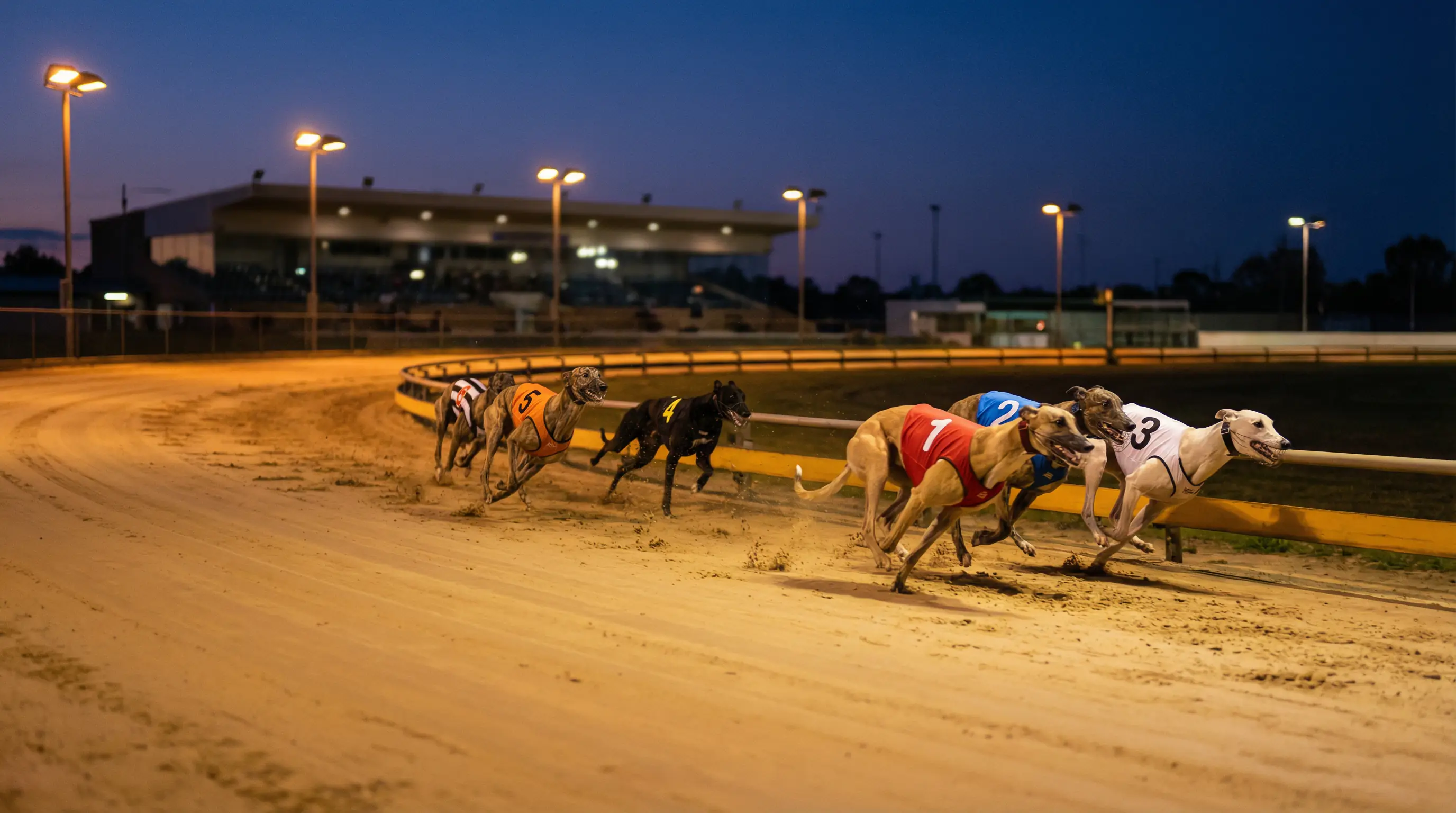
Betting the Derby Is a Campaign, Not a Punt
The English Greyhound Derby stretches across five weeks and six rounds — your betting plan needs to match that timeline. Treating the competition as a single event is the most expensive mistake a greyhound punter can make. It is not a race. It is a tournament, and tournaments reward patience, adjustment and structure in a way that individual races do not.
Consider the arc. One hundred and ninety-two dogs enter the first round. Half are eliminated in a single weekend. By the quarter-finals, fewer than thirty remain. The semi-finals reduce the field to twelve, and the final puts six dogs in the traps for the biggest prize in British greyhound racing — £175,000 at Towcester over 500 metres. At every stage, the market recalibrates. Dogs that looked unbeatable in the first round get drawn badly in the third. Outsiders record fast times from awkward traps and halve their ante-post price overnight. The form picture after round four bears almost no resemblance to the form picture that existed when the ante-post books opened.
A betting campaign acknowledges this reality and plans for it. The campaign has four distinct phases: pre-competition research, early-round accumulation, mid-competition adjustment and final-night execution. Each phase has its own objectives, its own risk profile and its own staking logic. What works in the first phase — wide research, speculative ante-post positions at long prices — would be reckless in the final phase, where the field is small and the market is tight. What works on final night — concentrated stakes on a six-dog field — would be pointless in the opening round, where the information is too thin to justify conviction bets.
The punters who profit from the Derby year after year are not the ones who pick the winner. They are the ones who manage the campaign well enough that their winning positions outweigh their losing ones across the full five weeks. That requires a plan, and the plan starts before a single heat is run.
Also explore our odds and betting guide.
Pre-Derby Research: What to Analyse Before Round One
The best Derby bets are placed before the hare runs for the first time. The research phase is where the entire campaign takes shape, and it begins weeks before the first round of heats. The goal is simple: build an informed shortlist of dogs whose ability, track suitability and price represent genuine value in the ante-post market.
Trial form at Towcester is the single most important data source. In March and April, leading contenders are sent to the Derby course for official trials, and these times give you the first direct measurement of how a dog handles the 500-metre trip on sand with wide bends and an outside Swaffham hare. Not every dog trials publicly — some trainers prefer to keep their hand hidden — but when trial times are available, they should be the foundation of your assessment. A fast time from a dog that has been racing at a different track all winter is a stronger signal than six months of dominant graded form elsewhere.
Kennel form and trainer patterns are the next layer. Certain trainers consistently target the Derby with their best dogs, and their entry declarations carry real information. When Graham Holland enters a team of five or six, the market responds because his kennel has produced two Derby winners in recent years and regularly places dogs in the semi-finals and final. When Patrick Janssens — whose Thorn Falcon and Droopys Plunge won in 2021 and 2025 respectively — enters a lightly raced type, that signals ambition. (Towcester Racecourse — Past Winners) Tracking which trainers are aiming their strongest runners at the Derby, rather than at other summer competitions, helps you identify which dogs are being prepared for peak performance at the right time.
Irish form requires dedicated attention. Four of the last five Derby winners were trained in Ireland, and the cross-channel challenge has become the dominant force in the competition. The Irish racing programme — particularly the Maiden Derby and the early-season classics at Shelbourne Park — produces dogs that arrive at Towcester with experience against top-class opposition. Watching how these dogs perform in Irish trials and early-season open races gives you a window into the quality of the raiding party before the English ante-post market fully accounts for it.
Finally, read the market itself. Opening ante-post prices are the bookmakers’ best assessment of probability, and they contain information even when they are wrong. A dog at 33/1 is being told it has roughly a three percent chance. If your research suggests a materially higher probability — based on trial form, trainer intent and track suitability — the price is too long and the bet has value. Build a checklist: trial time at Towcester, graded form level, running style, trainer record in the Derby, Irish or English base, and draw preferences. Score each dog against these criteria, compare the result to the market price, and you have a structured basis for your ante-post selections.
Strategy for Early Heats (Rounds 1–3)
Early rounds are cheap education — watch the track, read the pace maps, and only strike when the market has made a mistake. The first three rounds of the Derby eliminate roughly 160 dogs from the competition, and that process generates an enormous volume of new form data. Every heat is run over the Derby course under race conditions, meaning you now have actual Towcester times, trap-draw responses and running-style evidence for every surviving dog. The temptation is to bet heavily on this fresh data. The discipline is to be selective.
The opening weekend of heats is primarily an observation exercise. Half the field is running at Towcester for the first time under competitive pressure, and first-round performances are inherently noisy. A dog might record a slow time because it was drawn awkwardly, encountered crowding at the first bend, or simply needed a race to acclimatise to the track. Equally, a dog might clock a fast time in a weak heat with no early pace to test it. First-round results confirm or deny some pre-competition assumptions, but they rarely provide the certainty needed for aggressive staking.
By the second and third rounds, the picture clarifies. Dogs that qualified comfortably in round one are now racing against tougher opposition, and the separation between genuine Derby contenders and dogs that benefited from a kind draw becomes visible. This is the phase where targeted bets on specific heats can offer value — particularly on dogs whose round-one performance was better than the finishing position suggested. A dog that was crowded at the first bend, lost two lengths, and still qualified in third might be significantly underpriced for a second-round heat where the draw is kinder.
Spotting Improvers Early
Improvement in the early heats manifests in specific, measurable ways. The most reliable indicator is a closing sectional trend — a dog whose finishing speed improved from round one to round two, even if the overall time remained static. This suggests that the dog is adapting to the Towcester surface and finding its rhythm through the wide bends, which is precisely the trajectory you want from a potential semi-finalist.
Dogs overcoming trap disadvantage are another signal. A railer drawn in Trap 5 that qualifies despite being forced wide has shown more ability than a railer drawn in Trap 1 that led throughout. If the same dog draws an inside box in the next round, its price may not reflect the improved circumstances. First-time Towcester runners that qualify are worth monitoring especially closely — their round-one time establishes a baseline, and any improvement in subsequent rounds indicates genuine course suitability rather than a one-off performance.
When to Sit Out a Round
Not every round demands a bet. This is the hardest lesson in Derby campaign management, and the most profitable. A round with no clear value — where the market has priced every heat roughly correctly, or where the information is too ambiguous to form a confident view — is a round to watch rather than wager.
The compulsion to bet on every round is driven by engagement, not by logic. The Derby runs for five weeks, and the desire to have action keeps punters placing bets on heats where they have no meaningful edge. Sitting out a round costs you nothing. Betting on a round where you have no edge costs you the margin — and across a five-week campaign, those marginal losses accumulate into significant drag on your overall return. Keep your powder dry for the rounds where your research gives you a genuine reason to act.
Quarter-Final and Semi-Final Approach
The quarter-finals are where ante-post bets start paying off or dying — and where your hedging discipline matters most. By this stage, the field has been reduced to approximately twenty-four dogs, and the quality gap between heats has narrowed sharply. Every surviving dog has won or placed in at least three rounds of competition at Towcester, and the pretenders have been eliminated. The quarter-finals are the first stage where every heat feels like it could produce a finalist, and the market reflects that intensity with tighter prices and smaller edges.
For punters holding ante-post positions, the quarter-final is a decision point. If your selection has progressed with improving form and a shortening price, you have a valuable asset. The question is what to do with it. Letting it run offers the full potential return if the dog reaches the final and wins. Hedging — by backing other dogs in the same quarter-final or laying your selection on the exchange — locks in a portion of the profit regardless of the result. The right approach depends on the price movement: if your dog’s price has shortened from 33/1 to 8/1, the ante-post position already represents significant value, and hedging a portion to guarantee a return on your initial stake is sound risk management. If the price has barely moved, there is less to protect and letting the position run makes more sense.
Semi-finals demand a different mindset. The field is twelve dogs across two heats, and the three qualifiers from each heat contest the final. This is the round where form peaks — the dogs are race-fit, course-acclimatised and at the sharpest point of their preparation cycle. It is also the round where some dogs peak too early. A dog that produces a career-best performance in the semi-final may have left its best race on the track before the final. Experienced Derby bettors look for dogs that qualify well within themselves — comfortably rather than spectacularly — because they are the ones most likely to have something in reserve for final night.
The semi-final also determines the final’s trap draw, which is assigned by the racing manager based on running style and seeding. The draw can transform a dog’s prospects. A wide runner drawn in Trap 1 for the final faces a structural disadvantage; the same dog in Trap 5 or 6 is a different proposition entirely. Wait for the final draw before making any final-night decisions — the trap allocation often reshapes the market more than the semi-final results themselves.
Final-Night Betting: The Six-Dog Showdown
Six dogs, one race, no second chances — this is where everything you have learned either works or it does not. The Derby final at Towcester is a 500-metre race that takes approximately thirty seconds from trap to line. The market for this single race is deeper and more liquid than the market for most entire graded meetings, and the price you take matters enormously because the margins between the six finalists are razor-thin.
Trap draw analysis is the starting point for final-night strategy. The draw for the final is published earlier in the week, and it immediately reshapes the outright market. At Towcester, the wide bends reduce the extreme inside-bias found at tighter tracks, but positional advantage still matters. Trap 1 gives a dog the shortest path to the first bend and suits railers. Traps 5 and 6 suit wide runners who can use the outside to maintain speed through the sweeping turns. The middle traps — 3 and 4 — are the least predictable, because dogs drawn there must commit quickly to either the rail or the outside, and early-race crowding tends to concentrate in the middle of the pack.
Price comparison across bookmakers is non-negotiable on final night. The major firms — bet365, Paddy Power, Coral, Ladbrokes, William Hill, Star Sports — will all price the six-dog field, and differences of a full point or more are common. A dog at 7/1 with one bookmaker and 9/1 with another represents a significant gap, and consistently taking the best available price is the simplest way to improve your long-term return. If you are holding an ante-post position, checking whether a top-up bet at the current price improves your overall position is worth the calculation.
The exchange versus bookmaker decision is particularly relevant for the final. On Betfair, the Derby final generates enough liquidity for meaningful trading. If you believe a dog is overpriced in the bookmaker market, the exchange allows you to back at the bookmaker price and potentially lay later if the price shortens — locking in a position regardless of the result. Conversely, if you believe a dog is too short, laying it on the exchange and backing the field is a viable strategy in a six-runner race where any of the finalists has a realistic chance.
One final consideration: starting price versus board price. In the Derby final, the SP is determined by on-course market activity and can differ materially from the prices available in the ante-post and early final-night markets. If you have taken a price ante-post, you are committed to that price — SP does not apply. If you are betting on the day, taking the board price before the off is generally preferable to accepting SP, because the on-course market for a high-profile final can be volatile and the SP may not reflect the value that was available earlier. However, if the board price has shortened below your assessment of fair value, staying out entirely is a legitimate option. The final is one race. You do not have to bet on it just because you have followed the competition for five weeks.
Bankroll Framework for a Derby Campaign
Allocate your Derby bankroll before the first heat — not after your second losing bet. A five-week betting campaign requires a financial structure, and the structure should be set in advance, when your judgment is clear and your emotions are not invested in any particular outcome.
A practical allocation splits the total Derby bankroll into four segments. Around twenty to twenty-five percent for ante-post bets placed before the first round — these are your speculative positions at the longest prices, where non-runner risk is highest but potential returns are greatest. Thirty to thirty-five percent for heat-by-heat bets across rounds one through three, where you are betting selectively on individual heats rather than outright markets. Twenty percent for the quarter-final and semi-final phase, where stakes are slightly larger because the surviving field is stronger and your information advantage is greater. And the remaining twenty to twenty-five percent for final night, where you are betting into a tight, well-informed market with a six-dog field.
The ante-post segment should be spread across two or three selections rather than concentrated on a single dog. Non-runner attrition means that some of your ante-post stakes will be lost to injuries and withdrawals before the competition begins — this is the cost of playing in the ante-post market and should be budgeted for, not treated as bad luck. Individual ante-post stakes should represent no more than two to three percent of your total Derby bankroll.
Total-loss scenario planning is the final step. Before the campaign begins, calculate the worst case: every ante-post selection is a non-runner, every heat bet loses, and the final produces a result that defeats your position. If the total loss in that scenario exceeds what you can afford comfortably, reduce the bankroll. The Derby runs every year. There is no single edition that justifies financial stress. The dogs will be back at Towcester next June, and so should your bankroll.
What Five Weeks of Derby Betting Should Teach You
The dogs finish in thirty seconds — your education lasts five weeks. The English Greyhound Derby is the most compressed, data-rich betting laboratory in greyhound racing. No other event gives you six rounds of top-class form at the same track, over the same distance, against progressively stronger opposition. If you approach it as a campaign rather than a punt, the Derby teaches you more about greyhound betting in five weeks than a full year of graded-race wagering.
The lessons are specific and repeatable. You learn how ante-post prices behave in a large-field knockout competition and where the value window opens and closes. You learn which form indicators — sectional improvements, trap-draw resilience, closing speed on the Towcester bends — actually predict progression through the rounds and which are noise. You learn how to manage a position across multiple rounds, when to hedge and when to hold, and how to make final-night decisions based on data rather than narrative.
The post-campaign review is where those lessons become permanent. After the final, go back through your notes. Which pre-competition assessments proved correct? Which were wrong, and why? Did you bet on rounds where you had no edge, or did you maintain the discipline to sit out when the value was not there? Did your bankroll allocation hold up, or did you overcommit to the final at the expense of earlier rounds? Honest answers to these questions give you a sharper framework for the following year.
The 2026 Derby will follow the same format, the same course, the same five-week timeline. The dogs will be different. The trainers will adjust. The market will open with new names and new prices. But the structure of the betting opportunity is identical, and the punter who has refined their approach across previous campaigns arrives at the next one with an advantage that no amount of tipping advice can replicate. Strategy compounds. Build yours over time, and the Derby rewards the patience.
Find more strategy guides at englishgreyhoundderbyuk.