The Insurance Policy That Sometimes Pays Better Than the Main Bet
Each-way betting is one of the most widely used and least understood wager types in greyhound racing. Plenty of punters know that it covers both a win and a place. Fewer understand the mechanics well enough to identify when each-way offers genuine value and when it is a waste of half your stake. In a six-dog race like every round of the English Greyhound Derby, the mathematics of each-way betting are unusually favourable — but only in specific circumstances, and only at certain odds ranges.
This guide explains exactly how each-way works in a six-runner greyhound race, how place terms vary across bookmakers, and how to combine each-way bets with ante-post strategy for maximum effect during the Derby.
How Each Way Works in a 6-Dog Race
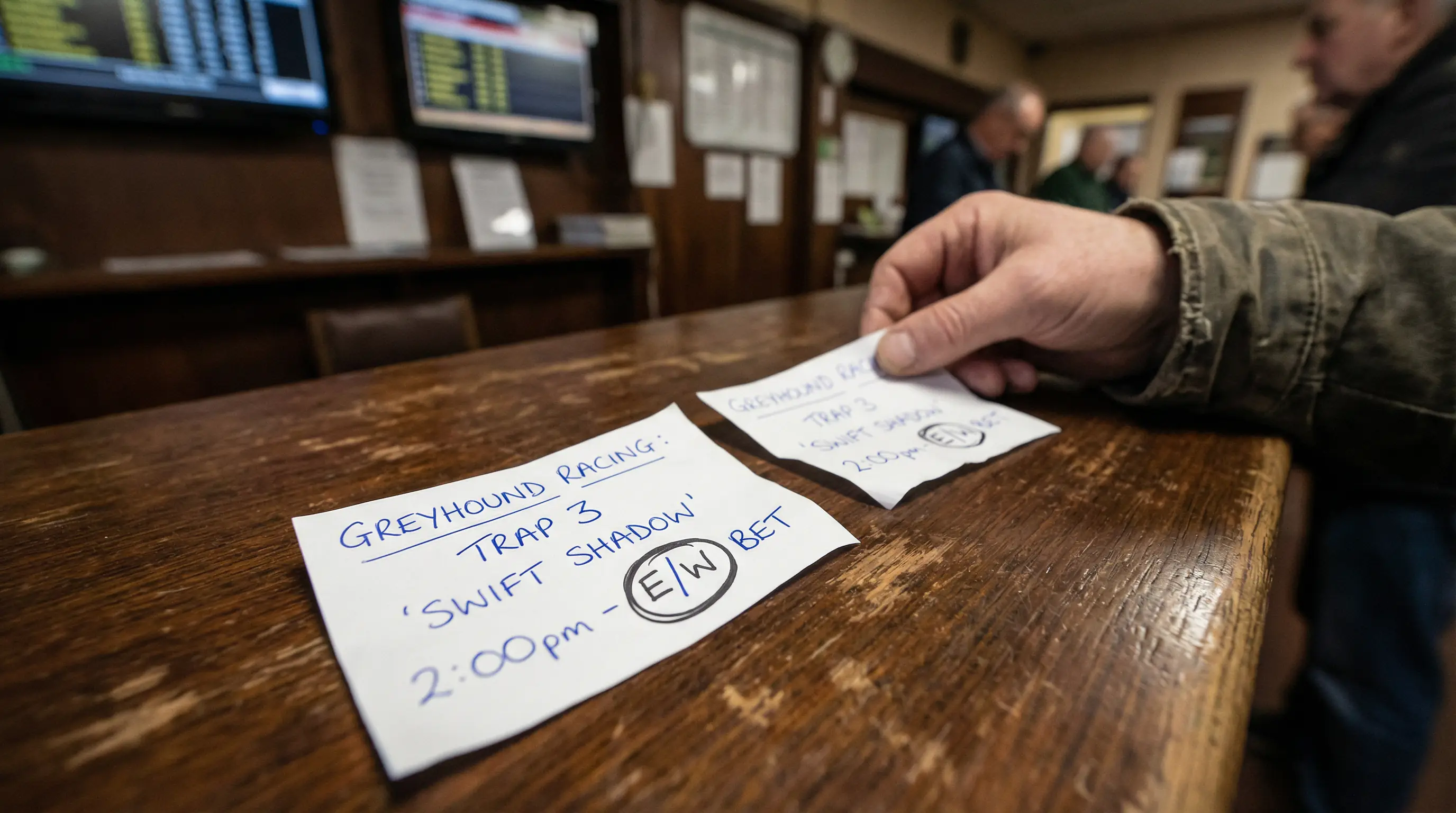
An each-way bet is two separate bets of equal value placed together. The first bet is a win bet: your dog must finish first for it to pay out. The second bet is a place bet: your dog must finish in one of the designated place positions for it to pay out. If the dog wins, both bets pay. If the dog finishes in a place position but does not win, only the place bet pays. If the dog finishes outside the places, both bets lose.
In a standard six-runner greyhound race, the bookmaker’s place terms typically cover the first two finishers at one quarter of the win odds. This means if you back a dog at 8/1 each way, the win portion pays 8/1 and the place portion pays 2/1 (one quarter of 8/1). Your total stake is double whatever you wager — a five-pound each-way bet costs ten pounds, because you are placing a five-pound win bet and a five-pound place bet.
Consider the arithmetic on a ten-pound each-way bet at 10/1. If the dog wins, the win portion returns 10 x 10 + 10 = 110 pounds. The place portion also pays, returning 10 x 2.5 + 10 = 35 pounds. Total return: 145 pounds on a 20-pound total stake. If the dog finishes second, only the place portion pays: 35 pounds on a 20-pound stake, a profit of 15 pounds. The win portion is lost.
The critical insight for six-dog racing is that the place terms cover two of six runners — a 33.3% probability in a perfectly even field. At 1/4 odds, the place portion of your bet needs to hit at a rate that compensates for the half of your stake that goes to the win bet. The break-even point for the place portion alone — the minimum odds at which the place bet generates a positive expected return assuming a 33% hit rate — is around 3/1. At odds of 4/1 and above, the place portion of a six-dog each-way bet begins to offer standalone value. At 8/1 and above, it becomes genuinely attractive.
Place Terms Across Bookmakers
Not all bookmakers offer the same place terms, and the differences can materially affect your returns. The standard for six-runner greyhound races in the UK is 1/4 odds on the first two places. Most major bookmakers — including the largest online platforms — adhere to this standard for regular graded racing. However, for major events like the Derby final, some bookmakers enhance their terms as a promotional tool.
Enhanced place terms come in two forms. First, an increase in the fraction: paying 1/3 of the odds instead of 1/4. On a dog at 10/1, this changes the place payout from 2.5/1 to 3.33/1 — a significant improvement. Second, an increase in the number of places: paying on the first three finishers instead of two. In a six-dog race, three places from six runners means a 50% place probability, which transforms each-way betting into a substantially different proposition.
During the Derby, it is worth checking multiple bookmakers before placing each-way bets. A bookmaker offering 1/3 odds on two places gives you better per-bet value than one offering 1/4 odds. A bookmaker offering three places at 1/4 odds gives you better probability of collecting, though the individual payouts are unchanged. The optimal choice depends on your confidence level: if you rate your dog’s place chances highly but are uncertain about the win, enhanced place odds are preferable. If you want maximum coverage, extended places are better.
One point to watch: some bookmakers that advertise enhanced each-way terms restrict the offer to specific markets or minimum odds thresholds. An offer of “three places on the Derby final” may require a minimum odds of 3/1, excluding favourites. Read the terms before staking.
When Each Way Offers Value
Each-way betting offers genuine value in specific situations, and wastes money in others. The key variables are the odds, the dog’s form profile, and the competitive shape of the race.
The strongest each-way spots in Derby racing are dogs priced between 6/1 and 14/1 with consistent place form. A dog that has finished first or second in four of its last six races but is not the market favourite has a strong underlying probability of placing. At 8/1 each way, the place portion alone — paying 2/1 — offers a positive expected return if the dog places at its historical rate. The win portion is a bonus.
Each-way betting is weakest at very short odds. A dog at 6/4 each way pays just 3/8 on the place — about 37 pence per pound. In a six-dog race, the chance of that dog not placing at all is small but real. When it finishes first, you collect less than a straight win bet would have paid at the same outlay (because half your stake went to the place bet). When it finishes second, the place return barely covers the total stake. At odds-on prices, a straight win bet is almost always preferable to each-way.
The other weak spot is at very long odds — 25/1 and above — where the place return is generous but the dog’s actual chance of finishing in the first two is so low that the expected value is negative. Each-way on a 33/1 outsider sounds appealing because the place portion alone pays 8.25/1, but if that dog’s realistic place probability is less than 10%, you are paying for a fantasy. The exceptions are genuine class dogs that have been overlooked by the market — but if you believe a 33/1 shot has a genuine chance, a straight win bet at the full odds offers better value than diluting your stake across two bets.
Combining E/W with Ante-Post Strategy
Each-way and ante-post are a natural pairing in Derby betting. Ante-post prices are typically longer than race-day prices because they include the non-runner risk premium. That premium inflates the place portion of an each-way ante-post bet, making it more generous than the equivalent race-day each-way bet would be.
A dog available at 20/1 ante-post for the Derby, backed each way, returns 5/1 on the place portion alone. If that dog reaches the final — which eliminates the non-runner risk — and its race-day price has shortened to 8/1, the place portion of the ante-post bet (5/1) significantly outpays the place portion of a race-day each-way bet (2/1). The ante-post each-way bettor is being rewarded for accepting the earlier risk, even on the place portion.
The risk, naturally, is that the dog does not run in the final. Ante-post each-way bets lose both portions if the dog is eliminated or withdrawn. This makes staking discipline essential: commit only what you can afford to lose entirely, and spread your each-way ante-post exposure across two or three dogs rather than concentrating on one. If at least one of your selections reaches the final, the place payout at ante-post odds can compensate for the lost stakes on the eliminated dogs.
Half the Bet Saves the Whole Bankroll
Each-way betting is not a compromise between conviction and cowardice. It is a structural tool that exploits the mathematics of six-dog racing. The place terms in greyhound racing are more favourable than in most horse racing scenarios, because two places from six runners is a higher proportion than three places from twelve. That mathematical edge is real, and it is available on every round of every Derby.
The discipline is in choosing when to use it. Back each-way when the odds and the form both support a strong place probability. Back to win when you have conviction and the odds are short enough that the each-way place return adds nothing meaningful. And always check the terms — the difference between 1/4 and 1/3 odds, or between two places and three, can turn a marginal bet into a clearly profitable one.