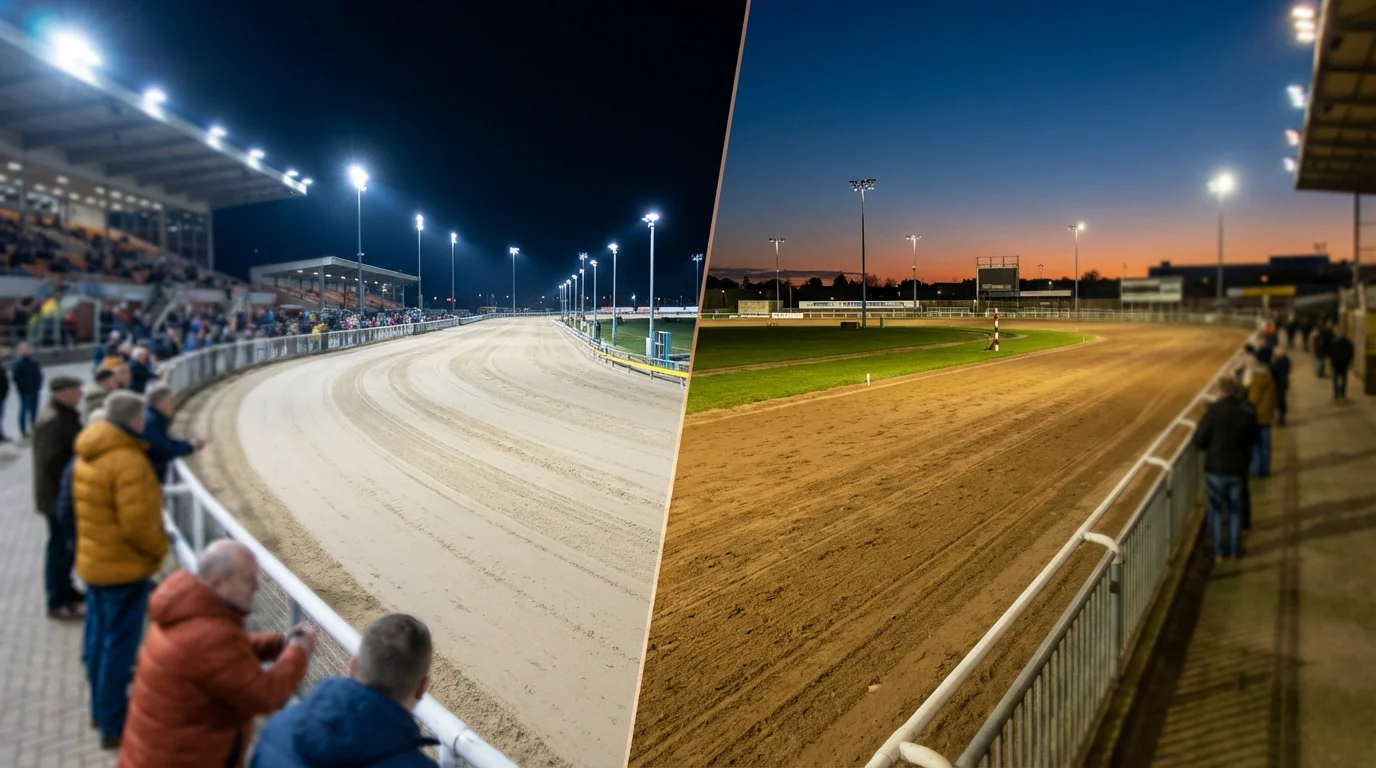
Two Races, Two Tracks, One Argument
The English Greyhound Derby and the Irish Greyhound Derby are the two most prestigious greyhound races in Europe, and the rivalry between them drives much of the sport’s competitive energy. Both are knockout competitions. Both attract the best dogs and trainers from across the British Isles and beyond. And both generate the largest ante-post betting markets in greyhound racing. But they are not the same race, and the differences between them — in format, venue, timing and betting dynamics — matter significantly for anyone placing money on either event.
Understanding how the two Derbies compare is not an academic exercise. It is a practical necessity for bettors, because the Irish Derby’s form lines are the single most commonly referenced dataset when assessing English Derby contenders. Three of the last five English Derby winners were Irish-trained, and many of them had Irish Derby form — either as winners, finalists or participants. Knowing how to read that form, and how to adjust it for the differences between Shelbourne Park and Towcester, is a skill that directly affects your Derby betting.
Format Comparison
Both Derbies follow a multi-round knockout format, but the structures differ in ways that affect the style of competition and the type of dog that thrives.
The English Greyhound Derby begins with 192 entries and runs over six rounds across approximately five weeks. Heats are staged mid-week and at weekends, with roughly one round per week. The format is condensed: dogs need to race frequently, recover quickly, and maintain form across a sustained period. This rewards physical resilience and trainers who manage their dogs’ energy across the campaign rather than peaking for a single night.
The Irish Greyhound Derby, held at Shelbourne Park in Dublin, also starts with a large entry field but typically runs over a longer calendar — eight to ten weeks, with rounds spaced further apart. The additional recovery time between rounds changes the dynamic. Dogs are less likely to accumulate fatigue, and trainers have more flexibility to schedule rest and preparation between heats. This favours dogs with exceptional raw speed over those whose strength is consistency and durability.
The English Derby runs heats of six dogs exclusively, with qualifying based on finishing position and fastest-loser times. The Irish Derby has historically used a mix of six-dog and eight-dog heats in the opening rounds, though recent formats have standardised around six. Eight-dog heats produce more crowding, more interference, and more unpredictable results — which in turn produces more upsets and longer-priced qualifiers in the early rounds. For bettors, the Irish Derby’s early rounds are statistically more volatile than their English equivalent.
Both competitions culminate in a six-dog final, run over approximately 500 metres. The final is a single race with no second chances — the format is identical in both countries. The difference is in what it takes to get there.
Venue & Track Differences
Towcester and Shelbourne Park are fundamentally different racing environments, and those differences directly affect which dogs perform well at each venue.
Towcester Racecourse features a purpose-built greyhound track with a 420-metre circumference, an all-sand surface, and some of the widest bends in British racing. The 500-metre Derby distance includes a relatively long run to the first bend, which gives dogs time to sort into their running positions before the crowding intensifies at the turn. The wide bends allow dogs to maintain speed through the turns, and the outside Swaffham hare encourages a slightly wider running line than tracks with an inside hare rail. The net effect is a track that is broadly fair across all trap positions and that rewards sustained pace over pure early speed.
Shelbourne Park is a tighter circuit with a 400-metre circumference and a more traditional configuration. The bends are sharper, the run to the first turn is shorter, and the inside rail is more congested — dogs drawn in the lower traps have a significant positional advantage. The surface is sand-based but rides differently to Towcester’s purpose-laid track. Early pace is at a premium at Shelbourne: dogs that break fast and reach the first bend in front have a structural advantage that is hard to overcome from behind.
These differences explain why some dogs that dominate at Shelbourne struggle at Towcester, and vice versa. A dog built for Shelbourne — explosive early speed, comfortable on tight bends, effective from an inside trap — may find Towcester’s wider geometry unfamiliar. The extra room on the bends can actually work against a front-runner if it allows closers to maintain their speed through the turns and mount a late challenge. Conversely, a strong finisher that lacks the early pace to lead at Shelbourne may thrive at Towcester, where the longer run-in and wider bends give it time and space to close.
Prize Money & Prestige
The English Greyhound Derby currently offers 175,000 pounds to the winner, making it the most lucrative greyhound race in the UK and Ireland by a significant margin. The total purse, including prize money distributed across all rounds, exceeds 350,000 pounds. The Irish Greyhound Derby winner receives 125,000 euros, with a total purse of around 300,000 euros. In raw financial terms, the English Derby is the bigger prize.
Prestige is harder to quantify. In the UK, the English Derby is unquestionably the pinnacle — the race that trainers, owners and bettors treat as the most important event on the calendar. In Ireland, the Irish Derby holds similar status, though some handlers view the English Derby as the ultimate test because of the longer travel, the unfamiliar track, and the international competition. Winning both Derbies in the same year — or across consecutive years — is considered the highest achievement in the sport. No dog has won the English and Irish Derby in the same calendar year in the modern era, though Bockos Diamond attempted the double in 2025 after winning the Irish Derby before finishing second at Towcester.
For bettors, the financial difference between the two Derbies matters primarily in terms of the quality of the field. The larger English prize purse attracts a wider range of entries from Ireland and continental Europe, which deepens the competition and makes the overall field more internationally diverse. The Irish Derby, while still attracting top-class dogs, draws more heavily from domestic runners and is shaped more by the Irish open-race circuit than by cross-channel raiding.
How Form Translates Between the Two
This is the question that matters most for betting purposes: if a dog ran well at the Irish Derby, what does that tell you about its chances at the English Derby?
The short answer is that Irish Derby form is a useful guide but not a reliable predictor. Dogs with strong Irish Derby records consistently feature in the English Derby market, and for good reason — they have proven themselves against high-quality competition in a knockout format. But the track differences mean that raw times and finishing positions from Shelbourne cannot be transplanted directly to Towcester without adjustment.
The adjustments are specific. A dog that led throughout at Shelbourne — relying on early pace to secure the inside rail and hold off challengers on tight bends — may find that its advantage is reduced at Towcester, where the wider bends allow other dogs to maintain their momentum and challenge on the outside. Conversely, a dog that finished strongly at Shelbourne but was disadvantaged by the track’s bias toward early pace may actually improve at Towcester, where the geometry favours sustained running speed over explosive breaks.
Running style is the critical translation variable. Dogs with tactical versatility — able to race on the rail or wide, from the front or from behind — tend to handle the transition between the two Derbies better than specialists. Sectional time analysis is useful here: a dog that posted strong closing sectionals at Shelbourne, even in defeat, may be ideally suited to Towcester’s longer finishing straight. A dog that posted exceptional first-bend sectionals but faded in the closing stages may be less effective on a track where the bends are easier and late pace is more important.
The practical rule for bettors: treat Irish Derby form as one input among several. Combine it with Towcester trial times if available, trap draw assessment for the English Derby itself, and an honest evaluation of whether the dog’s running style suits the track. Dogs whose Irish form suggests a strong finish will generally translate better than dogs whose Irish form was built entirely on early pace.
Two Derbies, One Conversation
The English and Irish Greyhound Derbies are not rivals in the way that competing football leagues are rivals. They are complementary events in a single sporting ecosystem. The Irish Derby produces the dogs and the form lines. The English Derby tests whether that form holds up on a different track, against an international field, over a more compressed schedule. Most of the sport’s great modern champions have contested both, and the conversation between the two races — which is harder, which produces the better winner, which is the true test of a Derby dog — has been running for decades without resolution.
For bettors, the relationship between the two Derbies is the richest source of information in the sport. An Irish Derby finalist whose running style suits Towcester, trained by a handler who has won at both venues, entering the English Derby at a price that reflects Shelbourne form rather than Towcester potential — that is the profile of a value bet. Finding it requires understanding both races, not just the one you are betting on. The two Derbies speak to each other constantly. The punters who listen to both sides of the conversation are the ones who tend to collect.