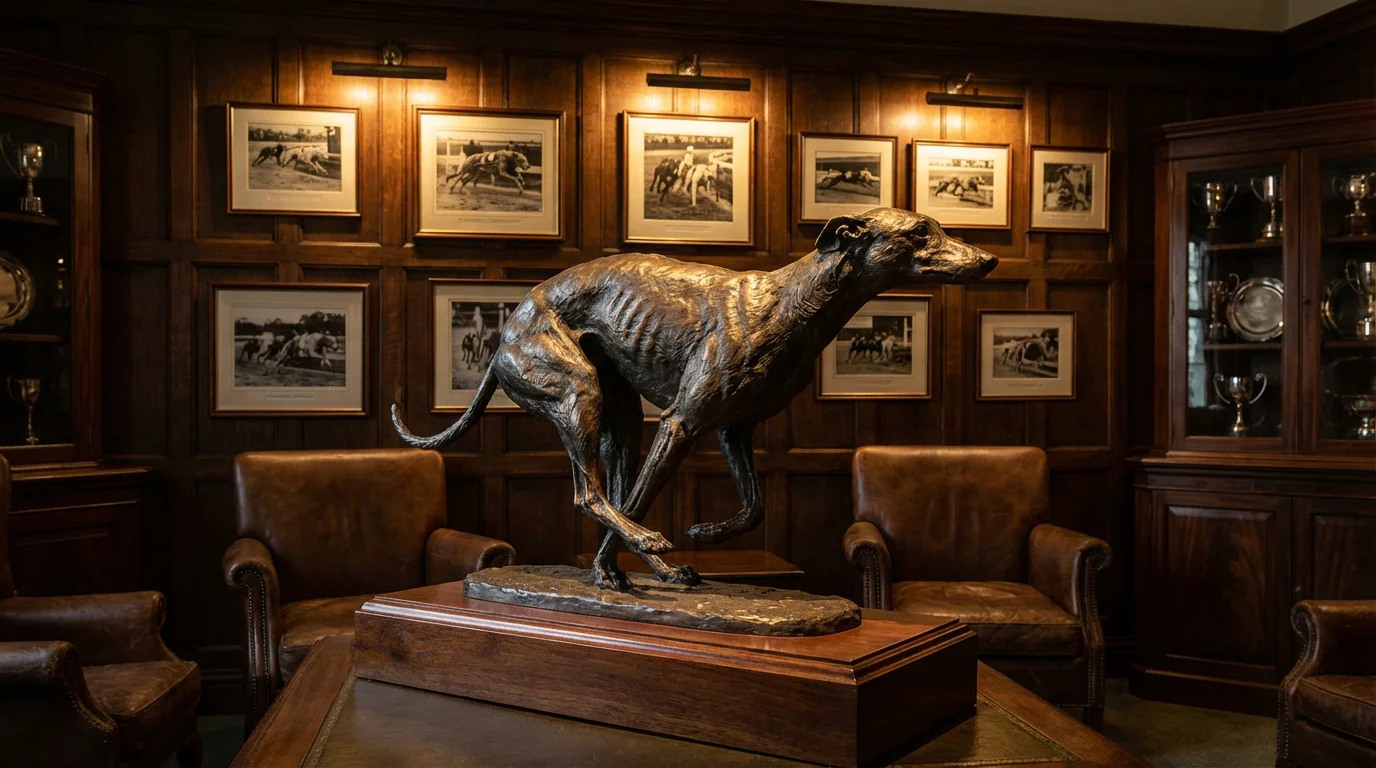
The Dogs That Defined the Race
The English Greyhound Derby has produced champions for nearly a century, but only a handful of them transcended the sport. These are the dogs whose names are recognised beyond the greyhound world — animals whose performances were so dominant, so dramatic, or so improbable that they became part of the broader sporting conversation. Their stories are worth knowing not just for the history but for the patterns they reveal. The same qualities that made Mick the Miller unbeatable in 1929 — early speed, composure under pressure, and a trainer who peaked the dog at exactly the right moment — are the same qualities that separate Derby winners from Derby runners-up today.
What follows is a profile of the most significant Derby champions, from the sport’s first superstar to the modern dogs whose victories still shape the ante-post market.
Mick the Miller
No greyhound in history has had a greater impact on the sport than Mick the Miller. Born in Ireland in 1926, he won the English Greyhound Derby in 1929 and 1930 — the first dog to win it consecutively — and became a genuine national celebrity in a way that no greyhound before or since has matched. He appeared in a feature film, was the subject of newspaper columns and music hall songs, and drew crowds that rivalled football matches. (GBGB – Mick the Miller)
Mick the Miller’s racing career was built on a combination of blistering early speed and an almost preternatural ability to find racing room in crowded fields. He was brought to England by Father Martin Brophy, and his 1929 Derby triumph was under trainer Paddy Horan, while Sidney Orton prepared him for his 1930 success. (Towcester Racecourse – Past Winners) The back-to-back Derby wins established a benchmark that stood for over forty years — until Patricias Hope repeated the feat in 1972 and 1973.
The betting lesson from Mick the Miller’s career is about market confidence. He was sent off at 4/7 for the 1929 final and 4/9 for the 1930 final — odds-on in both cases. The market was right. When a dog is genuinely superior to its rivals, the price reflects it, and backing the obvious choice at short odds can still be the correct play. The temptation to find value by opposing the favourite is strong, but some favourites are favourites for a reason. Mick the Miller was one of them.
He died in 1939. His taxidermied body is on display at the Natural History Museum in Tring — the only greyhound to receive such an honour, and a measure of the cultural footprint he left on a nation that, for a brief period in the interwar years, loved greyhound racing as much as any sport.
Rapid Ranger
Rapid Ranger won the Derby in 2000 and 2001, trained by Charlie Lister. His consecutive victories were at 7/4 on both occasions — they were Lister’s first and second Derby wins, launching an extraordinary run that would eventually yield seven titles. (Star Sports – Greyhound Derby Roll of Honour)
What made Rapid Ranger exceptional was not just his speed but his versatility. He could lead from the front or sit off the pace and close, adapting his running style to the race conditions. This tactical flexibility made him almost impossible to beat, because rival trainers could not devise a strategy to counter him — he could win from any position and any trap.
Rapid Ranger’s second Derby victory, in 2001, was particularly notable for the composure he showed under intense pressure. By that point, every other trainer in the competition had studied his racing style and attempted to neutralise it. Dogs were specifically entered and drawn to test his weaknesses. He had no weaknesses. He won the final comfortably, confirming that genuine class is the hardest thing to overcome in a six-dog race.
For bettors, Rapid Ranger’s legacy is a reminder that back-to-back Derby bids — while statistically unlikely — are most dangerous when the defending champion is trained by a handler with form in managing dogs through consecutive campaigns. Lister understood the physical and psychological toll of a five-week knockout. Rapid Ranger was not just the best dog in the field. He was the best-managed dog in the field.
Westmead Hawk
Westmead Hawk, trained by Nick Savva, won the Derby in 2005 and 2006 — the most recent dog to achieve the back-to-back. His two victories bookended a period in which he was widely regarded as the most talented greyhound of his generation, with a combination of raw speed and physical power that set him apart from the field.
His 2005 win came at 5/4, and his 2006 win at a remarkable 4/7 — the shortest-priced Derby winner since Mick the Miller. The market had him as an overwhelming favourite, and he duly delivered. Savva’s training was meticulous, and Westmead Hawk’s physical condition across both campaigns was a testament to the handler’s skill in keeping a high-class dog fit and motivated through the gruelling knockout schedule.
Westmead Hawk’s significance for modern Derby betting is his demonstration that when a dog is genuinely a class above, the format cannot stop it. The knockout structure is designed to produce upsets — random draws, crowded bends, accumulated fatigue — but a dog with enough quality and enough careful management can navigate all of those obstacles twice in succession. It is a reminder that the Derby ultimately rewards the best dog, even if the journey to the final is unpredictable.
Modern Legends: Thorn Falcon, De Lahdedah, Droopys Plunge
The Towcester era has produced its own set of memorable champions, each reflecting the modern Derby’s international character and competitive depth.
Thorn Falcon won the 2021 Derby for Patrick Janssens, the Belgian-born trainer based in Thetford. His victory was significant for several reasons: it was Janssens’ first Derby win, it came against a strong Irish-dominated field, and Thorn Falcon’s running style — a patient closer who produced devastating finishing speed — suited Towcester’s wide bends and long run-in perfectly. The dog’s ante-post odds had been relatively generous because his form at other tracks had not translated into headline results. At Towcester, on the sand, with room to run, he was a different animal. His victory at 7/2 illustrated a pattern that recurs in the modern Derby: dogs whose running style specifically suits Towcester’s geometry can outperform their general form.
De Lahdedah won the 2024 Derby for Liam Dowling and immediately entered the conversation about the best of the modern era. His finishing speed was exceptional — consistently the fastest closing sectional in every round he contested — and his ability to recover from poor early positions made him almost impossible to eliminate. He returned for the 2025 Derby as the defending champion and ran honourably in the final, finishing third behind Droopys Plunge and the favourite Bockos Diamond. His attempt at back-to-back wins fell short, but his two consecutive finals confirmed his status as a dog of rare quality.
Droopys Plunge, the 2025 champion trained by Janssens, won the final at 10/1 after a campaign that built steadily through the rounds. He was not the most fancied dog at any stage of the competition — that honour belonged to Bockos Diamond, the Irish Derby winner who was sent off at 11/10 for the final. But Droopys Plunge ran the perfect race: clean through the first bend, tracking the leaders through the middle stages, and producing a burst of finishing speed that carried him past Bockos Diamond in the final fifty metres. His victory was a textbook example of the closer’s art, and it provided Janssens with his second Derby win in four years.
The Track Remembers — Even When the Market Forgets
The common thread running through every great Derby dog is not speed alone. It is the combination of ability, temperament and preparation that allows a greyhound to produce its best performance on the biggest night. Mick the Miller had it. Rapid Ranger had it. Westmead Hawk had it. And in their different ways, Thorn Falcon, De Lahdedah and Droopys Plunge had it too.
For bettors, the profiles of these champions offer a template. Look for dogs with tactical versatility — the ability to win from different positions and different traps. Look for dogs trained by handlers who have demonstrated the ability to peak a greyhound for a specific week and a specific track. And look for dogs whose form at Towcester is better than their form elsewhere, because the Derby is not run on aggregate — it is run at Towcester, on sand, over 500 metres, and the dogs that thrive in those specific conditions are the ones that write their names on the roll of honour.