
When the Formbook Gets Torn Up
The English Greyhound Derby favourite has a losing record. That single fact should frame every ante-post selection, every race-day wager, and every expectation you carry into the competition. Since 1985, fewer than a third of Derby finals have been won by the market leader. The rest have been won by dogs at 3/1, 5/1, 10/1 — and occasionally at prices so long that the result redefined what punters thought was possible.
Upsets in the Derby are not flukes. They are structural. The competition format — random trap draws, knockout elimination, tight bends with six dogs converging simultaneously — manufactures the conditions for surprise results. Understanding why upsets happen, what the longest-priced winners had in common, and how to spot an upset before the market does is one of the most profitable skills in greyhound betting.
Also read our famous greyhound Derby dogs.
The Biggest Derby Upsets
The most seismic upset in modern Derby history came in 2017, when Astute Missile won at 28/1 — the longest-priced Derby winner of the Towcester era and one of the biggest shocks in the competition’s near-century-long history. Trained by Seamus Cahill, a handler with no previous Derby pedigree, Astute Missile qualified comfortably through the early rounds without attracting significant market attention. His form was decent but not exceptional, and the ante-post market treated him as an afterthought. In the final, he got a clean break from Trap 4, reached the first bend without interference, and sustained his pace to win by three-quarters of a length. The market had priced him as a 28/1 outsider. The clock said he ran the fastest time of his life.
Tartan Khan’s victory in 1975 at 25/1 was one of the great White City shocks. The pre-race market was dominated by heavily backed favourites with superior form figures, but Tartan Khan, a stayer drawn in Trap 2 in a five-runner final, trapped better than expected and took the lead at the third bend when the early leader Sallys Cobbler moved off the rail. His winning time was unremarkable — he had qualified for the final with three consecutive third-place finishes — but his ability to seize the opportunity when it arose and sustain his pace to the line was exceptional.
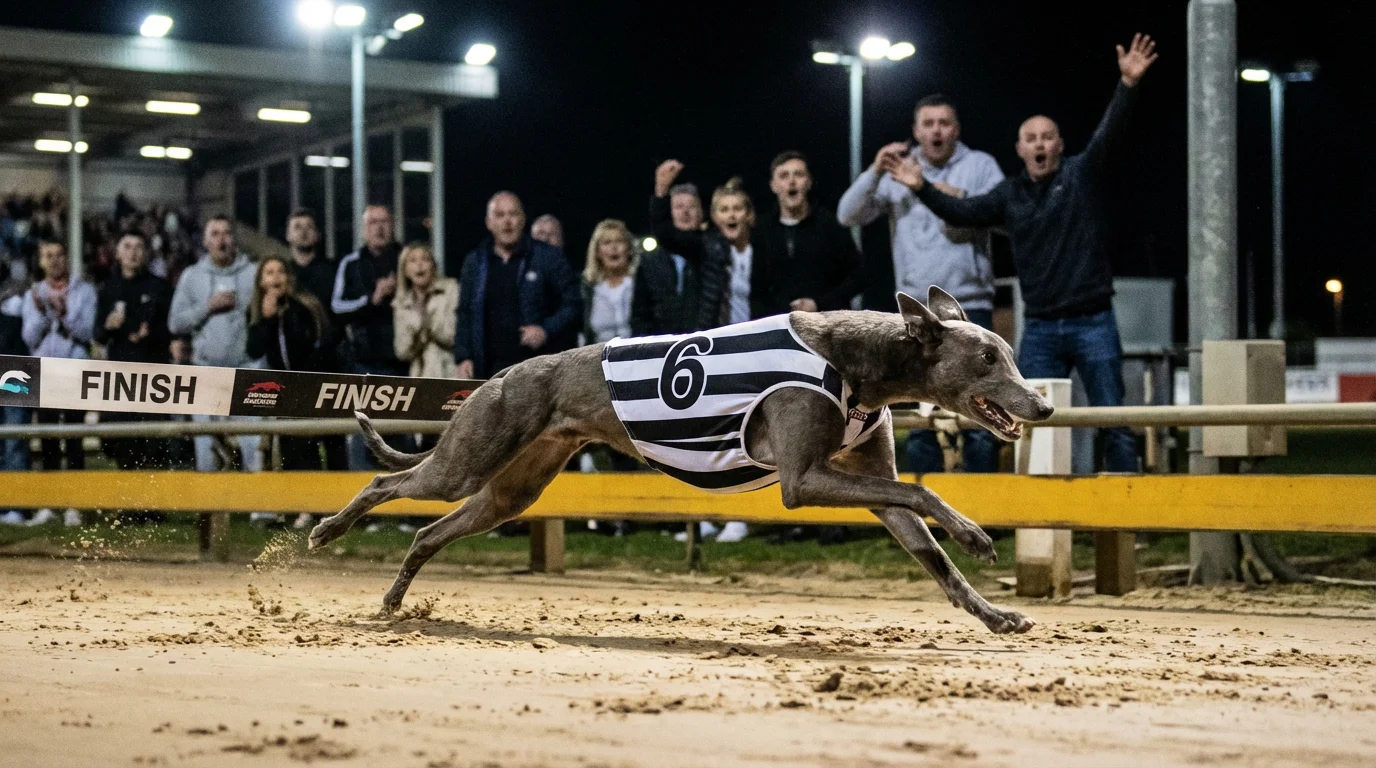
More recently, the 2025 Derby provided a reminder that even short-priced favourites are vulnerable. Bockos Diamond, the 11/10 favourite and Irish Derby champion, was prominent early on before being overhauled by Droopys Plunge at 10/1. The favourite did nothing wrong — he ran a fast time, broke well, and held the lead for 450 of 500 metres. He simply ran into a dog that had more closing speed on the night. That is the nature of a six-dog sprint: the margin between winning and losing is a neck, and the market cannot account for the final fifty metres with any certainty.
What Upset Winners Had in Common
Not every longshot winner is a true upset. Some are dogs that the market underpriced because their form was misread or their Towcester-specific ability was overlooked. Analysing the common traits of Derby upset winners reveals patterns that are more systematic than random.
The first pattern is a clean run in the final. Every major Derby upset involved the winning dog getting through the first bend without interference. In a six-dog race where the first bend is the point of maximum congestion, a clean break is not guaranteed for any dog — but it is more likely for dogs drawn in Trap 1 or Trap 6, where the inside or outside position provides natural protection from crowding. Astute Missile drew Trap 3, which is neutral, but the dogs on either side of him were wide runners and railers respectively, creating a channel through the first bend that he exploited perfectly.
The second pattern is closing speed. Most Derby upsets are won by dogs with strong finishing sectionals rather than exceptional early pace. Front-runners are more likely to be caught than closers are to be passed, because the front-runner must sustain maximum effort for the full 500 metres while the closer can conserve energy through the early stages and deploy it in the final hundred metres. Droopys Plunge’s 2025 victory followed this template exactly — a patient early run followed by a devastating close.
The third pattern is trainer anonymity. Several of the biggest Derby upsets were produced by trainers without established Derby records. The market assigns a premium to proven Derby handlers — Holland, Janssens, Dowling — and correspondingly underprices dogs from less fashionable kennels. When a dog from a smaller operation has the raw ability to compete but lacks the name recognition to attract market support, its price inflates beyond its true probability. That inflation is where the value lives.
How to Spot an Upset Before It Happens
Spotting a potential upset requires looking for the conditions that produce one, rather than trying to predict the unpredictable. Start with the trap draw. A dog with a strong closing sectional drawn in a position that gives it clean running room — Trap 5 or 6 for a wide runner, Trap 1 for a railer — is better positioned to produce an upset than the same dog drawn in a trap that conflicts with its style.
Next, check the sectional profiles. The dog with the best closing sectional in the heat does not always win, but when it does, the dividend tends to be generous because the market favours front-runners. If you can identify the closer in a Derby heat whose finishing speed is superior to the early-pace dogs, and whose draw gives it a clear path to the finish, you have a dog that is more likely to win than its price suggests.
Finally, look at the competitive dynamics of the heat. A race with two or three confirmed front-runners is more likely to produce an upset than a race with one dominant leader, because the front-runners interfere with each other at the first bend, creating gaps for closers to exploit. When the race card shows multiple dogs with fast first-bend sectionals drawn in adjacent traps, the likelihood of first-bend crowding increases — and so does the probability that a patient closer, sitting behind the chaos, will pick up the pieces.
Favourite Failure Patterns
Favourites fail in the Derby for identifiable reasons, and the failures follow patterns. The most common cause is first-bend trouble. A favourite drawn in a middle trap, forced to contest position with dogs on both sides, frequently loses its advantage before the race is two seconds old. The market prices the favourite on ability; it does not adequately account for the probability of first-bend interference.
The second common cause is cumulative fatigue. A dog that peaked in the semi-finals — running its fastest time to qualify — may arrive at the final physically depleted. The market sees the fast semi-final time and shortens the price. What the market does not see is that the dog had to work harder than usual to post that time, and the effort has left it a fraction slower for the final.
The third cause is tactical inflexibility. Favourites are often favoured because they have a dominant running style — usually front-running — that has carried them through the competition. In the final, against six dogs that have all been specifically prepared for this one race, that dominance is harder to establish. A front-runner that has led every heat may find that two or three other dogs contest the early pace in the final, pushing the speed higher than it has experienced and draining its reserves before the closing stages.
The Market Is Often Wrong — That’s Where the Money Lives
The Derby betting market is efficient in aggregate but unreliable in specific instances. It correctly identifies the general hierarchy of the field — the best dogs are usually near the top of the market — but it consistently overestimates the favourite’s probability of winning and underestimates the chances of mid-priced contenders in the 6/1 to 16/1 range. This mispricing is structural, driven by the public’s tendency to back the obvious choice, and it creates value for bettors willing to look past the headline name.
The lesson from nearly a century of Derby results is not that favourites always lose — they don’t. It is that they lose often enough, and at short enough prices, that backing the favourite to level stakes over time is a losing strategy. The money lives in the dogs that the market has underpriced: the closers with strong sectionals, the dogs from unfashionable kennels, the runners whose trap draw has been overlooked. These are not random selections. They are the logical output of form analysis that goes one step deeper than the consensus. That extra step is what separates a punter from the crowd.
Find more Derby history at englishgreyhoundderbyuk.