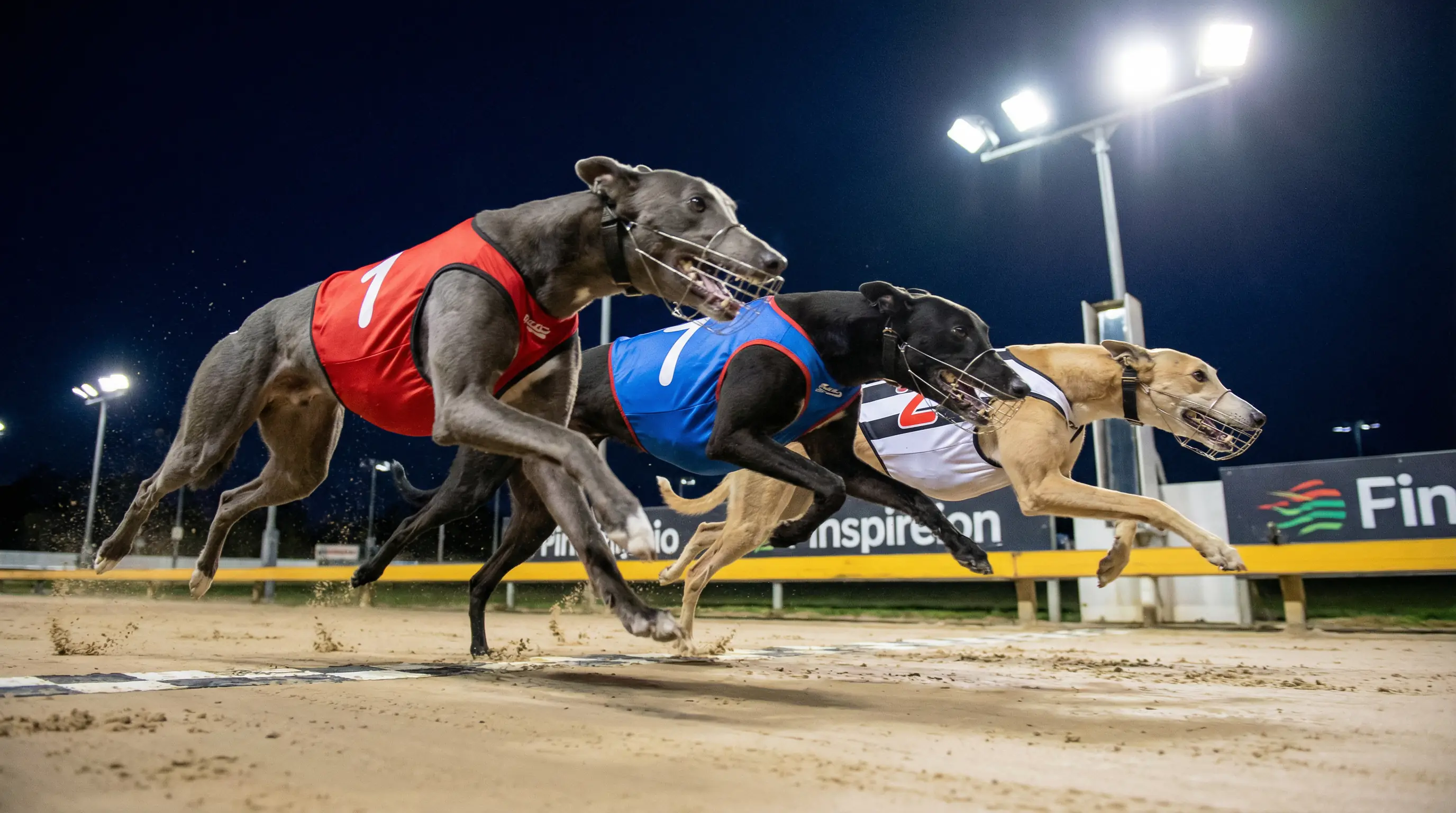
Beyond Win and Place: Predicting the Order
Win bets are about picking winners. Forecast and tricast bets are about reading races — predicting not just which dogs will perform best, but in what order they will cross the line. The distinction is significant because it shifts the skill requirement from simple form assessment to a more nuanced understanding of how a race is likely to unfold. Trap draws, running styles, pace dynamics and first-bend positioning all feed into a forecast or tricast selection in ways that a standard win bet does not require.
In a six-dog race like every round of the English Greyhound Derby, the permutations for forecasts and tricasts are small enough to analyse properly — far smaller than the equivalent in horse racing. This makes greyhound racing one of the few sports where forecast and tricast betting can be approached systematically rather than as a lottery. The returns reflect the difficulty: correctly predicted forecasts and tricasts regularly pay multiples that dwarf standard win payouts.
Straight Forecast Explained
A straight forecast requires you to predict the first and second finisher in exact order. Dog A must win, and Dog B must finish second. If the order is reversed — Dog B wins and Dog A is second — a straight forecast loses. The bet is available on every race at GBGB-licensed tracks and is offered by all major UK bookmakers.
The returns on a straight forecast are calculated using the computer straight forecast (CSF) formula, which is a pool-based dividend determined by the weight of money bet on each possible combination. The CSF payout varies from race to race, depending on how popular the winning combination was with other bettors. A forecast that most punters predicted — say, the 6/4 favourite winning with the 3/1 second favourite in second — might return 8/1 to 12/1. A less popular combination — the 10/1 outsider winning with a 7/1 shot second — might return 40/1 to 80/1.
Some bookmakers also offer fixed-price forecasts, where the odds are set before the race rather than determined by the pool. Fixed-price forecasts give you certainty — you know exactly what you will be paid if you win — but they typically pay slightly less than the CSF dividend. For the Derby, where pool sizes are large and CSF dividends tend to be stable and often generous, the pool option is usually the better choice.
The skill in forecast betting is identifying the likely first and second with enough confidence to commit to their exact order. This comes down to reading the race shape. A front-runner drawn in Trap 1 with dominant early speed is likely to lead. A strong closer drawn in Trap 5 or 6 with the best finishing sectional in the field is likely to fill second place, arriving too late to catch the leader but too fast for the rest. That combination — confident leader, strong finisher in second — is the classic forecast structure in greyhound racing.
Reverse Forecast & Combinations
A reverse forecast covers both possible finishing orders between two dogs. If you select Dog A and Dog B, the reverse forecast wins whether A finishes first and B second, or B finishes first and A second. The cost is double a straight forecast because it is two bets, but it eliminates the need to pick which of your two selections will actually win.
Reverse forecasts are particularly useful in Derby heats where two dogs stand out on form but their running styles make the finishing order hard to predict. If both are front-runners from adjacent traps, the battle for the lead at the first bend could go either way. If one is a railer and the other a wide runner, both may run clean races without interference, and the order depends on which has the better turn of foot on the night. In these scenarios, the reverse forecast captures value from both outcomes.
Combination forecasts extend the principle to three or more dogs. A three-dog combination forecast covers all six possible first-and-second arrangements among your three selections (A-B, B-A, A-C, C-A, B-C, C-B), costing six times a single straight forecast stake. The mathematics scale quickly: a four-dog combination covers twelve arrangements, costing twelve units. The coverage is broad, but the cost adds up, so combination forecasts are best reserved for races where your top three or four selections are clearly separated from the rest of the field — which is common in the later rounds of the Derby.
Tricast Bets: How to Predict the Top Three
A tricast requires you to predict the first, second and third finisher in exact order. It is the most difficult standard bet in greyhound racing, and the payouts reflect that difficulty. Tricast dividends in Derby heats regularly reach three-figure multiples of the stake, and in finals where the finishing order surprises the market, four-figure returns are not unheard of.
The pool-based tricast dividend is calculated the same way as the CSF, using the weight of money on each possible combination. In a six-dog race, there are 120 possible tricast combinations (6 x 5 x 4). Even in a Derby final with heavy betting volume, many of those combinations attract minimal money, which means that an unusual finishing order can produce an enormous dividend. This is the fundamental appeal of the tricast: when the result deviates from the consensus, the payout is disproportionately large.
Combination tricasts — covering all possible arrangements of three named dogs across first, second and third — cost six times a straight tricast stake. This is the most common way to play the tricast in greyhound racing, because predicting the exact order of three dogs over thirty seconds of racing is exceptionally difficult even with strong form analysis. The combination tricast reduces the bet to a simpler question: will these three dogs fill the first three places, in any order? If the answer is yes, you collect.
Selecting your three dogs for a tricast requires a different thought process than selecting a winner. You need to identify the three dogs most likely to occupy the front of the race at the finish, which means assessing not just raw ability but pace dynamics. Two confirmed front-runners in the same tricast may interfere with each other at the first bend, leaving a gap for a closer to slip through. The ideal tricast combination typically includes at least one front-runner (for the pace), one strong finisher (for the closing run), and one consistent dog whose form figures show regular first-to-third finishes regardless of the race dynamics.
Derby-Specific Forecast Strategy
The Derby’s knockout format creates specific conditions that favour forecast and tricast betting in the later rounds. By the quarter-finals, you have seen every surviving dog race at Towcester at least three times. You know their sectional profiles, their trap preferences, their response to crowding, and their running styles under Derby pressure. That accumulated data makes the race shape more predictable — not certain, but predictable enough to narrow the likely first, second and third with reasonable confidence.
The semi-finals are the optimal round for forecast betting. The field is reduced to twelve dogs across two heats of six. Each heat is stacked with proven runners, and the form lines between them are detailed and well documented. The market is tight on win bets — differences of half a length separate the leading contenders — but forecast and tricast dividends can still be substantial because the exact finishing order remains uncertain even among closely matched dogs.
For the final itself, combination tricasts offer the best risk-reward ratio. If your analysis identifies three dogs that you believe will fill the first three positions, a combination tricast at six times a unit stake captures the payout regardless of the order. In a competitive final where six dogs all have a plausible chance, the tricast dividend is likely to be large because the money is spread across many combinations. Your six-unit stake could return hundreds.
One tactical consideration: avoid overcomplicating your selections. The temptation in forecast and tricast betting is to cover more and more combinations, adding dogs and expanding coverage until the cost rivals a standard win bet at much shorter odds. The discipline is in narrowing your selections to the dogs that your analysis genuinely supports, accepting the risk of being wrong rather than diluting your returns by covering every possibility.
Precision Pays — When You’ve Done the Work
Forecast and tricast bets are not for every race or every bettor. They demand a higher level of analysis than a standard win bet, and they lose more often. But in the context of the English Greyhound Derby — where the field is small, the form is deep, the race shape is readable, and the pool dividends are large — they offer returns that no other bet type can match. The punter who correctly identifies the first two or three dogs in a Derby semi-final or final is rewarded not just for knowing who was best, but for understanding how the race was going to unfold. That is a deeper kind of knowledge, and the payout reflects it.