The Numbers That Set the Price
Greyhound racing odds are the market’s best guess at each dog’s chance of winning, expressed in a format that also tells you exactly what you will be paid if your bet lands. Every price you see — whether it is 5/1 at the track, 6.0 on a betting exchange, or SP in the morning paper — represents the same underlying concept: the relationship between your potential profit and your stake. If you cannot read odds fluently, you cannot assess value. And if you cannot assess value, you are donating money to the bookmaker.
UK greyhound racing uses fractional odds as its default format, but decimal odds are increasingly common on online platforms and essential on betting exchanges. Starting price — the official odds at the moment the traps open — carries its own rules and implications. This guide explains all three formats, shows you how to convert between them, and walks through the practical calculations you need for any greyhound bet.
Fractional Odds
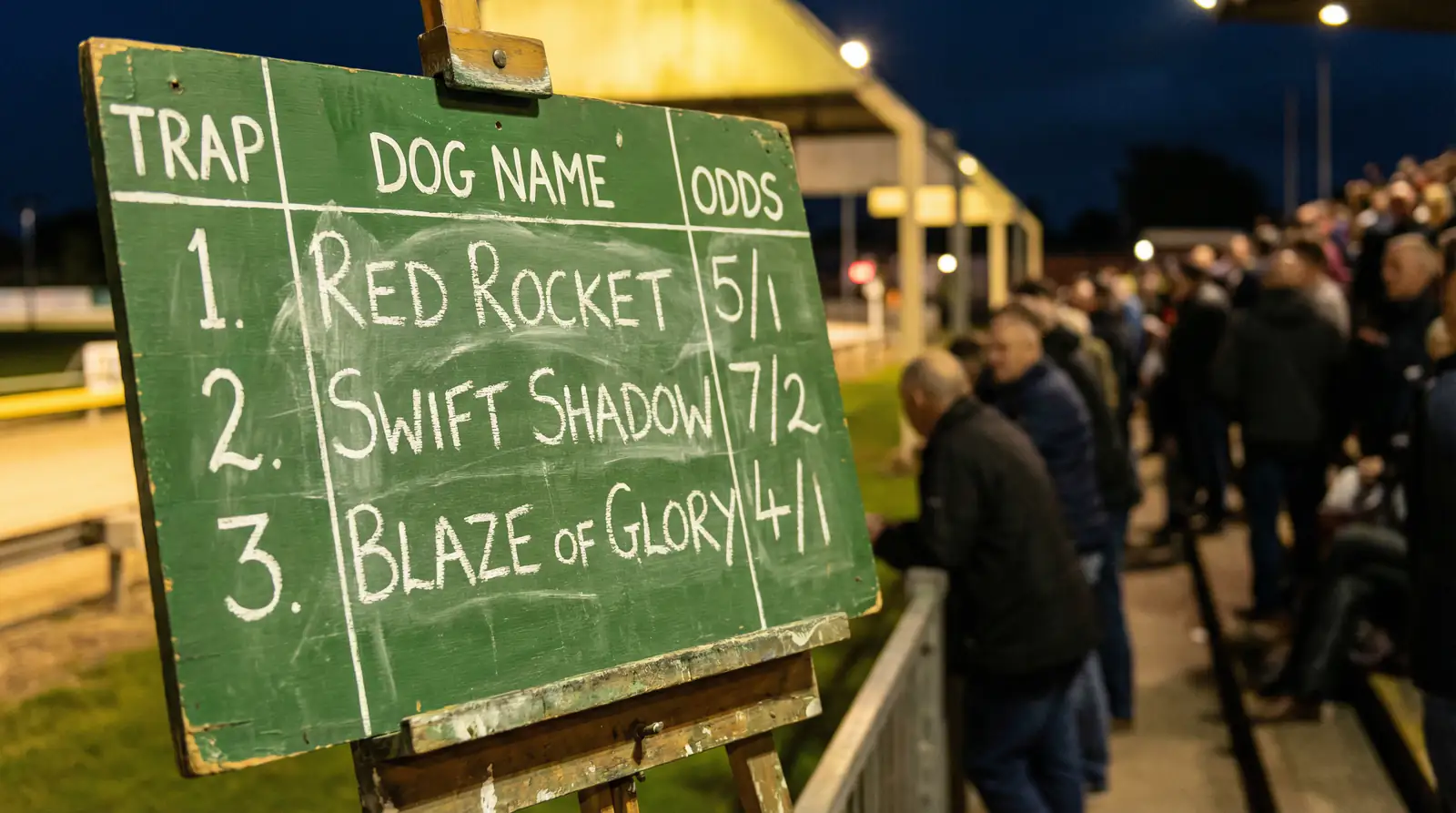
Fractional odds are the traditional British format and the one you will see on course at Towcester, in the Racing Post form guide, and at most high-street bookmakers. They express the profit relative to the stake as a ratio. A dog priced at 5/1 (read “five to one”) pays five pounds of profit for every one pound staked. Your total return is six pounds — the five pounds of profit plus your original one-pound stake back.
The format extends to odds-on prices, where the potential profit is less than the stake. A dog at 4/6 pays four pounds for every six staked — a profit of 67 pence per pound. These odds-on prices typically apply to strong favourites in Derby heats, where one dog is clearly superior to its opposition on form. The shorter the price, the higher the market’s confidence in the dog — and the lower the reward for being right.
A few fractional odds commonly seen in greyhound racing are worth memorising. Evens (1/1) means your profit equals your stake. 2/1 doubles your money. 10/1 returns eleven pounds for every pound staked. 33/1 — a price you might see on a Derby outsider in the ante-post market — returns thirty-four pounds per pound. The ability to instantly calculate these returns in your head is a basic but essential skill. If you need to reach for a calculator every time you see a price, you are operating too slowly for a market that moves in real time.
One quirk of fractional odds: they are not always expressed in their simplest form. A price of 6/4 is mathematically identical to 3/2 and represents the same thing — 1.5 times your stake as profit. Both expressions are used interchangeably in UK greyhound racing. Similarly, 11/8 and 100/30 appear regularly and require a moment’s mental arithmetic to convert to a clean return figure.
Decimal Odds & Conversion
Decimal odds are the standard format on betting exchanges and are used as the default on many European and international bookmaker platforms. They express the total return per unit staked, including the stake itself. A dog at decimal odds of 6.0 returns six pounds for every pound staked — which is identical to fractional odds of 5/1 (five pounds profit plus the one-pound stake).
Converting between the two formats is simple. To go from fractional to decimal: divide the first number by the second and add one. So 5/1 becomes (5/1) + 1 = 6.0. And 11/4 becomes (11/4) + 1 = 3.75. To go from decimal to fractional: subtract one, then express the result as a fraction. Decimal 3.5 becomes 3.5 – 1 = 2.5, which is 5/2 in fractional form.
Decimal odds have one significant practical advantage: they make it easier to compare prices quickly and to calculate combined returns on multiple bets. If you are placing an accumulator or assessing the implied probability of a field, decimal odds require less arithmetic. The implied probability of any decimal price is simply 1 divided by the odds: a dog at 4.0 has an implied probability of 25% (1/4). A dog at 10.0 has an implied probability of 10% (1/10). This makes it straightforward to assess whether a bookmaker’s prices add up to more or less than 100% — and how much margin (overround) has been built in.
Most online bookmakers allow you to toggle between fractional and decimal displays in your account settings. For greyhound betting, either format works — but being comfortable with both is essential if you use exchanges (which display decimal only) alongside traditional bookmakers (which default to fractional).
Starting Price vs Board Price
The starting price — commonly abbreviated to SP — is the official odds assigned to each dog at the moment the traps open. It is determined by on-course bookmakers (where they exist) or by an industry formula based on the weighted average of prices offered by major bookmakers at race time. When you see “SP” on a betting slip or a race result, it means the bettor accepted whatever odds were available at post time rather than taking a fixed price in advance.
The board price, by contrast, is the fixed price you see on the bookmaker’s board or screen at the time you place your bet. If you back a dog at 5/1 an hour before the race and the SP turns out to be 3/1, you keep your 5/1. If the SP turns out to be 8/1, you are stuck with 5/1 — unless you have Best Odds Guaranteed (BOG), which pays you whichever is higher.
The strategic decision between SP and board price depends on the specific situation. In most graded races, the market is relatively stable and the SP is close to the early prices, making the choice largely academic. In Derby heats and finals, however, the market can move sharply in the minutes before the off — driven by large bets from professional punters or late information about a dog’s condition. In these situations, taking an early board price on a dog you expect to shorten can be highly profitable. Conversely, if you believe a dog is likely to drift (its odds increase), waiting for SP — or placing your bet closer to the off — may yield a better price.
The rule of thumb for Derby betting: take early prices when you have strong conviction and expect the market to move in the dog’s favour. Take SP when you are uncertain about market direction or when you want to see how the betting develops in the final minutes. And always use a bookmaker offering BOG on greyhounds if possible, because it eliminates the downside of taking an early price that turns out to be shorter than the SP.
Calculating Returns on Greyhound Bets
The return calculation for a single win bet is straightforward: stake multiplied by the odds, plus the stake back. A ten-pound bet at 7/2 returns (10 x 3.5) + 10 = 45 pounds. In decimal terms, the same bet at 4.5 returns 10 x 4.5 = 45 pounds. The figure is identical because the formats describe the same thing.
For each-way bets, the calculation splits into two parts. The win part pays at full odds if the dog finishes first. The place part pays at a fraction of the odds (typically 1/4 in a six-dog race) if the dog finishes first or second. So a ten-pound each-way bet at 8/1 costs twenty pounds total. If the dog wins, the return is (10 x 8) + 10 for the win part, plus (10 x 2) + 10 for the place part — a total of 120 pounds. If the dog finishes second, only the place part pays: (10 x 2) + 10 = 30 pounds.
Forecast and tricast returns are not calculated from fixed odds. They are paid as a dividend from the Tote pool, which means the return depends on how much money was wagered on each possible combination. You will not know the exact payout until after the race. This unpredictability is part of the attraction — and the risk — of forecast betting.
For accumulator bets (parlaying multiple selections across different races), the return is calculated by multiplying the decimal odds of each selection together and applying that multiplied figure to the stake. Two selections at 3.0 and 4.0 give a combined decimal of 12.0, so a ten-pound accumulator returns 120 pounds if both selections win. Accumulators amplify returns but also amplify risk — one losing leg and the entire bet is void.
The Odds Are Information, Not Instruction
Every set of odds you encounter in greyhound racing — fractional, decimal, SP, or ante-post — encodes the market’s current opinion about a dog’s winning chance. That opinion is derived from form data, trainer reputation, track suitability, trap draw and the weight of money in the market. It is not fact. It is consensus, and consensus is frequently wrong.
Understanding odds formats is a prerequisite for greyhound betting, not a strategy in itself. The strategy comes from knowing when the odds are wrong — when a dog’s true probability of winning is higher than the price implies, or when the market has overreacted to a single piece of information and created value on the other side. Odds tell you what the market thinks. Your job is to decide whether the market is right.