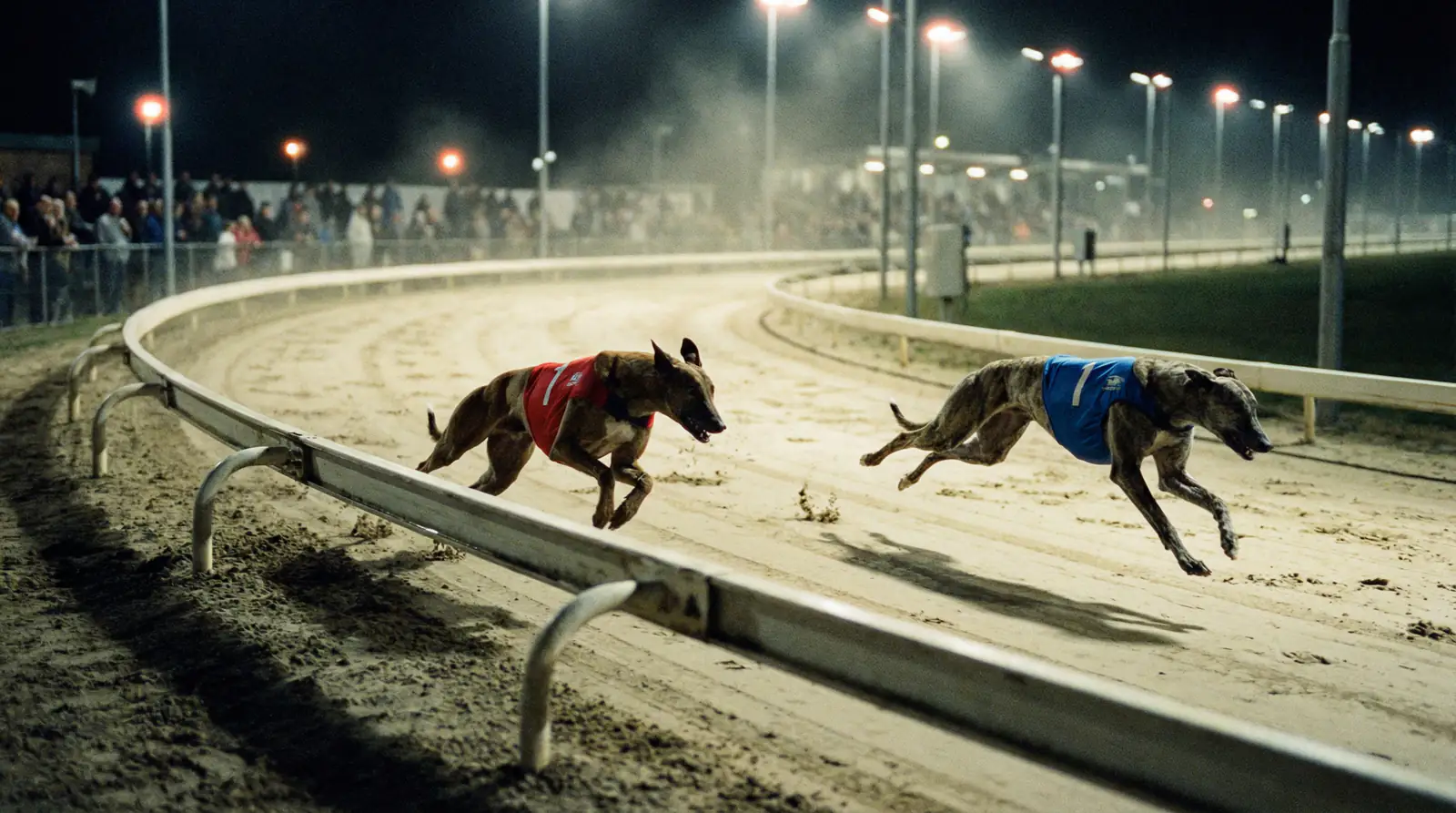
How a Dog Runs Matters More Than How Fast
Every greyhound has a preferred way of racing. Some hug the inside rail from the moment the traps open. Others swing wide on the bends, covering extra ground but avoiding the congestion that costs time along the rail. Some lead from start to finish. Others sit off the pace and produce a burst of speed in the closing stages. These running styles are not preferences in the way a human runner might choose a strategy — they are hardwired tendencies, shaped by a dog’s physical build, its temperament, and its early racing experiences.
For Derby betting, running style is the variable that connects trap draw, form figures and sectional times into a coherent picture. A dog’s form line may look inconsistent until you overlay its running style and the traps it drew in each race. A confirmed railer that finished fourth from Trap 5 ran a completely different race from the same dog finishing first from Trap 1. The form figures are 4 and 1. The dog’s ability did not change. Its running style interacted with its trap draw to produce two different outcomes.
Inside Railers
Railers are dogs that instinctively run close to the inside rail. From the moment they exit the trap, they angle toward the rail and hold that line through the bends and into the finishing straight. On the race card, this style is typically indicated by the comment “rls” (rails) in the post-race notes.
The advantage of railing is distance. The inside rail is the shortest route around the track. A dog that holds the rail through both bends covers less ground than a dog running two or three lanes wide, and over 500 metres, the distance saving can amount to several lengths. At a track like Towcester, where the bends are wide and the circumference is generous, a committed railer can save three to five metres per lap compared to a dog running in the middle of the track.
The disadvantage is vulnerability to crowding. The rail is where the traffic is densest, particularly at the first bend where multiple dogs converge toward the inside. A railer drawn in Trap 1 has a clear path to the rail. A railer drawn in Trap 4 or 5 has to cut across the field to reach it, and in doing so it risks being bumped, checked, or forced to break stride. This is why railers drawn wide show such inconsistent form — their ability has not changed, but their access to their preferred running line has been compromised.
For Derby betting, a confirmed railer drawn in Trap 1 or 2 is a stronger proposition than its raw form alone might suggest. The market usually adjusts for this to some degree, but not always fully, especially in the opening rounds where the random trap draw throws up plenty of mismatches.
Wide Runners
Wide runners take the opposite approach, racing two or three lanes off the inside rail. They sacrifice the distance advantage of the rail in exchange for clean running room. On the card, this style is noted as “wide” or sometimes “mid to wide.”
The benefit of running wide is freedom from interference. A dog that takes the bends in the outside lanes rarely encounters the crowding that plagues railers, and it can maintain its stride pattern without the interruptions caused by checking, bumping or being squeezed against the rail. At Towcester, where the bends are sweeping rather than tight, the distance penalty for running wide is smaller than at most tracks — perhaps one or two lengths per lap rather than three or four. This makes Towcester a comparatively favourable venue for wide runners.
The trade-off is that wide runners need more raw speed to compensate for the extra ground they cover. A dog that runs two metres off the rail for the entire 500-metre trip covers roughly eight to ten additional metres compared to a railer. Over a race decided by a length, that is a significant disadvantage. Wide runners that win the Derby tend to be exceptionally fast dogs — fast enough that the extra distance does not matter because they have more speed in reserve than their rivals.
From a betting perspective, wide runners are best assessed by their sectional times rather than their finishing positions. A wide runner that finishes third but posts the fastest closing sectional may actually be the best dog in the race — it covered more ground, encountered no trouble, and still finished within a length of the winner. If that dog draws a trap that suits its style in the next round — typically Trap 5 or 6, where it has room to run wide from the start — its finishing position may improve dramatically.
Front-Runners & Closers
The distinction between front-runners and closers describes pace preference rather than track position. A front-runner aims to lead from the first bend to the line. A closer sits behind the pace, conserving energy, and produces its strongest effort in the final hundred metres. Both styles can be combined with railing or running wide — you can have a front-running railer or a closing wide runner, and the combination determines how a dog is likely to race from any given trap.
Front-runners in the Derby need two things: early speed from the trap (a fast first-bend sectional) and enough stamina to maintain their advantage through 500 metres of competitive racing. The risk for front-runners is that the pace they set takes more out of them than it does of the dogs sitting behind. In the later rounds of the Derby, where every dog is fast and the closing sectionals of rivals are strong, a front-runner that dominated early-round heats may find its lead eroded in the final stages.
Closers, by contrast, rely on the pace being set by others. They need a fast dog in front to establish a tempo, and they need the closing speed to overhaul that dog in the run to the line. The risk for closers is that if no one sets a strong pace — if the front-runners are cautious or encounter trouble — the closer never gets the opportunity to use its finishing speed. It ends up running a moderate race because the conditions for its best performance never materialised.
The Derby final, with six high-quality dogs all racing at maximum effort, tends to produce a genuinely fast pace from the start. This generally favours closers, because the front-runners expend more energy establishing and maintaining the lead against strong opposition. Four of the last six Derby winners at Towcester have been dogs that were at or near the back of the field at the first bend and closed rapidly in the straight. The market knows this — which is why confirmed closers in the Derby tend to be shorter priced than their overall form might suggest.
How Running Style Interacts with Trap Draw
The combination of running style and trap draw is the single most important factor in predicting how a Derby heat will unfold. A front-running railer drawn in Trap 1 has the ideal setup: fast break, immediate rail access, clear run to the first bend, and every opportunity to establish an unassailable lead. A closing wide runner drawn in Trap 6 has an equally comfortable setup: room to break wide, no need to contest the first bend, and the space to build momentum into the finishing straight.
The problems arise when style and trap conflict. A railer drawn in Trap 6 faces a chaotic first bend, cutting across the field to reach the rail while five other dogs are establishing their positions. A front-runner drawn in Trap 4 — boxed between dogs on both sides — may not get the clean break it needs to lead. These style-draw mismatches are where the form guide lies most frequently, because a dog’s recent result reflects the draw it faced as much as its underlying ability.
The practical framework for Derby betting is to build a simple matrix for each heat: list the six dogs, note their running style (railer, wide, front-runner, closer, or a combination), and assess whether their trap draw supports or conflicts with that style. The dogs whose style aligns with their draw are the most likely to reproduce their best form. The dogs facing a mismatch are more likely to underperform — and if the market has not accounted for the mismatch, they may be overpriced. Conversely, a dog whose previous poor result was caused by a style-draw conflict, now drawn in a more favourable position, may be underpriced.
Style Is the Variable Most Punters Ignore
Running style is visible to anyone who reads the race card comments or watches the live stream. It is not hidden data. But it is the variable that casual bettors most consistently overlook, because it requires an extra step of analysis — connecting the style to the trap, the trap to the likely race shape, and the race shape to the probable finishing order. Most punters skip that step and bet on times, form figures or instinct.
That analytical gap is where the edge lives. In a six-dog Derby heat, correctly identifying how running styles will interact at the first bend — which dog will lead, which will rail, which will be forced wide — allows you to predict the race shape with a level of confidence that pure form analysis cannot match. Style does not override ability. The fastest dog still wins most of the time. But when two dogs are closely matched on ability, the one whose style is best served by the draw is the one that will cross the line first.