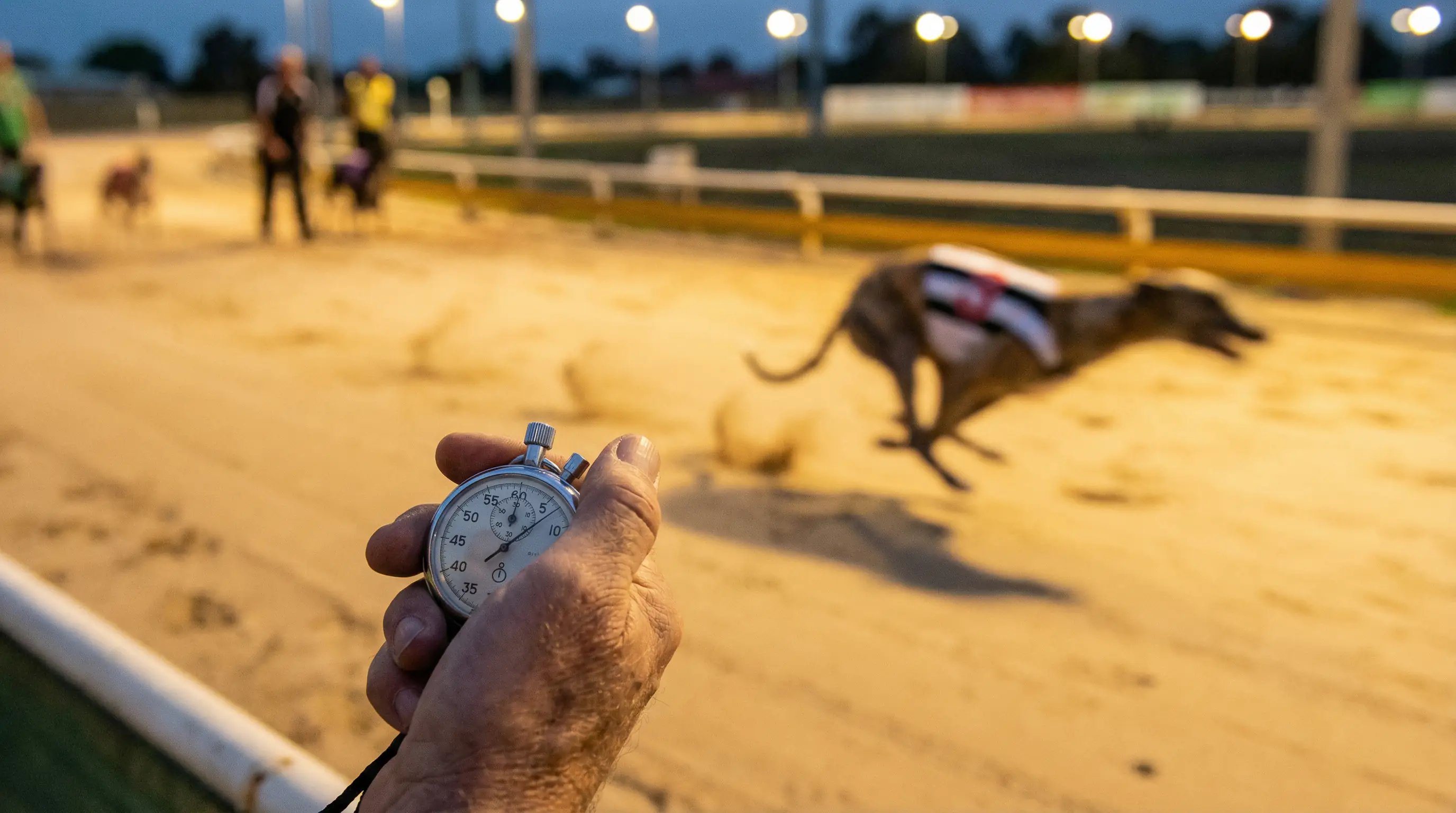
The Split That Splits the Field
Overall finishing times tell you how fast a greyhound ran a race. Sectional times tell you how it ran the race. That distinction is everything in Derby betting, because two dogs can cross the line in 28.70 seconds and have run completely different races — one leading from trap to line, the other checked early, forced wide and closing rapidly in the final hundred metres. The overall clock treats them as equals. The sectionals reveal that one dog had more in reserve.
Sectional timing breaks the race into segments, typically measured at fixed points around the track. At Towcester, the key sectional split is between the run to the first bend and the run from the last bend to the finishing line. These two phases of a 500-metre race correspond to distinct physical demands: acceleration and tactical positioning in the first phase, sustained pace and stamina in the second. The dogs that excel in both phases are the ones that win the Derby. The dogs that excel in one but not the other are the ones that offer value — because the market frequently prices on overall time alone.
What Are Sectional Times
Sectional times are intermediate time splits recorded at specific points during a greyhound race. The technology varies by track — some use electronic timing beams at fixed positions, others rely on calculated times derived from overall finishing positions and a mathematical model. At the most advanced tracks, timing beams at two or three points around the circuit allow the race to be broken into distinct phases: the run to the first bend, the middle section through the bends, and the closing run to the line.
In the context of the English Greyhound Derby at Towcester, the most commonly referenced sectional is the “run-up” time — the time from the traps opening to the dog reaching the first bend. This is sometimes called the “first-bend sectional” and it measures raw early speed: how quickly the dog exits the trap, accelerates, and reaches the point where the track begins to curve. A fast first-bend sectional indicates a dog with explosive pace that is likely to be at or near the front entering the first turn. A slower first-bend sectional, coupled with a fast overall time, indicates a dog that recovers ground in the latter stages of the race.
The complementary measure is the “closing sectional” or “finishing sectional” — the time taken to cover the final straight from the last bend to the line. This measures finishing speed and stamina. Dogs with strong closing sectionals are the ones that keep accelerating when others are tiring, and they tend to perform well in the later rounds of the Derby when cumulative fatigue thins the field.
First-Bend Sectional vs Finishing Sectional
The relationship between these two sectionals defines a greyhound’s racing profile. A dog with a fast first-bend sectional and a slow finishing sectional is a front-runner that fades. A dog with a slow first-bend sectional and a fast finishing sectional is a closer that relies on late pace. A dog that posts competitive times in both phases is the complete package — and is typically the one the market prices accordingly.
For Derby betting, the finishing sectional is generally the more valuable piece of data. Here is why. The Derby is a knockout competition run over five weeks, and the dogs that survive to the final have typically raced five times in quick succession. Physical fatigue accumulates. Early speed tends to deteriorate faster than closing speed, because the explosive muscle fibres responsible for trap speed are the first to tire under repeated strain. A dog that relies purely on breaking fast and leading from the front may perform brilliantly in the opening rounds but find its first-bend sectional slipping by the semi-finals. A dog whose strength is a strong closing sectional — one that can maintain its finishing pace even after several hard races — holds its form deeper into the competition.
This is not a universal rule. Some front-runners have the constitution to maintain their early speed across five weeks, and they win Derbies too. But when two dogs have similar overall times, the one with the stronger finishing sectional is, on balance, the safer bet to sustain its form through the later rounds. The market does not always price this correctly, particularly in the early stages of the competition when overall times attract more attention than sectional splits.
The practical application is to compare sectional profiles within each Derby heat. If you are assessing a six-dog race and two dogs have posted similar overall times, check their sectional breakdown. The dog with the faster closing sectional is more likely to finish strongly, particularly in a heat where the pace is set by another runner. The dog with the faster first-bend sectional is more likely to lead, but also more vulnerable to trouble at the first turn if it fails to clear the field.
How Sectionals Identify Hidden Form
The real power of sectional analysis is in exposing form that the raw results conceal. Consider a dog that finishes fourth in a Derby heat with an overall time of 29.10 — on the surface, a moderate performance. But if its closing sectional was the fastest of the six runners, it tells you the dog encountered trouble early (probably visible in the race comments as “crd 1st” or “blk 2nd”) and was making up ground rapidly in the closing stages. That dog ran a better race than the result suggests, and if it draws a more favourable trap in the next round, it may win comfortably.
The reverse scenario is equally important. A dog that wins a heat in 28.60 with the fastest first-bend sectional but the slowest closing sectional got to the front early and held on. It may have been tiring in the final fifty metres, and a faster-closing rival might have caught it with another ten metres of track. In the next round, against stronger opposition that pushes the early pace harder, that dog’s finishing weakness may be exposed. The winning time looked impressive. The sectional profile suggests vulnerability.
Sectionals also reveal which dogs are running within themselves. A greyhound that posts a moderate overall time but with evenly distributed sectionals — neither pushing hard early nor accelerating late — may be a dog that its trainer is deliberately holding back, conserving energy for later rounds. This is common practice among experienced Derby trainers, who understand that a dog does not need to win every heat in record time. It just needs to qualify. If a dog’s sectionals suggest it has gears it has not yet shown, its current ante-post price may not reflect its full ability.
Using Sectionals for Derby Betting
The practical framework for using sectionals in Derby betting is straightforward. After each round, compile the first-bend and finishing sectionals for every surviving dog. Rank them separately. The dogs that appear in the top third of both lists are the strongest overall runners in the competition. The dogs that appear in the top third of the finishing-sectional list but not the first-bend list are the potential improvers — closers whose overall times may not yet reflect their best performance.
Cross-reference your sectional rankings with the trap draws for the next round. A dog with a strong closing sectional drawn in Trap 6 — where it has room to run wide and build momentum into the finish — is a stronger proposition than the same dog drawn in Trap 1, where it may be boxed in against the rail and unable to use its finishing pace. Sectionals and trap draw interact constantly, and the punters who combine both datasets have a material advantage over those who consider them in isolation.
One final note: sectional data is not always publicly available in the same way that overall times are. Some specialist form services and racing databases publish sectionals for major meetings, and the Derby at Towcester is well covered. But you may need to subscribe to a service or consult specialist analysts to access the full sectional breakdown for every round. The investment is worth it if you are betting seriously on the Derby, because the sectional data is the closest thing to an analytical edge that the average punter can access without insider information.
The Clock Doesn’t Lie — But It Doesn’t Tell the Whole Truth
Overall times are useful. Sectional times are more useful. But neither replaces watching a race and understanding the context behind the numbers. A fast closing sectional recorded on a night when the sand was drying and the going was turning in favour of late runners is not the same as the same sectional on heavy ground, where every dog struggled in the closing stages. Times are data points, and data points require interpretation.
What sectionals offer is a layer of analysis that most punters do not bother with. They separate the dogs that looked good from the dogs that were good. In a competition as tightly contested as the English Greyhound Derby, that separation is often worth several points of value in the betting market. The clock runs the same for every dog. What matters is how each dog uses the time it has.