The Starting Box That Changes Everything
In greyhound racing, the trap draw is the single variable that punters most consistently underweight. Every dog in a six-runner race is assigned a starting trap numbered one through six, and that number dictates its position across the track at the moment the lids fly open. Trap 1 is closest to the inside rail. Trap 6 is widest. The distance between them is measured in feet, but the consequences are measured in finishing positions.
Trap draw matters because greyhound racing is a short-distance sport decided in tight margins. Over 500 metres at Towcester, the winning margin in a typical Derby heat is a length or less. A dog that gets a clean run to the first bend from a favourable inside trap can establish a position that it never relinquishes. A dog drawn wide — forced to cover extra ground on the first turn — may run a faster raw time and still finish behind a slower dog that held the rail throughout. For bettors, ignoring trap draw is like ignoring the starting grid in Formula One.
This guide explains what the trap draw is, how it works in practice, and what the statistics tell us about which traps produce winners at different tracks.
What Is a Trap Draw
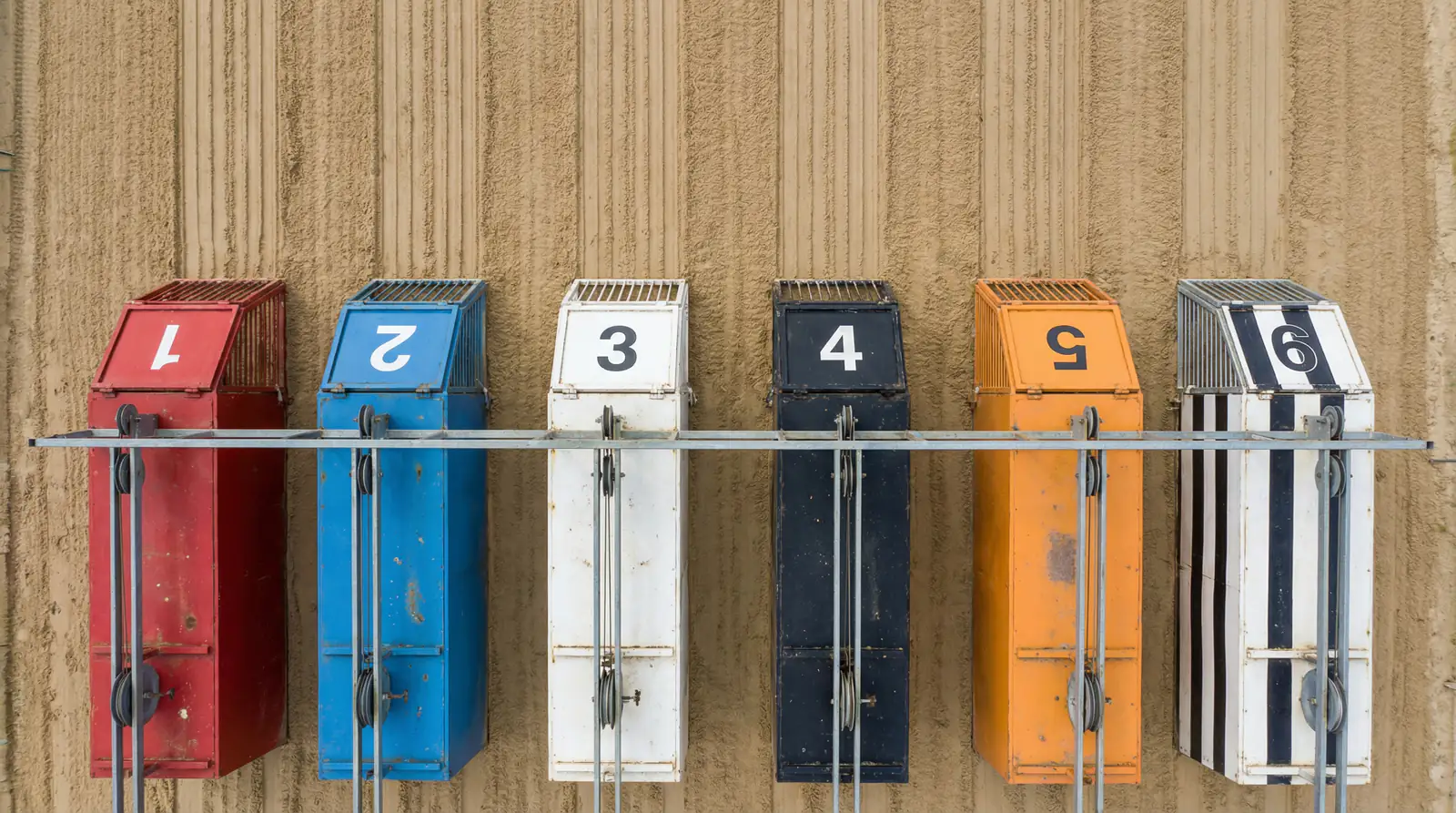
The trap draw is the allocation of starting boxes to each dog in a race. In UK greyhound racing, there are six traps, numbered one to six from the inside rail outward. Each trap is painted a standard colour — red for Trap 1, blue for Trap 2, white for Trap 3, black for Trap 4, orange for Trap 5, and black-and-white stripes for Trap 6. The dogs wear racing jackets matching their trap colour, which makes them identifiable to spectators and bettors during the race.
In standard graded racing — the everyday meetings at tracks around the UK — the trap draw is managed by the racing manager with some consideration of each dog’s preferred running style. Railers (dogs that prefer to run close to the inside rail) are more likely to be drawn in the lower traps, while wide runners are more likely to be drawn outside. This is intended to reduce crowding and produce safer, more competitive racing.
In the English Greyhound Derby and other open races, the draw is random. Dogs are assigned traps without reference to their running style. This creates the possibility that a committed railer ends up in Trap 5 or 6, facing the prospect of either cutting across the field to reach the rail — risking interference — or running wide for the entire race. Equally, a wide runner drawn in Trap 1 may find itself boxed in against the rail with no room to express its natural stride. These mismatches between running style and trap are where some of the biggest Derby betting opportunities — and upsets — originate.
Inside vs Outside: Statistical Breakdown
Across UK greyhound racing as a whole, Trap 1 produces more winners than any other box. This is not surprising: the inside trap offers the shortest route to the first bend, immediate access to the rail, and protection from interference on the left-hand side (since there is no dog to its inside). Aggregate data from GBGB-licensed tracks typically shows Trap 1 winning around 18-20% of races, slightly above the expected 16.7% share in a six-dog race.
Trap 2 and Trap 3 also tend to outperform their expected share, though by smaller margins. The middle traps — 3 and 4 — are generally the most neutral positions, where a dog’s raw ability and early speed matter more than positional advantage. Trap 5 and Trap 6 are statistically the weakest in terms of overall win percentage, though the margin varies significantly by track. At circuits with tight bends, Trap 6 is a clear disadvantage. At tracks with wider, more sweeping turns, the outside draw matters less.
The important qualification is that these are aggregate figures. They describe the average outcome across thousands of races at dozens of tracks. For Derby betting, the numbers that matter are track-specific — and Towcester is not an average track.
Towcester was purpose-built in 2014 with some of the widest bends in British greyhound racing. (Towcester Racecourse) The designers explicitly intended to minimise trap bias and reduce crowding at the first turn. The result is a track where the statistical advantage of inside traps is smaller than at tighter circuits like Romford or Crayford. Trap 1 still outperforms at Towcester, but the margin is narrower, and Trap 6 performs closer to its expected share than it does at most other venues. This is one of the reasons why the Derby at Towcester tends to produce more competitive finals — the draw, while still relevant, does not dominate the outcome the way it might at a tighter track.
How Trap Draw Affects Running Lines
The mechanical impact of trap draw is straightforward, but the racing impact is more nuanced. When the traps open, six dogs accelerate simultaneously. Within the first few strides, their natural running styles begin to assert themselves: railers angle toward the inside rail, wide runners drift toward the outside, and front-runners try to establish an early lead regardless of trap position.
The critical moment occurs at the first bend. If a railer is drawn inside — say, Trap 1 or 2 — it can take the bend on the rail without interference. If that same railer is drawn in Trap 5, it has to cut across the path of three or four other dogs to reach the rail. This frequently causes crowding, known as “trouble at the first bend,” which is one of the most common causes of form reversal in greyhound racing. A dog can have outstanding form over the distance and still run badly if it gets checked or bumped at the first turn.
Wide runners face the opposite problem. A dog that naturally runs two or three lanes off the rail needs room to its outside. Drawn in Trap 6, it has that room. Drawn in Trap 1, it either has to run against its natural instincts or push outward through traffic, losing ground. The trap draw does not just affect the physical distance a dog covers — it affects the psychological comfort of the dog and the likelihood of a clean, uninterrupted run.
For bettors, the practical application is to cross-reference a dog’s preferred running style (visible from its form comments — “rls” for rails, “wide” for wide runner, “mid” for middle track) with its trap draw in any given race. A confirmed railer drawn in Trap 1 is a stronger proposition than the same dog drawn in Trap 5, even if the raw form is identical. The market adjusts for this to some extent, but not always fully — particularly in the opening rounds of the Derby, where the random draw throws up mismatches that the odds do not fully reflect.
Track-Specific Trap Bias
Every greyhound track in Britain has its own trap bias profile, shaped by the circumference, bend tightness, hare rail position and surface type. What works at one track does not necessarily apply at another, and treating trap statistics as universal is a common mistake.
At tighter tracks like Romford (circumference 345 metres) and Crayford (370 metres), the inside traps have a pronounced advantage because the bends are sharp and the run to the first turn is short. Dogs drawn wide have to cover significantly more ground, and the crowding at the first bend is often severe. At these venues, Trap 1 can win 22-24% of races — well above its expected share.
At larger tracks like Towcester (420 metres circumference), the wider bends reduce the distance penalty for outside traps. The run to the first bend at Towcester is longer than at most circuits, which gives dogs more time to sort into their preferred positions before the crowding intensifies. The outside Swaffham hare at Towcester also influences running lines: dogs tend to drift slightly wider on the bends because the hare runs on the outside of the track rather than the inside. This subtly benefits dogs drawn in the higher traps.
For Derby betting specifically, the takeaway is this: do not apply generic trap statistics to Towcester. Use Towcester-specific data from the 500-metre distance. A dog drawn in Trap 6 for a Derby heat at Towcester is not facing the same disadvantage as a Trap 6 draw at Crayford. Adjust your assessment accordingly, and look for the market’s failure to make that distinction — because it often does not.
The Trap Isn’t the Whole Story
Trap draw is a significant variable, but it is not a verdict. The best greyhound in a six-dog race can win from any trap if it has enough quality, enough early pace, or enough finishing speed to overcome a positional disadvantage. Droopys Plunge won the 2025 Derby from Trap 4 — a middle draw that theoretically offers neither the rail advantage of Trap 1 nor the wide room of Trap 6. He won because he had the talent and the tactical sense to find racing room when it mattered.
The right approach is to treat trap draw as one factor in a multi-variable assessment. It should influence your confidence in a selection, adjust the odds at which you are willing to bet, and flag potential risks in otherwise strong form profiles. But it should not replace form analysis, sectional time data, or running style assessment. A dog with brilliant form and an unfavourable draw is not a write-off — it is a dog whose price may have drifted to a point where it offers value precisely because less informed punters have overreacted to the trap number.