

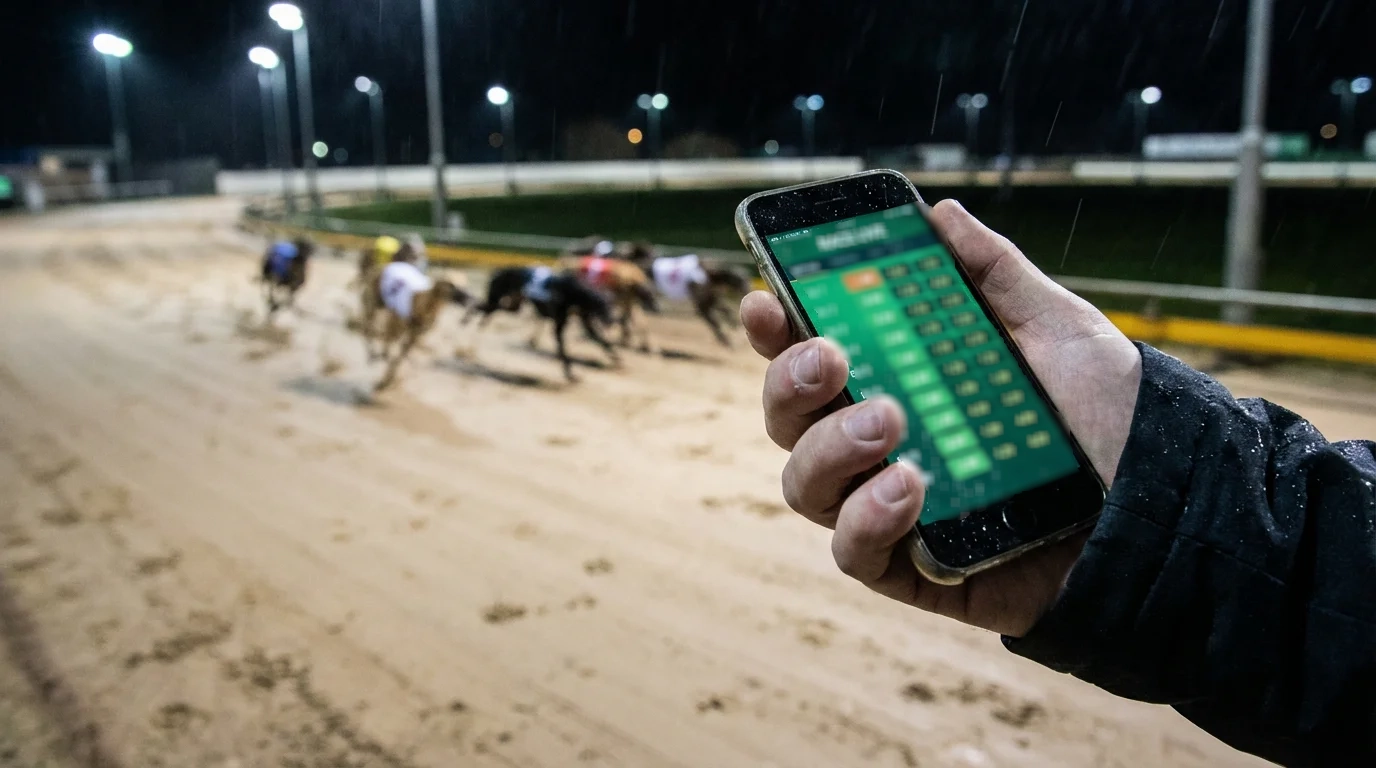
Betting at the Speed of the Race
A greyhound race over 500 metres lasts approximately thirty seconds. That is the window in which in-play betting operates — and it is both the appeal and the constraint. In-play greyhound betting is the fastest live betting market in any sport, and it is not for everyone. The margin for decision-making is measured in fractions of a second, the information available is visual rather than statistical, and the price movements are extreme. A dog leading at the first bend might trade at 1.3 on a betting exchange. If it is bumped at the second bend, it might be 5.0 before you blink.
For most Derby bettors, the value lies in pre-race analysis — the work done before the traps open. But for a specific subset of punters, particularly those using betting exchanges, in-play trading offers a way to manage positions, lock in profits and hedge pre-race bets in real time. This guide explains how it works, what markets are available, and when it makes sense to engage with the in-play market rather than the pre-race one.
How Live Greyhound Betting Works
In-play betting on greyhound racing is primarily available through betting exchanges — platforms where you bet against other punters rather than against a bookmaker. The largest exchange markets for UK greyhound racing carry sufficient liquidity for the Derby’s later rounds, though everyday graded meetings rarely generate enough in-play volume for meaningful trading.
The mechanics are simple. Before the race, you can back a dog at the available odds or lay it (bet against it). Once the traps open, the odds begin to move in real time based on what is happening on the track. A dog that breaks well and leads at the first bend sees its in-play odds shorten dramatically — from, say, 4.0 pre-race to 1.5 in-play. A dog that stumbles at the traps or is checked at the first bend sees its odds lengthen from 4.0 to 15.0 or higher.
The in-play market on exchanges remains open for the entire duration of the race, though most activity occurs in the first ten to fifteen seconds — between the traps opening and the dogs emerging from the second bend. By that point, the likely finishing order is usually apparent, and the odds reflect it. The final seconds of the race produce minimal trading because the outcome is effectively decided.
Traditional bookmakers also offer some in-play greyhound markets, but these are typically more limited. Most bookmaker in-play markets close within a few seconds of the traps opening, or they offer cash-out functionality on pre-race bets rather than a full in-play betting interface. For genuine in-play trading — entering and exiting positions during the race — an exchange account is essentially required.
In-Play Markets & Timing
The in-play market for a greyhound race has a distinct rhythm. Before the traps open, the pre-race market is active and liquid, with odds moving in response to money flow. The moment the traps open, there is a brief pause — typically one to two seconds — as the live feed reaches viewers and the market adjusts to the initial trap break. Then the first wave of in-play activity begins.
The most significant price movement occurs at the first bend. This is the moment when the race takes shape: the leader emerges, the also-rans are shuffled back, and any interference or crowding becomes visible. A dog that negotiates the first bend cleanly in front will see its in-play odds halve or more. A dog that is badly crowded will see its odds multiply several times over. For in-play traders, the first bend is the event — the point at which the pre-race position is either confirmed or invalidated.
The second bend produces a smaller price adjustment. By this point, the running order is largely established, and the odds reflect the likely finishing positions with reasonable accuracy. Dogs in first or second place trade at very short prices (1.1 to 1.5), while dogs in fourth, fifth or sixth trade at long odds or are virtually ignored by the market.
The final straight — the last hundred metres — produces almost no meaningful in-play trading. The outcome is too obvious, the odds are too short on the leader, and the time available is too brief. Any in-play activity in the final seconds is either automated trading algorithms completing their positions or punters who have delayed their exit past the optimal point.
Exchange Trading During Races
The practical application of in-play greyhound trading is not to pick winners during the race. It is to manage risk on pre-race positions. The typical in-play trading strategy works like this: you back a dog pre-race at, say, 6.0 (5/1). The dog breaks well, leads at the first bend, and its in-play price shortens to 2.0 (1/1). You then lay the dog at 2.0, locking in a profit regardless of whether it wins or loses.
If it wins, you win the back bet at 6.0 and lose the lay bet at 2.0, for a net profit. If it loses, you lose the back bet but win the lay bet, also for a net profit (though a smaller one). The exact figures depend on the stakes and the prices, but the principle is the same: by trading in-play, you convert an uncertain pre-race position into a guaranteed profit once the race develops in your favour.
This strategy requires discipline, fast execution, and a live stream with minimal delay. A one-second lag between the live action and your screen can mean the difference between laying at 2.0 and laying at 1.5, which significantly affects the profit profile. For the Derby final, where exchange liquidity is at its highest and the stakes are meaningful, in-play trading is a viable approach for experienced exchange users. For everyday meetings, the liquidity is often too thin for reliable execution.
When In-Play Beats Pre-Race
In-play betting is not inherently superior to pre-race betting. For the vast majority of greyhound bettors, pre-race analysis and execution will produce better results. The form study, the trap draw assessment, the sectional analysis — all of this is pre-race work, and it forms the basis of any edge you might have. In-play trading is a secondary tool that manages positions you have already established.
The specific scenarios where in-play adds value are limited. First, hedging a strong ante-post position: if you backed a dog at 20/1 ante-post and it reaches the final, you may want to lay some of that position in-play to guarantee a return regardless of the result. Second, exiting a deteriorating position: if your pre-race selection stumbles from the traps, you can cut your losses by laying in-play at longer odds rather than watching the entire stake disappear. Third, exploiting overreactions: the in-play market occasionally overreacts to first-bend trouble, pushing a dog’s odds far higher than its actual winning probability warrants. If you believe a checked dog can recover, backing it in-play at inflated odds can offer value.
None of these scenarios require you to make decisions in the heat of the moment without preparation. Effective in-play trading is planned before the race: you decide in advance at what price you will exit, at what point you will hedge, and what conditions would trigger an in-play back. The thirty seconds of racing then become an execution window rather than a decision-making window.
Thirty Seconds Is Enough — If You’re Prepared
In-play greyhound betting is the most compressed form of live sports trading in existence. There is no half-time, no drinks break, no pause for replay. The race starts, the market moves, and within thirty seconds it is over. For most punters, watching the race live and using the visual information to inform their next pre-race bet is the smarter use of those thirty seconds. For exchange traders with the tools, the speed, and the pre-planned strategy to execute within that window, in-play greyhound markets offer a risk management layer that no other approach can replicate. The key is knowing which type of bettor you are — and not pretending to be the other.