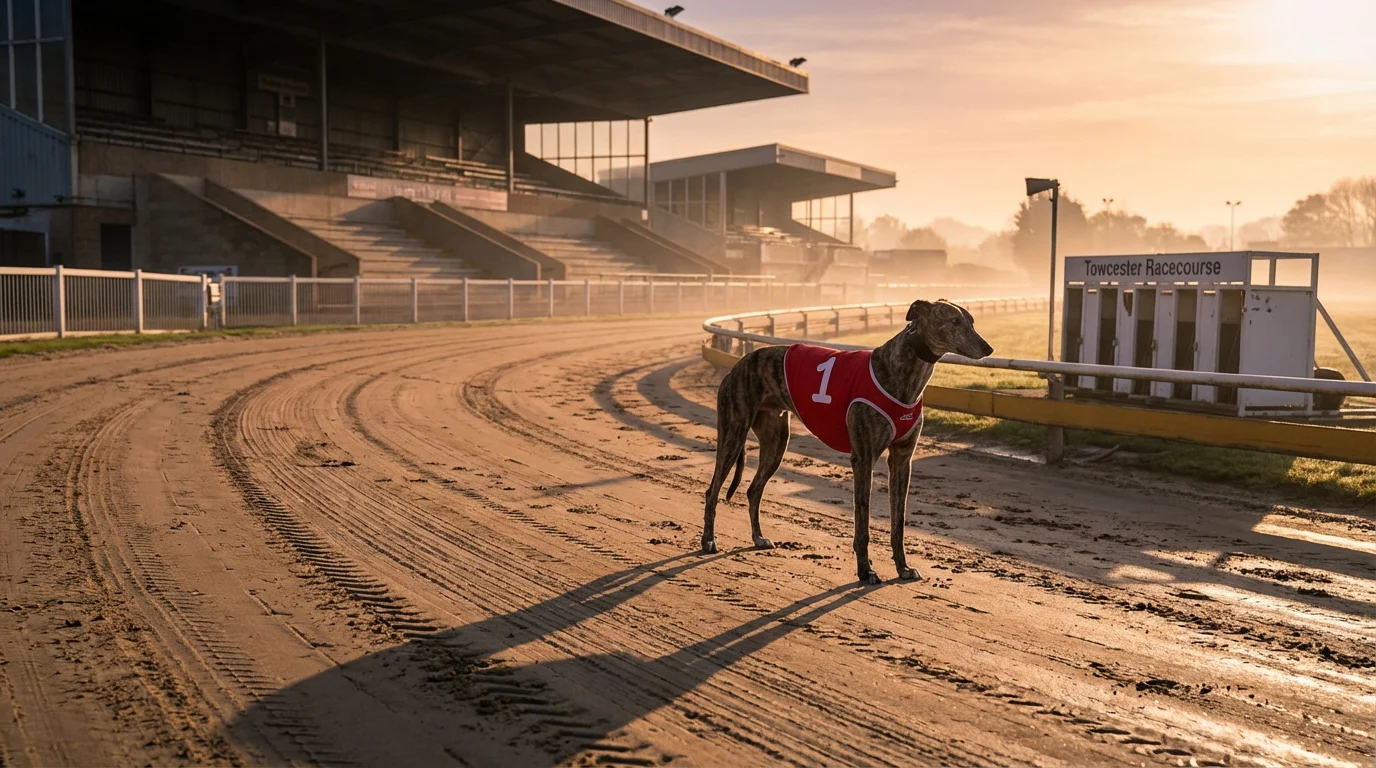
The Road to June Starts Now
The 2026 English Greyhound Derby field is still taking shape — but the smart money starts forming opinions before the entries close. Towcester Racecourse will host the Derby for the sixth consecutive year, with the first-round heats expected in May and the final scheduled for mid-June. The prize money remains at a British-record 175,000 pounds for the winner, and the competition format stays unchanged: 192 entries, six rounds of knockout racing, one final.
At this stage in the calendar, the ante-post market is open but sparse. A handful of bookmakers have posted early prices on dogs whose open-race form through the winter months has caught attention. These prices will shift dramatically once the official entry list is published and Towcester trials begin in earnest during March and April. For punters willing to do their homework now, that pre-entry window is where the best value tends to hide — prices that will look generous by the time the first heat is run.
What follows is an early assessment of the market, the trainers likely to shape the competition, the Irish contingent that has dominated recent renewals, and the trial form that will begin filtering through from Towcester in the coming weeks. None of this is a tip sheet. It is a framework for watching the right dogs, at the right tracks, before the wider market catches up.
Early Ante-Post Market Assessment
Opening prices tell you who the bookmakers respect — cross-referencing with trial form tells you who they have underrated. The ante-post market for the 2026 Derby is in its infancy, with most bookmakers offering prices on a limited field of twenty to thirty dogs. The favourite at this stage typically sits around 6/1 to 10/1, with a cluster of fancied runners between 12/1 and 25/1 and a long tail of outsiders stretching to 100/1 and beyond.
History suggests caution with early favourites. Since 2010, only a handful of ante-post market leaders at this stage of the year have gone on to win the Derby. The 2025 winner, Droopys Plunge, was available at prices well above 20/1 before the competition started and went off at 10/1 for the final. Bockos Diamond, the 2025 Irish Derby champion and strong ante-post favourite, was sent off at 11/10 for the final and finished second. Being the best dog on paper and being the best dog on the night at Towcester are not the same thing.
The approach that tends to yield results at this stage is to identify two or three dogs whose winter form — particularly in open races and classic trials — suggests they are better than their current price implies. Look for greyhounds posting consistent sub-29-second times over 500 metres at tracks with comparable configurations. Look for dogs whose trainers have a history of peaking runners for the Derby rather than burning them out in the spring calendar. And critically, look for dogs that have already trialled at Towcester or whose running style suits the track’s wide, sweeping bends.
The key numbers to monitor as the market develops: any dog breaking 28.70 in a Towcester trial between March and April is announcing itself as a serious contender. Dogs running sub-28.50 are potential finalists. And anything approaching the track record territory of 28.17 — while rare — marks a genuine superstar.
Trainers to Watch in 2026
The handlers who peaked at the right time last year may not be the ones building momentum now. That said, recent Derby history is dominated by a small group of trainers who consistently prepare dogs for the unique demands of a five-week knockout at Towcester.
Graham Holland remains the most powerful force in modern Derby training. The Tipperary-based handler has sent waves of dogs to Towcester in recent years and came agonisingly close in 2025 with Bockos Diamond, who led entering the final straight before being caught. Holland’s strength is depth — he typically qualifies three or four dogs to the latter rounds, giving him multiple shots at the final. Any dog emerging from his yard with strong trial form should be taken seriously from the outset.
Patrick Janssens, the Belgian-born trainer based in Thetford, enters 2026 as defending champion after Droopys Plunge’s victory. Janssens is now a two-time Derby winner, having also won with Thorn Falcon in 2021. (GBGB – 2025 Derby Final report) His operation is smaller than Holland’s, but his record of preparing dogs specifically for Towcester is outstanding. Watch for any dog from his kennel posted for early Towcester trials.
Liam Dowling trained the 2024 champion De Lahdedah and will be keen to bounce back after De Lahdedah’s near-miss in the 2025 final. Dowling’s dogs tend to be strong finishers — closers who peak in the final two hundred metres — and that style suits Towcester’s long run to the line. Among English-based trainers, Mark Wallis and Kevin Hutton both operate from Towcester itself, giving their runners a home-track advantage that should not be underestimated in the early rounds.
Irish Contenders & Cross-Channel Form
Three of the last five Derby winners were Irish-trained — the 2026 Irish trials are required watching. The dominance of Irish handlers at Towcester is not a fluke. It reflects a deep talent pool, a strong open-race circuit that tests dogs against high-quality opposition year-round, and a culture of targeting the English Derby as the pinnacle of the sport.
The Irish Derby at Shelbourne Park in Dublin traditionally runs in late summer, meaning the English Derby serves as the first major championship target of the year for many Irish-trained dogs. Handlers like Holland, Dowling, and others from the Munster and Leinster circuits begin their Derby campaigns by entering dogs in the Easter Cup and other spring opens, using those performances to gauge which runners are ready for the Towcester trip.
For bettors, the challenge with Irish form is translation. Shelbourne Park and Towcester are very different tracks — Shelbourne is a tighter circuit with a shorter run to the first bend, favouring early-pace dogs in a way that Towcester’s wider bends do not. A dog that dominates at Shelbourne may struggle at Towcester if it relies on a fast break rather than sustained pace. Conversely, a dog that finishes well at Irish tracks but lacks the early speed to lead at Shelbourne may find Towcester’s more forgiving geometry ideally suited to its running style.
The dogs to track from Ireland are those running well in the spring classic trials — particularly any that make the trip to Towcester for a pre-Derby trial in April. A dog’s first experience of Towcester’s sand surface, its unique hare rail, and its wide bends is often telling. Some adapt immediately. Others need two or three runs to find their rhythm, which is why the early rounds of the Derby itself often serve as acclimatisation for Irish raiders.
Trial Form from Towcester
Nothing substitutes for a dog’s first run at Towcester — trial times in March and April set the baseline. The Derby trial stakes programme at Towcester begins several weeks before the first official heat and provides the most direct form evidence available. These trials are run under race conditions over the Derby distance of 500 metres, and they attract dogs from across the UK and Ireland specifically preparing for the competition.
When assessing trial form, focus on three things. First, the raw time — anything below 28.80 on standard going is competitive, and anything below 28.60 flags a dog with genuine class. Second, the sectional split — a dog that runs a fast first bend but fades in the closing stages may look impressive on the clock but lack the stamina for the later rounds of a knockout competition. Third, the manner of the performance — a dog that wins easing down, running within itself, is a more attractive prospect than one that has to dig deep to post a fast time.
Trial form also reveals how dogs handle Towcester’s specific characteristics. The sand surface rides differently to the synthetic or grassland tracks many dogs train on. The wide bends allow runners to maintain speed through the turns in a way that tighter circuits do not, which benefits dogs with a long, flowing stride. And the outside Swaffham hare runs on the opposite side to many tracks’ inside hare rail, which can unsettle dogs seeing it for the first time.
Too Early to Call, Not Too Early to Watch
The winner might already be in training — your job is to find them before the market does. At this point in the season, certainty is impossible and unwise. Dogs get injured. Trainers change plans. Trial form can flatter or deceive. But the structure of the Derby rewards those who start paying attention early, because the ante-post market is least efficient when it is least informed.
The practical takeaway is simple: monitor the trial results from Towcester as they emerge, watch the Irish spring opens for dogs being specifically aimed at the Derby, and note which trainers are running dogs at Towcester for the first time in March and April. When the entry list is published, compare it against your notes. The dogs you have already flagged — the ones running fast trials, trained by Derby-proven handlers, with running styles that suit the track — will be the ones whose ante-post prices still offer value. By the time the wider market adjusts, that window will have closed.