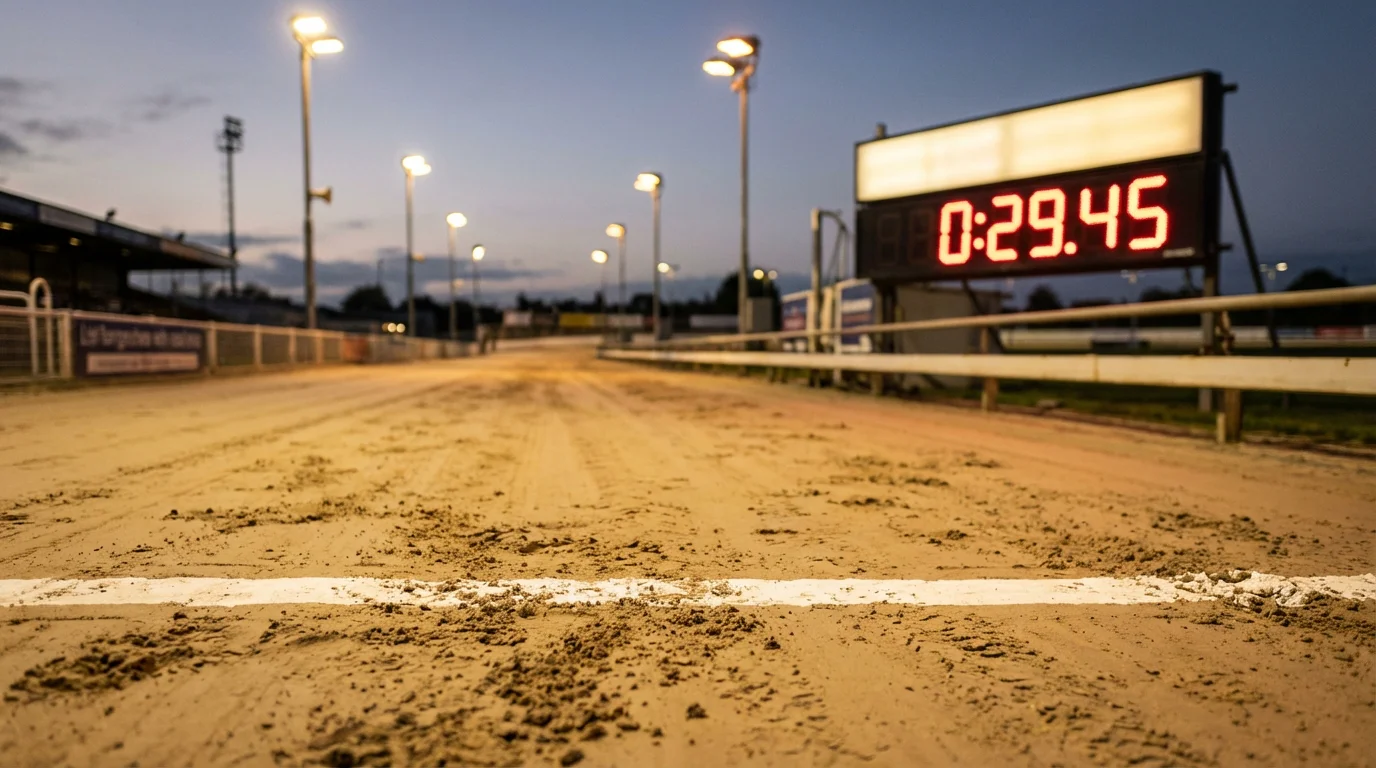
The Clock Sets the Standard
At Towcester, time is the universal currency. Every dog that races over the 500-metre Derby distance is measured against the same clock, and that clock tells you more about a greyhound’s quality than its form figures, its trainer or its pedigree. A dog that runs 28.50 at Towcester is a better animal than one running 29.10 — all else being equal. But all else is rarely equal, and the context behind the numbers is where the analytical value lies.
Towcester’s all-sand surface, purpose-built bends and outside Swaffham hare produce times that are specific to the venue. A time of 28.70 at Towcester does not map directly onto 28.70 at Romford or Shelbourne Park. Understanding what constitutes a fast time at Towcester, how conditions affect the clock, and what pace thresholds separate Derby-calibre dogs from the rest is essential for anyone betting seriously on the competition.
Track Record Holders
The Towcester 500-metre track record is the benchmark against which all Derby performances are measured. The record has been lowered several times since the track opened for greyhound racing in 2014, with each new mark reflecting improvements in both dog quality and the track’s maturation as a racing surface.
Track records at purpose-built venues tend to stabilise after the first few years of operation, as the sand surface beds in and the racing line around the bends becomes established. Towcester reached that point around 2018, and since then the record has been adjusted only by exceptional individual performances rather than by ongoing improvements in the track’s speed.
The record is held by De Lahdedah, who clocked 28.44 in the first round of the 2025 Derby — a time that represents the absolute ceiling of what has been achieved over 500 metres on this surface. For perspective, the average Derby final winning time since 2017 has been in the 28.58 to 29.06 range, meaning the record holder ran roughly one to five lengths faster than a typical Derby winner. That gap is the difference between a very good greyhound and a generational talent.
For betting purposes, the track record is a reference point rather than a target. No punter should expect a Derby heat winner to approach the record — conditions, opposition and race dynamics rarely align to produce a record-breaking performance under competitive pressure. What the record tells you is the theoretical limit, against which all other times can be measured as a percentage of maximum pace.
Average Winning Times by Going
The going — the condition of the sand surface, influenced primarily by moisture content — has a measurable effect on times at Towcester. The track uses a standardised going description (fast, standard, slow, or heavy) that reflects how the surface is riding on any given evening. The difference between fast and heavy going can be four to six tenths of a second over 500 metres, which is the equivalent of three to five lengths.
On fast going, the sand is dry and firm. The surface offers maximum grip, and dogs can reach their top speed without wasting energy. Average winning times for open-class races on fast going at Towcester cluster around 28.40 to 28.70. On standard going, the surface has moderate moisture and rides slightly slower. Average times shift to 28.60 to 28.90. On slow going, usually after sustained rain, the sand holds more water and the surface becomes heavier. Times move to 28.80 to 29.10. On heavy going — rare at Towcester, which has an advanced drainage system — times can exceed 29.20.
The critical point is that comparing times across different going conditions without adjustment is misleading. A dog that runs 28.90 on heavy going has produced a significantly better performance than one running 28.80 on fast going, even though the raw number is slower. The adjustment is not precise — there is no universally agreed formula — but a rough correction of plus or minus 0.15 seconds per step on the going scale is a reasonable working estimate. This means a 28.90 on heavy going is roughly equivalent to a 28.60 on fast going, which transforms the assessment entirely.
During the Derby, going conditions can vary between rounds and sometimes between heats on the same evening. Rain during the meeting changes the going as the card progresses. Checking the official going report before each round and adjusting your time comparisons accordingly is a basic but frequently overlooked step in form analysis.
What Times Indicate Derby Calibre
Across the Towcester era of the English Greyhound Derby, a set of time thresholds has emerged that reliably separates the serious contenders from the also-rans.
Sub-28.50 on standard going marks a genuinely exceptional performance. Dogs running at this level are potential Derby winners and are typically priced accordingly in the ante-post market. Fewer than a handful of dogs in any given year are capable of breaking 28.50 at Towcester, and when one does so in a trial or early-round heat, the market reacts immediately.
The 28.50 to 28.70 range on standard going is Derby-final territory. Dogs consistently running in this band are competitive at the highest level and can expect to reach the semi-finals or final if they avoid trouble in running. Most Derby finalists over the past five years have posted at least one sub-28.70 run during the competition, and several have done so multiple times.
The 28.70 to 28.90 range is competitive but not dominant. Dogs at this level are solid quarter-final contenders that may reach the semi-finals with favourable draws and clean runs but are unlikely to win the final unless conditions shift in their favour. This is the range where value bets often emerge — dogs priced at 16/1 to 33/1 whose times put them just outside the leading group but whose running style or draw could elevate their performance in the right heat.
Above 29.00 on standard going is below Derby standard for the later rounds. A dog consistently running over 29.00 may qualify through the early heats against weaker opposition but will be exposed when the field quality intensifies in the quarter-finals. Backing dogs at this level for outright Derby success is generally not advisable.
Pace Thresholds for Each Round
The Derby’s pace profile follows a predictable arc. First-round heats are run at a moderate overall pace because the fields include dogs at varying levels of fitness and Towcester experience. Average winning times in the first round typically sit around 28.70 to 29.00. By the second and third rounds, as the weaker dogs are eliminated, the pace quickens — average winning times drop to 28.55 to 28.80.
The quarter-finals represent a step change. The surviving twenty-four dogs are all proven Derby performers, and the competition intensity drives the pace down further. Quarter-final winning times typically fall in the 28.45 to 28.70 range. The semi-finals are faster still, often producing the quickest times of the entire competition, because the twelve remaining dogs are all running at peak effort to secure a final berth.
The final itself does not always produce the fastest time of the competition. The pressure, the atmosphere, and the tactical awareness of six handlers all trying to win the biggest race of the year can produce a cagier race than the semi-finals. Some finals are won in sub-28.50. Others are won closer to 28.70, with the difference determined by race dynamics rather than raw ability. A fast final suggests that one dog was dominant enough to set its own pace. A slower final suggests a tactically contested race where positioning mattered more than speed.
Time Is Context — Not Conclusion
Times at Towcester are the most objective measure of a greyhound’s ability over the Derby distance. They cut through the subjectivity of form figures and running-style assessments and give you a number that can be compared across rounds, across years, and across dogs. That objectivity is their strength — and their limitation.
A time tells you nothing about the circumstances that produced it. A 28.55 recorded from a clear lead with no interference is a different performance from a 28.55 recorded after being checked at the first bend and recovering ground in the straight. The first dog ran within itself. The second may have run a 28.35 race if it had got a clear run. Times are essential data points, but they must be read alongside race comments, sectional splits, going reports and visual observation to produce a complete picture. The clock at Towcester does not lie — but it does not tell you everything either.