
The Variable Nobody Picks
You can study form for hours, analyse sectional splits to two decimal places, and identify the perfect trap-draw-to-running-style match — and then a thunderstorm rolls in over Towcester thirty minutes before the off and changes everything. Weather is the uncontrollable variable in greyhound racing, and its effect on track conditions, running times and race dynamics is larger than most punters acknowledge. It does not invalidate your analysis. But it can alter which dogs benefit and which are disadvantaged, and the bettor who adjusts for conditions will outperform the one who ignores them.
This guide covers how rain, wind and temperature affect greyhound performance, how to read going reports at UK tracks, and how Towcester’s specific drainage characteristics shape the Derby racing surface.
Also read our greyhound sectional times explained.
Rain, Wind & Sand: How Elements Affect Performance
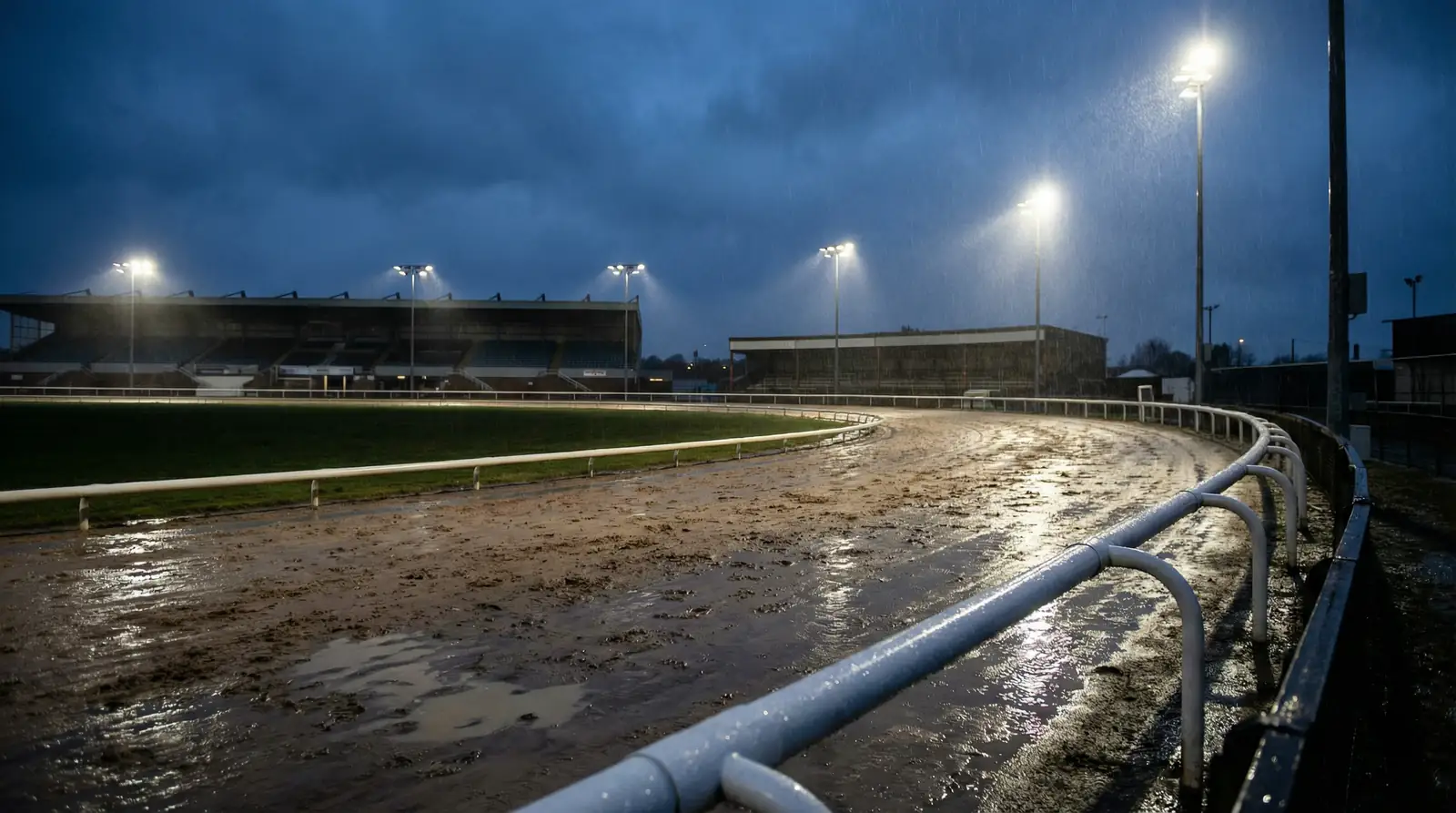
Rain is the dominant weather factor in UK greyhound racing. When it falls on a sand track, the surface absorbs moisture and becomes heavier. A wet sand surface provides less grip, slows acceleration, and demands more physical effort from the dogs to maintain speed. The effect is most pronounced in the first fifty metres — the acceleration phase from the traps — where grip is essential. Dogs with explosive early pace are disproportionately affected by rain because their advantage depends on quick acceleration that a heavy surface inhibits.
Conversely, dogs that rely on sustained pace rather than raw speed tend to handle wet conditions better. Their running style does not depend on the initial burst from the traps, and their aerobic stamina allows them to maintain effort when the surface is sapping energy from every stride. This is why Derby heats run on heavy going often produce results that differ from the form guide — the dogs best suited to heavy conditions are not always the ones the market favours based on dry-track form.
Wind affects greyhound racing more than most people realise. A strong headwind on the finishing straight slows closing times and can turn a one-length lead at the final bend into a two-length winning margin, because the lead dog provides a partial windbreak for the dogs behind it. Paradoxically, this can actually favour closers in some circumstances: a strong headwind slows the front-runner more than the dog drafting behind it, and the closer uses the leader’s slipstream before producing its run in the final metres.
Temperature has a subtler effect. Greyhounds are lean, muscular athletes with very low body fat, which makes them sensitive to extremes of heat and cold. Hot evenings — above 25 degrees Celsius — can cause dogs to overheat during the race, reducing their stamina in the closing stages. Cold evenings tighten muscles and increase the risk of injury, particularly in the early phases of the race before the dogs have warmed up. The ideal racing temperature is in the 12 to 20 degree range, which covers most English summer evenings — including the Derby period.
Going Reports for Greyhound Tracks
Every GBGB-licensed track publishes a going report before each meeting. The report describes the condition of the racing surface using standardised terminology: fast, standard, slow, or heavy. Some tracks add intermediate descriptions — standard-to-slow, for example — for conditions that fall between the main categories.
The going report is determined by the track manager, typically by assessing the moisture content of the sand surface. At modern venues like Towcester, moisture meters are used to provide an objective reading, though the final going call still involves a degree of judgment. The report is published in advance of the meeting and may be updated if conditions change — a rain shower during the first few races can shift the going from standard to slow mid-meeting.
For betting purposes, the going report should be checked before placing any race-day wager. A dog whose form is built on fast going may underperform on heavy ground, and vice versa. The form guide typically records the going for each of a dog’s recent races, allowing you to compare its performance across conditions. A dog that runs well on both fast and heavy going is a more reliable selection than one whose best times all come on fast ground — particularly during the Derby, where rain during the five-week competition is not unusual.
One common mistake is to treat the going report as absolute. “Standard” going at Towcester and “standard” going at Crayford do not mean the same thing, because the tracks use different sand compositions and different drainage systems. Going reports are useful within a single track — comparing this week’s conditions to last week’s — but less useful for cross-track comparisons.
How Towcester Drains
Towcester Racecourse was purpose-built with a modern drainage system that sets it apart from many older UK tracks. The sand surface is laid over a drainage layer that channels moisture away from the racing surface, and the track’s slightly cambered profile (higher on the outside, lower on the inside) encourages water to drain toward collection points at the inside rail.
The practical result is that Towcester handles rain better than most UK greyhound tracks. A moderate shower that would turn an older, less well-drained track to heavy going may only shift Towcester from fast to standard. Sustained heavy rain will still affect the surface — no drainage system can prevent a waterlogged track if the rainfall is extreme — but the recovery time is faster. A Towcester meeting that starts on slow going after morning rain may be riding closer to standard by the later races as the drainage system does its work.
This drainage profile has specific implications for Derby betting. First, it means that going conditions at Towcester are generally more consistent across a meeting than at other tracks, which makes time comparisons between heats on the same card more reliable. Second, it means that Towcester rarely produces genuinely heavy going during the summer Derby period, when rainfall tends to be intermittent rather than sustained. Most Derby rounds are run on fast or standard going, with slow going an occasional factor and heavy going a rarity.
Third, the drainage pattern affects the inside rail more than the outside of the track. Because water drains inward, the inside running line can be marginally slower than the outside in wet conditions. This is a subtle effect, but it can influence trap draw value: on a night when rain has fallen, the inside traps may lose a fraction of their usual advantage because the rail is riding heavier than the middle and outside lanes.
Adjusting Selections for Weather
The practical approach to weather adjustment in Derby betting is straightforward. Before each round, check the forecast and the going report. If the going is fast or standard, your standard form analysis applies without significant adjustment. If the going is slow or heavy, reconsider your selections with three questions in mind.
First, has this dog performed well on similar going before? Check the going conditions recorded for its recent form entries. A dog with proven form on heavy ground is a safer selection than one whose form is exclusively on fast going. Second, does this dog’s running style suit heavy conditions? Dogs with sustained pace and strong finishing sectionals tend to handle heavy going better than pure speedsters. Third, does the heavy going change the likely race dynamics? If the pace is expected to be slower overall, front-runners may find it easier to hold their leads because closers cannot generate the same finishing burst on a heavy surface.
If conditions change between heats on the same evening — rain starting mid-meeting, for example — be prepared to adjust your bets accordingly. A selection that looked ideal on fast going may be less attractive two hours later if the track has deteriorated. The flexibility to revise your view in response to changing conditions is a mark of disciplined betting.
You Can’t Control the Weather — But You Can Read It
Weather is the great equaliser in greyhound racing. It does not respect form, pedigree, or market support. It arrives on its own schedule and changes the conditions under which every dog races. The bettors who lose to weather are the ones who ignore it — who place their bets on Tuesday morning and do not reconsider when Saturday’s forecast turns wet. The bettors who profit from weather are the ones who treat it as one more piece of data: checkable, interpretable, and factored into every decision. The rain falls on everyone. The question is who adapts.
Get more race analysis at englishgreyhoundderbyuk.