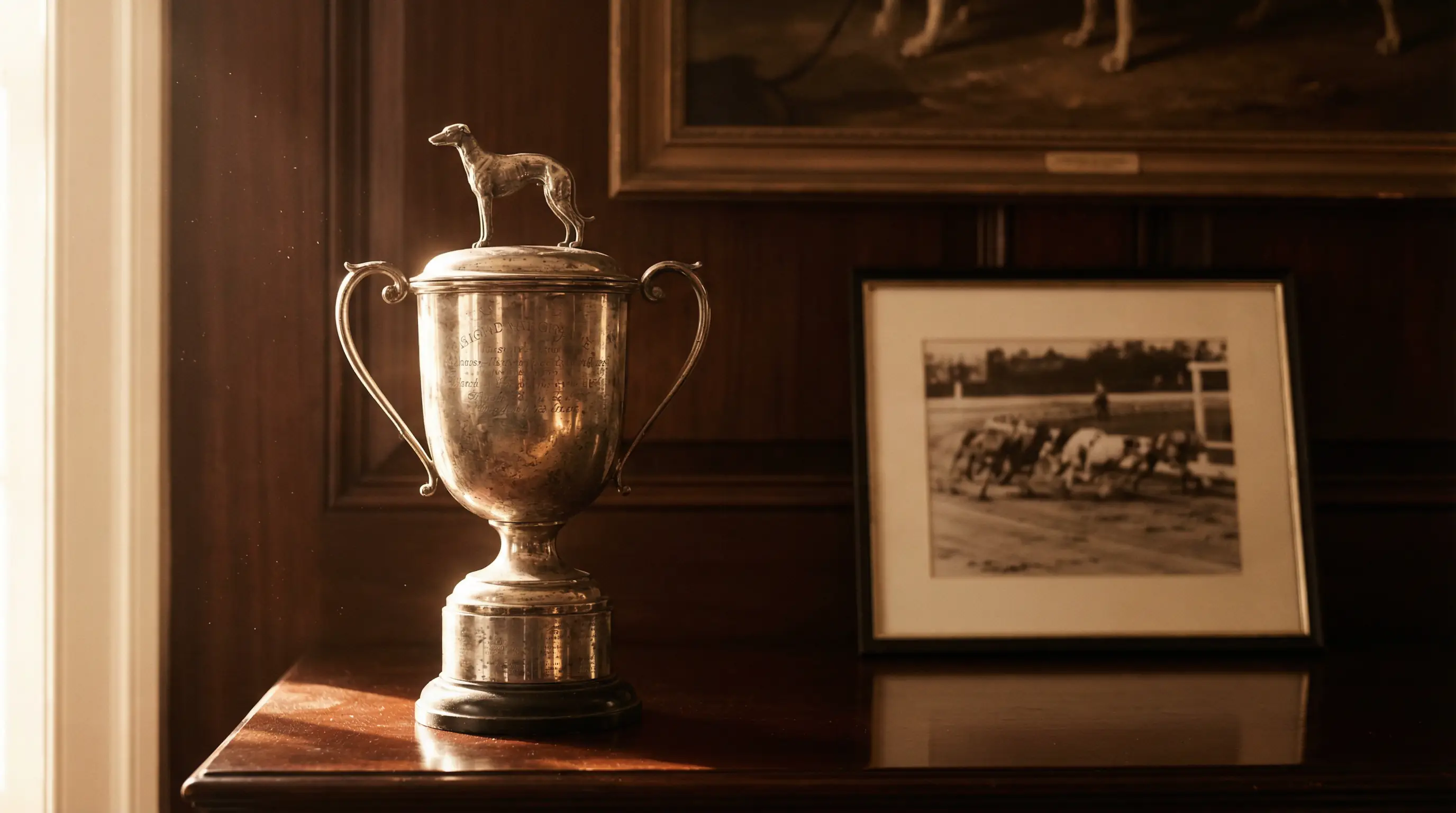
Ninety-Eight Years of the Greatest Dog Race in Britain
Entry Badge won the first English Greyhound Derby in 1927 at White City — and no greyhound event since has matched its hold on British sport. The Derby was not merely a race from the start. It was a statement. Greyhound racing had arrived in the United Kingdom only a year earlier, and the decision to stage a championship event at White City Stadium — built for the 1908 London Olympics — signalled the ambition of a sport that was already drawing enormous crowds in working-class London. (GBGB — Entry Badge)
What followed over nearly a century is a story of cultural impact, venue upheaval and sporting evolution that few British competitions of any kind can match. The Derby has outlived three home stadiums, survived a world war, weathered the collapse of greyhound racing’s mass-audience era and emerged into the modern age as the most prestigious event on the British greyhound calendar. The first prize stands at £175,000. The competition draws entries from across the UK and Ireland. The format — 192 entries, six rounds, one six-dog final — remains one of the toughest knockout structures in any sport.
This is not a chronological list of winners. It is the story of how a race became an institution, told through the venues that housed it, the dogs and trainers that defined it, and the commercial forces that shaped its survival. For bettors, history is not sentimental — it is structural. The patterns embedded in nearly a century of Derby results still inform the way the modern market behaves.
The White City Era: 1927–1984
For fifty-seven years, White City Stadium was the Derby — and the Derby was White City. The stadium in Shepherd’s Bush, west London, was the sport’s cathedral. Built to host the 1908 Olympics and converted for greyhound racing in the 1920s, White City could hold tens of thousands of spectators, and on Derby night it frequently did. In an era before widespread television, the Derby final was a social event as much as a sporting one — crowds dressed for the occasion, restaurants inside the stadium served dinner, and the atmosphere carried a charge that contemporary accounts describe as electric.
Entry Badge’s victory in 1927 set the template. Trained by Joe Harmon and sent off at 1/4 favourite, the inaugural winner demonstrated that the Derby would attract the best dogs in the country and that the public would turn up to watch them. The prize money — £1,000 — was substantial for the era, and the media coverage was extensive. Within two years, the Derby had produced its first genuine sporting celebrity.
The war interrupted but did not end the competition. The 1940 final was held at Harringay Stadium after White City was requisitioned, and the race was suspended entirely from 1941 to 1944. It returned in 1945 and resumed its place at the centre of British greyhound racing without missing a beat. The post-war decades were the sport’s golden age in terms of attendance. Greyhound racing regularly drew larger crowds than football in many cities, and the Derby final was the pinnacle of a social calendar that stretched from local tracks to the grand occasion at White City.
The 1960s and 1970s produced a string of memorable champions. Sand Star won the 1969 Derby for Ireland’s Hamilton Orr, foreshadowing the cross-channel raiding tradition that would become dominant decades later. Patricias Hope became the second dog to win consecutive Derbies in 1972 and 1973 — the first under Adam Jackson and the second after switching to Johnny O’Connor’s kennel. (Ladbrokes — Famous Derby Winners) That a dog could change trainer between Derby wins and still deliver speaks to the quality of the animal rather than the method, and Patricias Hope remains one of the most respected names on the roll of honour.
Sponsorship arrived in 1973 when pet food manufacturer Spillers attached its name to the race, increasing the commercial profile and the prize fund. By 1980, the Spillers-sponsored prize had reached £35,000 — a transformative sum for an era when most graded races offered a few hundred pounds to the winner. The Daily Mirror took over in 1983. The following year, Whisper Wishes won the final White City Derby, blazing to the front from Trap 4 and holding off Irish raider Morans Beef in a finish that served as a fitting farewell to a venue that had hosted the event for fifty-seven years. The stadium closed, and with it closed the first and longest chapter in the Derby’s history.
Mick the Miller: The Dog That Made Greyhound Racing
No account of the Derby’s history is complete without Mick the Miller, and no greyhound before or since has had a comparable cultural impact. An Irish-bred dog who survived a near-fatal bout of distemper as a puppy, Mick the Miller won the Derby in 1929 and again in 1930, becoming the first dog to win the race twice. His nineteen consecutive victories in England made him a household name in an era when greyhound racing was competing with football and cricket for the public’s attention. (GBGB — Mick the Miller)
His fame extended beyond the track. Mick the Miller appeared in a feature film, was the subject of newspaper columns and magazine articles, and drew crowds of fifty thousand to White City on Derby night. When he died in 1939, his body was preserved and placed in the Natural History Museum — an honour typically reserved for specimens of scientific significance, not sporting celebrities. His body has since been moved to the Natural History Museum at Tring in Hertfordshire. His legacy set the standard for what a Derby champion could mean to the wider public, and every subsequent dual winner has been measured against him.
Wimbledon Years: 1985–2016
When the Derby moved to Wimbledon, it lost the old-world glamour of White City — and gained something sharper. Wimbledon Stadium, in south-west London, was a more modern venue with better facilities for televised coverage, and the move coincided with the growth of satellite television’s interest in greyhound racing. The Derby became a staple of the broadcast calendar, and the exposure brought a new generation of viewers and bettors to the sport.
The Wimbledon era was defined by one trainer above all others. Charlie Lister won seven Derbies between 1997 and 2013 — a record that may never be equalled. His first, with Some Picture in 1997, announced a dominance that would span nearly two decades. Some Picture was arguably the most brilliant of his winners, going unbeaten through the entire competition and clocking a blistering 28.23 in the final. Rapid Ranger followed with back-to-back victories in 2000 and 2001. Farloe Verdict in 2003, Bandicoot Tipoki in 2010, Taylors Sky in 2011 — whose winning time of 28.17 set the Wimbledon track record — and Sidaz Jack in 2013 completed the tally. Lister’s method was meticulous: physical conditioning, controlled preparation and an ability to bring dogs to peak fitness for the final earned him the title Derby King and, eventually, an OBE. (Coral — Greyhound Derby Winners List)
Rapid Ranger’s back-to-back victories in 2000 and 2001 were the Wimbledon era’s most dramatic achievement. The dog had been anything but a star as a puppy, only flourishing after a kennel switch to Lister. His 2000 win was emphatic — three and a half lengths clear of the field — and the decision to bring him back in 2001 rather than retire him to stud proved inspired. He became the third dog in history to win consecutive Derbies and even returned for a tilt at a third in 2002, reaching the third round before his campaign ended.
Westmead Hawk’s victories in 2005 and 2006 for trainer Nick Savva added another dimension entirely. His trademark late surges — coming from last to first with devastating finishing speed — captivated the Wimbledon crowd and brought greyhound racing mainstream media coverage it had not enjoyed since Mick the Miller. Savva then trained Westmead Lord to win the 2007 Derby, completing a remarkable hat-trick of victories from his kennel. (GBGB — Westmead Hawk) The 1990s also produced memorable champions outside the Lister orbit: Chart King won the 1999 final at a short-priced 8/11 favourite, one of the most dominant performances of the decade, while Toms The Best completed a cross-channel double in 1998 by adding the English Derby to his Irish triumph — a feat that would not be replicated for a quarter of a century.
The final Wimbledon Derby in 2016 was won by Paul Hennessy’s Jaytee Jet, an Irish-trained runner whose victory foreshadowed the cross-channel dominance that would define the next chapter. Wimbledon Stadium closed in March 2017, the last greyhound track in London, and was redeveloped for housing. (GBGB) The Derby was homeless, and the race that had defined two iconic London stadiums would need to reinvent itself in the provinces.
The Towcester Chapter: 2017–Present
Towcester was built from scratch — a purpose-designed track for a race that had been looking for a permanent home. The new venue, a greyhound track constructed inside the Towcester horse racecourse in Northamptonshire, had opened in December 2014 at a cost of £1.5 million, with 60,000 tonnes of soil laid to create a 420-metre circumference circuit with the widest bends in British greyhound racing. For a competition that had spent its entire history in London, the move to a market town off the A5 was a cultural shock — but the track itself was a genuine upgrade.
The transition was not smooth. The first Towcester Derby in 2017 produced one of the biggest upsets in modern history when Astute Missile, a 28/1 outsider trained by Seamus Cahill from Hove, won the final — the longest-priced winner in the competition’s recorded history. (Towcester Racecourse — Past Winners) Dorotas Wildcat followed in 2018 for locally based Kevin Hutton, running the race in a rapid 28.85. Then, in August 2018, the Towcester Racecourse Company went into administration. The track closed, 134 staff were made redundant, and the Derby lost its home for the second time in two years.
The 2019 Derby moved to Nottingham’s Colwick Park, where Priceless Blake won for Irish trainer Paul Hennessy. The 2020 edition was disrupted by the COVID-19 pandemic, eventually taking place at a reopened Towcester later that year, where Pat Buckley’s Deerjet Sydney triumphed. The period of instability tested the Derby’s resilience, but the competition’s prestige proved strong enough to survive two venue changes and a global shutdown.
Since 2021, Towcester has stabilised as the Derby’s home, and the competition has entered a new phase defined by Irish dominance. Thorn Falcon won in 2021 for Patrick Janssens — one of the few English-based trainers to compete consistently with the Irish raiders. Graham Holland then won back-to-back Derbies with Romeo Magico in 2022 and Gaytime Nemo in 2023, establishing his Riverside Kennels operation as the most powerful force in the modern competition. De Lahdedah’s 2024 victory for Liam Dowling continued the Irish streak, equalling the 500-metre track record with a time of 28.58 — a remarkable performance that demonstrated the calibre of dog that the current Derby attracts. And in 2025, Droopys Plunge — the sole English-trained finalist — upset the Irish contingent at 10/1 to win for Janssens, demonstrating that the home challenge, while outnumbered, is far from outclassed. (Greyhound Racing UK — 2025 Derby Report)
The Derby’s Greatest Trainers
Seven wins do not happen by accident — Charlie Lister’s Derby record is as much about method as it is about talent. Lister’s dominance from 1997 to 2013 was built on a training system that prioritised peak fitness for the final above all else. His dogs were famously hard to beat in the later rounds, and his ability to bring a runner to its absolute best for the six-dog showdown was unmatched. He retired from training in 2018, and no active handler has come close to his record.
Nick Savva’s four wins — Westmead Hawk twice and Westmead Lord once, plus an earlier success — established him as the Derby’s most successful breeder-trainer. His Westmead kennel produced dogs specifically bred for the demands of top-class competition, and his emphasis on finishing speed over early pace gave him a distinctive edge on the Wimbledon circuit.
The modern era belongs to the Irish handlers. Graham Holland, English-born but based in Ireland, won the 2022 and 2023 Derbies and has placed multiple dogs in consecutive finals. His operation at Riverside Kennels is the most prolific producer of open-class greyhounds in Europe, and his ability to identify and develop dogs capable of handling the English Derby’s demands has reshaped the competitive landscape. Patrick Janssens, based at Towcester itself, has won twice — Thorn Falcon in 2021 and Droopys Plunge in 2025 — making him the most successful home-based trainer of the Towcester era. Paul Hennessy, a dual winner with Priceless Blake in 2019 and Jaytee Jet in 2016, and Liam Dowling, whose De Lahdedah won in 2024, complete the picture of an Irish training community that now dominates the event their White City predecessors rarely entered.
Format Evolution: From Eight-Dog Heats to the Modern Knockout
The Derby has not always been the six-dog final we know — the format has been reshaped several times to reflect changes in the sport and in the betting market. The original Derbies at White City featured eight-dog heats, a format that produced more chaotic racing and less predictable outcomes. The transition to six-dog races reduced crowding, improved welfare and — not coincidentally — made betting more analytically tractable.
Distance has also evolved. The earliest Derbies were run over 500 yards at White City. The switch to metric distances saw the race run over 480 metres before settling at 500 metres, the distance it covers today at Towcester. Each distance change subtly altered the demands of the competition: 500 metres is long enough to test stamina and finishing speed, but short enough that early pace and first-bend position remain critical. The current distance represents a balance that rewards versatile dogs — those with both the speed to lead early and the constitution to maintain it through four bends.
The knockout structure — six rounds from first-round heats to the final — has remained broadly consistent throughout the modern era, though the number of entries has fluctuated. The current format of 192 entries is among the largest fields in the competition’s history, and the depth of the entry list reflects the growth of cross-channel participation. Irish trainers now enter teams of five or six runners where once they might have sent one or two, and the competition for qualifying places in the later rounds has intensified accordingly.
Prize Money and Commercial Growth
From £1,000 in 1927 to £175,000 today — the Derby’s commercial growth mirrors the sport’s ambitions. The prize money trajectory tells a story of gradual professionalism. Spillers’ sponsorship in 1973 increased the purse significantly, and successive sponsors — the Daily Mirror, the Sporting Life, William Hill, Blue Square and now Star Sports — each raised the financial stakes. The current first prize of £175,000 makes the Derby the richest greyhound race in Britain and one of the richest in the world.
Television has been the critical commercial driver. Sky Sports’ coverage of the Wimbledon Derbies brought the sport to a national audience and attracted bookmaker investment in ante-post markets that would not have been commercially viable without broadcast exposure. The current broadcasting arrangements — Racing Post Greyhound TV, SIS Racing and the Gone To The Dogs YouTube channel — maintain coverage for a more fragmented audience, and the betting market around the Derby remains the deepest and most liquid in greyhound racing.
The commercial structure also shapes the competition itself. Prize money is distributed across all six rounds, not just the final, which ensures that even dogs eliminated in the early heats earn returns for their connections. This financial incentive broadens the entry pool and raises the overall quality of the competition — trainers are willing to travel from Ireland and enter multiple dogs because the prize structure justifies the cost.
Nearly a Century On: What the Derby’s History Tells Bettors
History does not repeat in greyhound racing — but patterns in trainer dominance, trap bias, and upset frequency absolutely do. Nearly a century of Derby results offers a dataset that, properly read, informs modern betting in specific and practical ways.
Trainer dominance is cyclical but predictable. Lister dominated for two decades. Holland has dominated the early Towcester era. When a trainer’s operation is at its peak — the kennel is strong, the dog supply is deep, the preparation method is refined — backing their leading entries carries a structural edge. Conversely, when a dominant trainer’s results begin to plateau, the market is often slow to adjust, continuing to price the kennel’s name rather than the kennel’s current form.
The favourite’s record is another historical lesson. Across the full span of the Derby, the market leader on final night has won less frequently than casual bettors assume. Since the move to Wimbledon, the average winning SP has sat in the mid-range of the market — around 5/1 to 8/1 — with multiple winners returned at double-figure prices. Astute Missile’s 28/1 success in 2017 was extreme, but Droopys Plunge at 10/1 in 2025, Gaytime Nemo at 9/1 in 2023 and Priceless Blake at 6/1 in 2019 all represent winners that the market did not place at the head of the betting. For the punter, this means that the Derby final consistently offers value at prices longer than the favourite, and that blind loyalty to the market leader is a losing approach over time.
The Irish raider trend is the defining pattern of the current era. Four of the last five winners were Irish-trained, and the cross-channel challenge shows no sign of weakening. For bettors, this means that ignoring Irish form is no longer an option — it is a structural disadvantage. The 2026 Derby will almost certainly feature another heavyweight Irish entry, and the ante-post market will price them accordingly. Understanding the history that produced this pattern — the depth of the Irish racing programme, the quality of Irish breeding and the experience of Irish trainers in knockout competition — is necessary context for anyone planning a serious Derby campaign.