The Track That Hosts Britain’s Biggest Race
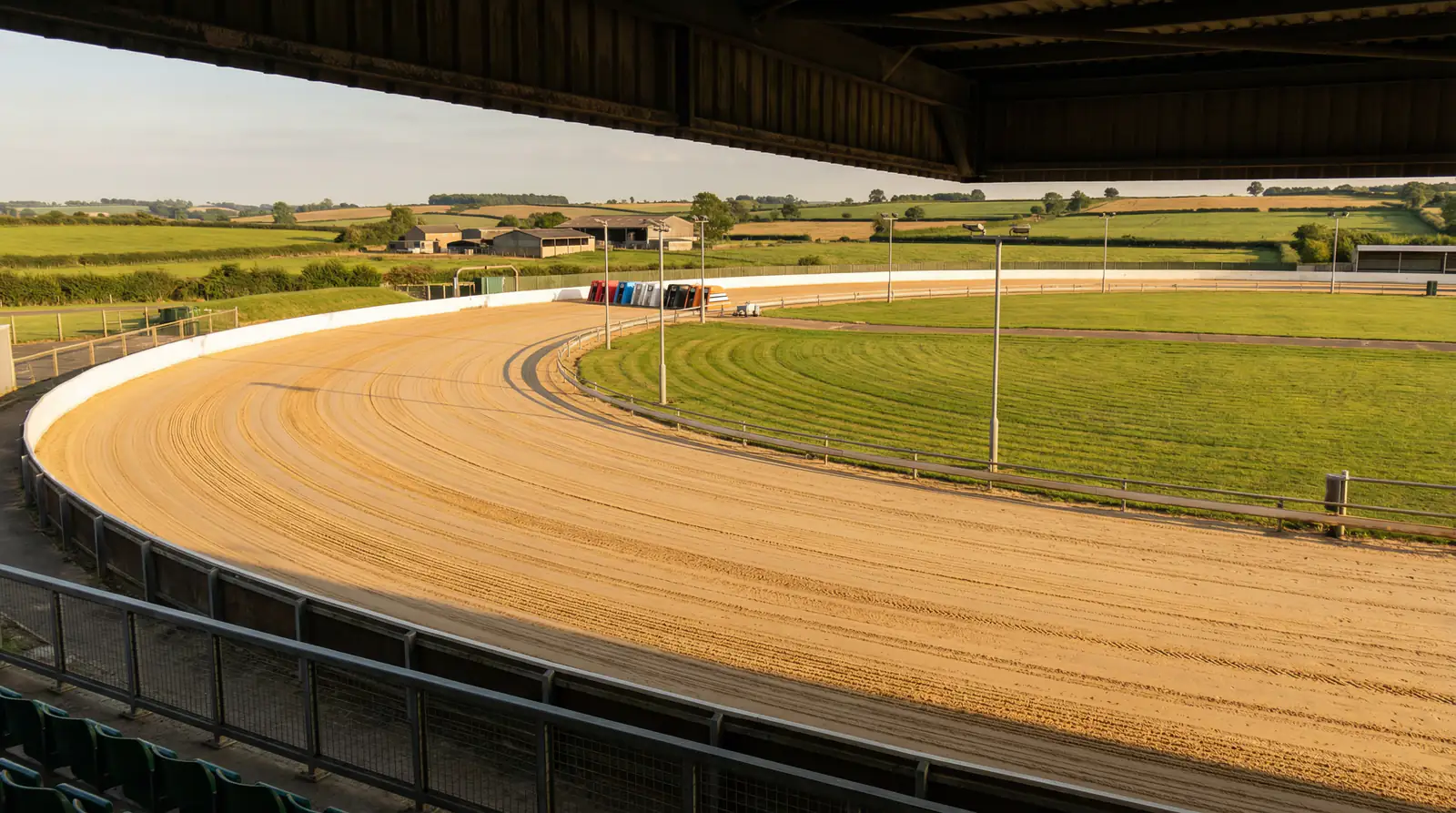
Towcester was purpose-built in 2014 inside a horse racecourse — and everything about its design affects how the Derby is won. The greyhound track at Towcester Racecourse in Northamptonshire is unlike any other GBGB venue. It was designed from the ground up rather than retrofitted from an existing stadium, and the physical decisions made during its construction — the circumference, the bend radius, the surface material, the hare position — have created a racing environment with specific characteristics that directly shape betting outcomes.
Understanding Towcester is not optional for anyone serious about the English Greyhound Derby. The competition runs exclusively at this venue, over its 500-metre configuration, across all six rounds. Every dog in the field must handle Towcester’s sand surface, navigate its wide bends and deal with its outside Swaffham hare. Dogs that thrive here often look unremarkable on other tracks. Dogs that dominate elsewhere sometimes struggle with the demands that Towcester’s layout imposes. Track knowledge is a genuine betting edge — it helps you identify which form lines are reliable, which dogs are overpriced on the strength of form at dissimilar venues, and which running styles are rewarded by the course’s physical characteristics.
The creation of the track was the brainchild of Lord Hesketh, the racecourse owner, who recognised an opportunity to install a greyhound circuit inside the horse racing course. Chief Executive Kevin Ackerman oversaw the project, which cost £1.5 million and required 60,000 tonnes of soil to raise the greyhound surface to a level position relative to the horse racing straight. (Greyhound Racing History — Towcester) The result was a modern, purpose-designed facility with wider bends than any existing British track — an engineering choice made with greyhound welfare in mind that has had profound competitive consequences.
Track Dimensions and Layout
Four hundred and twenty metres of circumference, with bends wide enough to eliminate most crowding — but not all of it. Towcester’s 420-metre circumference places it in the upper range of GBGB tracks, comparable to Sheffield (425m) and smaller than Nottingham (437m) but larger than many of the traditional inner-city venues that greyhound racing has historically called home. Romford, before its closure, ran at around 380 metres. Monmore sits at 415 metres. The additional circumference at Towcester means wider turns and longer straights, both of which affect the way races are run.
The track offers multiple race distances: 260, 480, 500, 655, 686 and 906 metres. The Derby is contested over 500 metres, which is a standard four-bend trip. The run-up from the traps to the first bend is long enough to allow dogs to establish their preferred racing position before the first turn, which reduces — but does not eliminate — the crowding that shorter run-ups produce. At tighter tracks, the run to the first bend is a scramble where trap position confers an immediate advantage. At Towcester, the extra distance gives dogs more time to find space, and the consequence is that early pace alone does not guarantee first-bend position to the same extent.
The bends themselves are the track’s defining feature. They are the widest in British greyhound racing, designed to accommodate eight-dog races as well as the standard six-dog format. For the punter, the width has a critical implication: wide runners — dogs that race around the outside rather than the rail — lose less ground on Towcester’s bends than they do at tighter circuits. At a track like the former Romford, running wide added measurable lengths to a dog’s race distance and was a significant disadvantage. At Towcester, the penalty for racing wide is reduced, and dogs with a natural inclination to run around the field can do so without being fatally compromised.
The hare is an outside Swaffham type, positioned on the outer rail. This is significant because the hare’s position influences the natural racing line of the dogs. An outside hare encourages dogs to run slightly wider than they would with an inside hare, which further benefits wide runners and reduces the rail-hugging advantage that inside traps enjoy at tracks with an inside hare. The combination of wide bends and an outside hare gives Towcester a specific bias profile that differs materially from most other GBGB venues.
Sand Surface and Going Conditions
Sand drains faster than standard circuits — and that changes which dogs handle Towcester in the wet. Towcester’s racing surface is sand, which is standard for modern GBGB tracks but behaves differently from the synthetic surfaces and older sand compositions found at some established venues. The sand was laid as part of the original construction in 2014, over the 60,000 tonnes of soil that raised the track to its current level, and the drainage system was engineered to handle the run-off from the surrounding Northamptonshire terrain.
In practice, this drainage design means Towcester recovers from rainfall faster than many older tracks. A moderate shower that would produce a going figure of +20 or more at a less well-drained venue might register as +10 or +15 at Towcester, because the water moves through the sand and substrate more efficiently. For form readers, this has a practical consequence: going adjustments at Towcester may overstate the actual impact of wet conditions relative to other tracks. A calculated time posted on going of +15 at Towcester might be roughly equivalent to a calculated time posted on going of +10 elsewhere — the sand has absorbed less water by the time the race is run.
Dog weight interacts with going conditions in specific ways on sand. Heavier dogs — typically those above thirty-two or thirty-three kilograms — tend to lose more ground on a wet sand surface because their mass compresses the surface further with each stride. Lighter dogs handle wet sand more efficiently, maintaining their natural stride length where heavier runners shorten theirs. In the context of the Derby, which runs from May to June when British weather is variable, checking the going report on race night and adjusting your assessment of heavier dogs accordingly is a routine but important step.
Dry conditions firm the sand and produce faster times, sometimes significantly faster. On fast going at Towcester, the 500-metre times can drop below 28.50, which places extreme demands on dogs that rely on sustained pace rather than raw speed. The going report is published before each meeting and updated throughout the card, and any serious form assessment should note the going figure for every performance being evaluated.
For Derby betting specifically, the going report on each round of heats can alter the competitive landscape overnight. A dog that recorded an ordinary 29.05 in the first round on going of +25 might be a 28.70 dog on normal going — a significantly different proposition. Conversely, a dog that blazed a headline-grabbing 28.55 in fast conditions might be a 28.80 runner under standard going. Stripping back the going adjustment and comparing like-for-like calculated times is essential work for anyone assessing which dogs have genuine class and which have been flattered by the surface underfoot.
Trap Bias at Towcester: The Data
Bias at Towcester is subtler than most tracks — the wide bends were designed to minimise it, but the outside hare introduces its own asymmetry. Every greyhound track has some degree of trap bias, and Towcester is no exception, despite its engineering intentions. The wide bends reduce the crowding that typically punishes outside draws at tighter circuits, but the outside Swaffham hare creates a pull towards the wider racing line that affects how dogs from different traps navigate the first bend.
Over a large sample of 500-metre races at Towcester, the trap statistics show a relatively even distribution of winners compared to tighter tracks, but with specific tendencies that merit attention. The overall win rate across all six traps clusters closer to the theoretical 16.7% than at most GBGB venues, which confirms the design intent of the wide bends. However, the place rate — how often a trap finishes in the first three — reveals more nuanced patterns, and the interaction between trap position and running style produces predictable performance trends.
Inside Traps: 1 to 3
Trap 1 at Towcester benefits from the shortest run to the first bend and the inside rail position, which suits natural railers who can break cleanly and establish position on the rail before the first turn. However, the outside hare means that Trap 1 dogs are running against the natural drift of the field towards the outer rail. A dog drawn in Trap 1 that shows early pace can use the inside line effectively, but a slow starter drawn here may find itself squeezed as the field moves wider.
Trap 2 occupies a middle ground — close enough to the rail to benefit from inside running but with slightly more room to adjust than Trap 1. Trap 3, the outermost of the inside draws, is often the least predictable of the three. Dogs drawn here must commit quickly to either the rail or the middle of the track, and the decision is partly dictated by the dogs drawn on either side. A fast dog in Trap 2 pulling inside and a fast dog in Trap 4 pushing wide can leave a Trap 3 runner in an uncomfortable position approaching the first bend.
Outside Traps: 4 to 6
Trap 5 has historically been the most successful trap at Towcester in terms of overall win percentage, with a strike rate that some analyses place at around 18% — above the 16.7% average. This aligns with the track’s design: the outside Swaffham hare encourages a natural racing line that favours dogs drawn in the outer positions, and Trap 5 offers a combination of space to the outside and proximity to the hare rail that suits wide-running dogs.
Trap 6, the widest draw, benefits wide runners who can use the outside to build speed through the turn but has the longest run to the first bend, which can leave a slow-starting dog isolated on the outside without cover. Trap 4 is the transitional draw — not quite inside, not quite outside — and its success depends heavily on the running styles of the dogs drawn on either side. In the context of the Derby, where the trap draw changes at every round and the racing manager seeds the final draw based on running style, understanding how each trap position interacts with a dog’s natural preferences is essential for accurate assessment.
Running Styles That Suit Towcester
Wide runners get away with more at Towcester than at any other GBGB track — and that shapes the entire Derby form book. The combination of sweeping turns and an outside hare creates a racing environment that naturally rewards dogs who run around the outside of the field. At tighter tracks, wide running adds significant distance to a dog’s race and is generally a disadvantage unless the dog possesses exceptional sustained pace. At Towcester, the extra distance covered by a wide runner is smaller in absolute terms, and the compensation — clean air, less crowding, an unobstructed path through the turns — often outweighs the cost.
Closers — dogs with strong finishing speed who sit behind the pace in the early stages — are also well-suited to Towcester’s layout. The long finishing straight rewards dogs that can sustain their run from the final bend to the line, and the generous bend radius allows closers to pick a path around tiring front-runners without being blocked on the inside rail. At the Derby level, where the early pace in every heat is fierce and the first bend is crowded regardless of the track’s dimensions, closers often find their best opportunities in the second half of the race.
Pure front-runners — dogs that rely on blinding early pace to lead from trap to line — face a more complex picture at Towcester. From inside traps (1 and 2), a front-runner can use the short run to the first bend and the inside rail to establish a clear lead, and from there the spacious turns are less of a factor because the dog is already in front. From outside traps, however, a front-runner must cover more ground to reach the first bend in front, and the outside hare can pull the dog wider than its natural racing line, costing a length or more. Front-runners with genuine class can still dominate at Towcester — several Derby winners have led from the front — but the track is less forgiving of one-dimensional pace than tighter circuits.
The 2025 Derby final illustrated the running-style dynamic perfectly. Droopys Plunge, drawn in Trap 1, used a quick break and the inside rail to post the fastest first-bend sectional in the final — 4.03 seconds — before sustaining his speed through the wide bends and holding off closers on the run-in. (Greyhound Racing UK — 2025 Derby Report) His was a railer’s win from the ideal draw. Behind him, De Lahdedah — a dog capable of winning from the front or rallying from behind — found himself trapped for room early and had to produce a closing run from last to challenge for second. The track rewarded the dog that adapted to its conditions and punished the one that encountered traffic, regardless of underlying class. That interplay between style, draw and Towcester’s physical layout repeats in virtually every round of every Derby.
Key Times and Track Record at 500m
The track record stands at 28.58 — any dog breaking 28.70 in Derby heats is announcing genuine final-night credentials. That record was equalled by De Lahdedah in the 2024 Derby final, trained by Liam Dowling, and it remains the benchmark against which all Towcester 500-metre performances are measured. The time was first set by King Memphis in the opening round of the same competition, underlining the calibre of dog required to produce a time of that quality under race conditions.
For practical form assessment, the time thresholds at Towcester can be grouped into bands. A sub-28.60 performance on normal going represents elite-level running — the kind of time that only genuine Derby contenders produce. Times between 28.60 and 28.80 on normal going indicate high-class open-race ability, comfortably good enough to qualify through the rounds and be competitive in a semi-final. Times between 28.80 and 29.00 are solid without being exceptional, typical of dogs that might reach the quarter-finals but are unlikely to trouble the semi-final market unless conditions or the draw work in their favour. Times above 29.00 on normal going suggest a dog that is not quite at Derby standard over the 500-metre trip, though going conditions must always be factored in — a 29.10 on heavy going of +30 might translate to a 28.80 on normal conditions.
Going conditions move these thresholds significantly. On fast going (-10 or faster), the entire time scale shifts downward, and times that would look modest on normal going become genuinely impressive. On slow going (+20 or more), the reverse applies. The going adjustment on the race card accounts for this, but experienced form readers also apply their own judgment about how much a specific dog’s time was helped or hindered by the conditions. A dog that clocks 28.65 on fast going of -15 has produced a less impressive performance than one that clocks 28.75 on slow going of +15 — the adjusted times might be similar, but the latter dog has done more physical work to produce its result.
How Towcester Shapes Derby Betting
Every track has an identity — Towcester’s identity rewards dogs with sustained pace through wide bends, and punters who know which dogs that suits. The practical betting principles that emerge from Towcester’s physical characteristics can be summarised in a handful of actionable points that apply to every round of the Derby.
First, weight Towcester-specific form above all other form data. A fast time at Towcester is more predictive of future Towcester performance than a fast time at any other track. Dogs that have trialled or raced at the venue and performed well have demonstrated course suitability in a way that cannot be inferred from form at dissimilar circuits. When assessing Derby contenders, prioritise Towcester times over times from home tracks, regardless of how impressive those home-track times appear.
Second, respect wide runners and closers more than the market typically does. Towcester’s layout systematically favours these running styles, and dogs whose form at tighter tracks looks moderate may improve significantly when they encounter the generous turns and a longer finishing straight. Conversely, front-runners from tight-track backgrounds may find that their usual margin of early-pace dominance is smaller at Towcester, and their prices may be shorter than their actual probability warrants.
Third, adjust for trap draw at every round. The trap draw changes after each stage of the Derby, and a dog’s performance in one round from Trap 1 is not directly comparable to its prospects in the next round from Trap 5. The interaction between running style and trap position is magnified at Towcester because the track’s design creates specific advantages and disadvantages for each combination. A wide runner in Trap 6 and a railer in Trap 1 are both well-served. A railer in Trap 6 and a wide runner in Trap 1 are both compromised. Reading the draw through the lens of the track’s bias profile is one of the most reliable edges available.
Finally, do not overweight the home-trained dog advantage. At some tracks, locally trained dogs outperform visitors because familiarity with the venue confers a significant edge. At Towcester, the evidence is more ambiguous. The track has been the Derby’s home since 2017, and in that period, Irish-trained dogs — many of whom had never run at the venue before the competition — have dominated the results. Towcester’s unique layout creates specific demands, but those demands can be met by dogs from any training base if they possess the right running style and the right class. The home-trained dog advantage is smaller here than at most venues, and betting as though local knowledge is decisive is a mistake the form book corrects repeatedly.